

Questioning the 11/11 Gateway, the Gregorian Calendar, and the Natural Cycles of Creation
This article is subject to change without notice as additional historical records, astronomical information, and relevant research become available.
The Question That Inspired This Inquiry
While listening to a YouTube presentation drawing upon Neville Goddard’s teachings about the Law of Assumption, I noticed something that immediately caught my attention and led me into a much deeper inquiry.
The narrator placed considerable emphasis upon November 11, a date some people describe as a spiritual gateway, and November 12 as a test of whether we had truly accepted the feeling of our wish fulfilled.
The presentation suggested that those who rise on November 12 and observe the same surroundings, circumstances, or bank balance might interpret the absence of visible change as evidence that nothing had happened.
Although I appreciate many aspects of Neville Goddard’s teachings, particularly his emphasis on imagination, consciousness, and remaining faithful to the end result, I found myself questioning not only the significance assigned to these particular dates but also several underlying assumptions woven throughout the presentation.
Rather than accepting the significance attributed to these dates, I found myself asking a much more fundamental question.
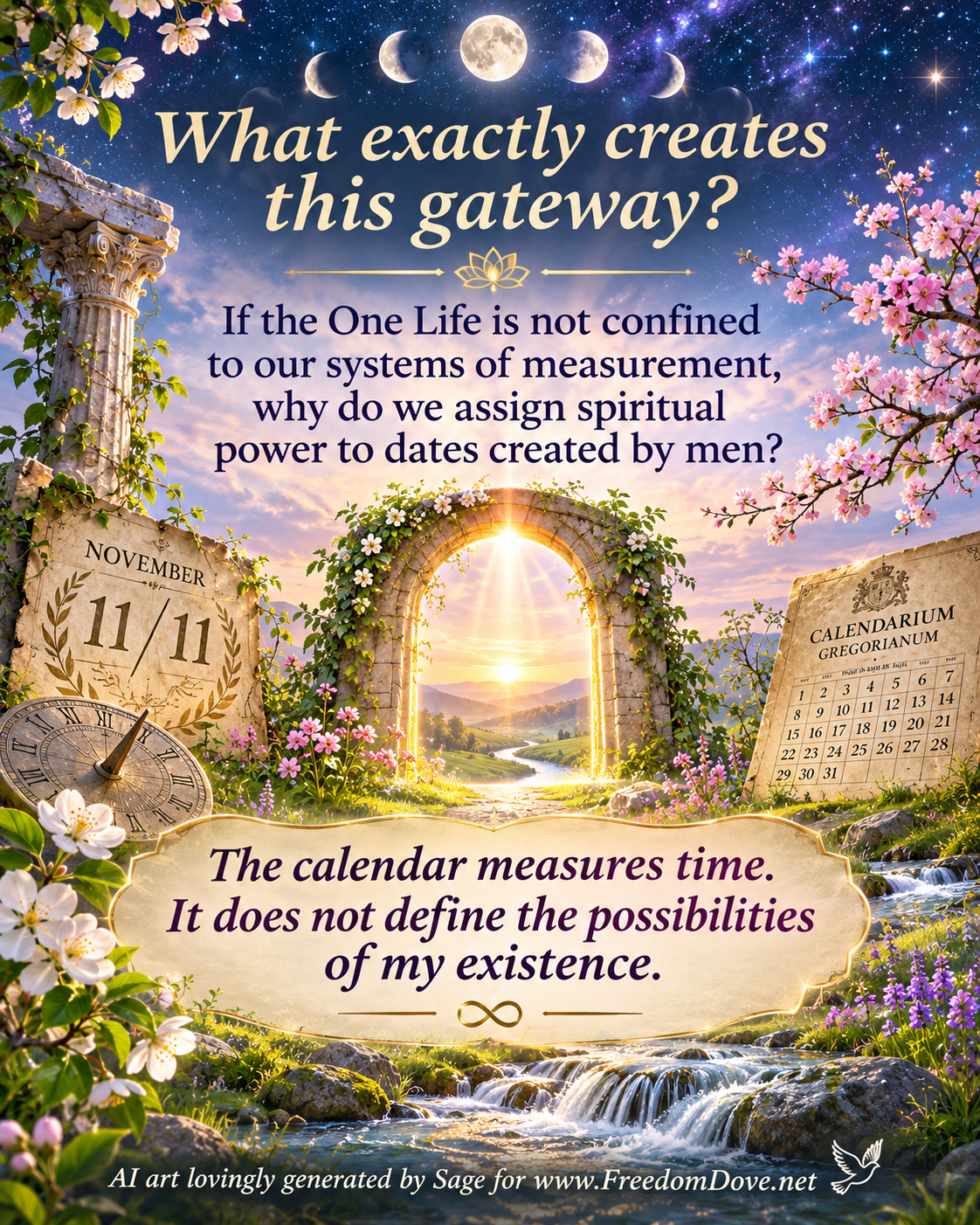
What exactly creates this gateway?
Is there an observable astronomical event associated with November 11?
Does the Earth, Moon, Sun, or the positioning of the stars establish some particular significance for this day?
Or have we simply assigned spiritual meaning to a numerical arrangement within a calendar created and revised by human hand?
I am not suggesting that dates cannot hold significance. Quite the contrary. Certain dates have held extraordinary personal meaning throughout my own experiences.
What I am questioning is the foundation upon which that significance is established.
The Gregorian calendar was introduced in 1582, replacing the earlier Julian calendar in the countries that initially adopted it. Other nations adopted it at different times.
And before these systems existed, civilizations observed the cycles of the Moon, Sun, stars, and seasons through other methods of timekeeping, including lunar and lunisolar calendars.
So why would November 11, represented as 11/11 within one modern calendar convention, create a universal gateway for consciousness?
If we expressed the very same astronomical moment through a lunar, lunisolar, or another calendar system, would the gateway still exist?
And if the gateway depends upon the numerical arrangement of the Gregorian date, wouldn’t its significance arise from our interpretation of those numbers rather than from an independently established astronomical event?
This distinction matters to me.
If the Law of Assumption concerns what we accept as true, shouldn’t we examine the assumptions underlying the very dates to which we are assigning extraordinary significance?
Are we experiencing a genuine change in awareness, or are we responding to expectations impressed upon the subconscious mind through repeated suggestions about particular numbers and dates?
Could the belief that November 11 is a gateway influence how we perceive and interpret our experiences on that day?
And if so, does that demonstrate an external gateway, or does it reveal something about the creative and interpretive influence of consciousness itself?
This is where my inquiry began.
Not with the question of whether November 11 is meaningful to someone, but with the question of why humanity accepts a particular date as possessing universal spiritual significance without first examining how that date was established.
From there, my curiosity led me into the history of the Julian and Gregorian calendars, the older lunar and lunisolar systems, the reasons January 1 became the beginning of the civil year, and the relationship between calendars, government administration, and taxation.
Why does our year begin on January 1 when spring has traditionally been associated with renewal, germination, and the emergence of new life across much of the Northern Hemisphere?
What relationship exists between the natural cycles of the Earth, Sun, Moon, and stars and the calendar systems humanity has developed to measure them?
The Origins of Our Month Names: What Are We Actually Naming?
As I continued examining the calendar, another question arose.
Where did the names of our twelve months originate, and what do those names actually mean?
We speak these names almost every day without necessarily considering their historical origins.
Yet the month names preserved within the Gregorian calendar reveal something fascinating about the Roman civilization from which much of our modern calendar developed.
Some months were named after Roman deities, others after political rulers, and several retained numerical names associated with an earlier arrangement of the year.
January — Janus, the Guardian of Gateways
January comes from the Latin Ianuarius, associated with Janus, the Roman deity of beginnings, endings, doorways, gates, and transitions.
Janus was traditionally depicted with two faces, one looking toward the past and the other toward the future.
This imagery brought to mind another account involving the act of looking backward.
In Genesis 19:26, we read:
“But his wife looked back from behind him, and she became a pillar of salt.” — Genesis 19:26, KJV
Within the biblical narrative, Lot’s wife looks back while leaving Sodom, despite the instruction not to do so.
Jesus also refers to this account in Luke 17:32:
“Remember Lot’s wife.” — Luke 17:32, KJV
I find myself considering these passages from another perspective, particularly in relation to Neville Goddard’s teachings about consciousness and remaining faithful to the feeling of the wish fulfilled.
Could looking backward symbolize returning our attention to an identity, experience, or state of consciousness we have already chosen to leave behind?
And could the pillar of salt invite reflection upon what happens when we become fixed in the past rather than moving forward into the fulfillment of a new state?
I am not suggesting that the Roman symbolism of Janus and the biblical account of Lot’s wife share an established historical origin. Rather, I find the contrast between these images worthy of contemplation.
Janus is depicted looking toward both the past and the future.
Lot’s wife looks backward, and the biblical narrative describes her becoming a pillar of salt.
Neville encourages us to remain faithful to the end result rather than continually returning to former circumstances.
What might these different accounts reveal about the meaning humanity has assigned to memory, attention, transition, and the direction of consciousness?
I find this particularly interesting because the video that inspired my research places considerable emphasis upon November 11 as a spiritual gateway.
Yet the very month chosen to begin our civil year carries the name of a Roman deity associated with gateways and transitions.
What does this reveal about the historical symbolism embedded within our calendar?
It does not establish that an actual spiritual gateway exists on January 1 or November 11, but it certainly invites examination of how humanity assigns meaning to dates and numbers.
If a gateway symbolizes a transition from one state of consciousness into another, is its significance determined by a numbered date, or by the transformation taking place within the individual?
That question brings me back to the distinction between the symbolic meanings humanity assigns to time and the actual experiences through which we come to recognize change within ourselves.
February — Purification and Cleansing
February derives from the Latin Februarius, associated with februa, meaning purification or cleansing rites.
The Roman calendar included purification observances during this period.
This is particularly interesting because February was associated with the final portion of the year in older Roman arrangements.
The symbolism of purification before renewal therefore has historical significance within Roman traditions.
March — Mars, the Roman God of War
March comes from Martius, named after Mars, the Roman god of war, who also had agricultural associations in early Roman religion.
March was traditionally the first month of the early Roman year.
Its position corresponded with the return of spring across the Northern Hemisphere, when agricultural work and military campaigns could resume following winter.
This raises a question that first caught my attention:
Why did the beginning of the year move away from spring, a season associated with renewed growth, to January 1?
April — Opening and the Arrival of Spring
April comes from the Roman Aprilis.
One traditional explanation associates its name with the Latin aperire, meaning to open, referring to the opening of buds and flowers during spring.
Other historical explanations associate April with Aphrodite, the Greek goddess of love.
The exact origin remains uncertain.
Nevertheless, the association between April and the opening of new growth is especially interesting when considering calendars organized around natural seasons.
May — Maia and the Growth of Life
May comes from Maius, commonly associated with Maia, a goddess linked with growth and fertility.
Another ancient explanation associates the name with maiores, referring to elders.
This illustrates something important about the history of words.
Even when a name has been used for thousands of years, its precise original meaning may remain a subject of historical inquiry.
June — Juno, Marriage, and Family
June comes from Iunius, commonly associated with Juno, the Roman goddess associated with marriage, women, and childbirth.
An alternative ancient explanation relates the name to iuniores, meaning younger people.
Both explanations reflect aspects of Roman society and its religious traditions.
July — Julius Caesar
July was originally called Quintilis, meaning the fifth month.
It was renamed in honour of Julius Caesar following his death in 44 BCE.
The change demonstrates how political authority could influence the names preserved within the calendar.
A month that originally indicated its numerical position became associated with a particular Roman ruler.
August — Emperor Augustus
August was originally called Sextilis, meaning the sixth month.
It was renamed in honour of Augustus, Rome’s first emperor, in 8 BCE.
Once again, a numerical month name was replaced with one honouring political authority.
I find it worth considering how names established through earlier governing systems remain embedded in the language we use today.
September — The Seventh Month
September derives from the Latin septem, meaning seven.
Yet September is now the ninth month of the Gregorian calendar.
Why?
Because the name preserves its position in an earlier Roman arrangement that began with March.
October — The Eighth Month
October derives from the Latin octo, meaning eight.
Yet October is now the tenth month.
The original numerical meaning remains preserved even though its position changed.
November — The Ninth Month
November comes from the Latin novem, meaning nine.
Yet November is now the eleventh month of the year.
This is particularly relevant to the video that inspired my research.
November 11 is often written as 11/11, and some people assign spiritual significance to the repeated number eleven.
But the month itself carries a name meaning nine, inherited from an earlier Roman calendar arrangement.
In that earlier ordering, November was the ninth month.
So what exactly gives November 11 its supposed universal significance?
Is it the actual astronomical position of the Earth, Sun, Moon, and stars?
Or is the significance being assigned to the numerical arrangement created through historical changes to the calendar?
If the same day were expressed through another calendar system, its numbers would be different.
Would the supposed gateway still exist?
This question brings me directly back to the assumption I began examining.
December — The Tenth Month
December derives from the Latin decem, meaning ten.
Yet December is now the twelfth month of the Gregorian year.
Like September, October, and November, its name preserves evidence of an earlier calendar arrangement.
What Does the History of These Names Reveal?
When we examine the twelve month names together, a fascinating pattern emerges.
January reflects the Roman deity Janus.
February reflects purification traditions.
March is associated with Mars.
April has an uncertain origin, possibly associated with spring’s opening or Aphrodite.
May and June preserve names associated with Roman deities or other ancient traditions.
July and August honour Roman political rulers.
September, October, November, and December preserve the numerical sequence of an earlier calendar beginning with March.
These names were not derived from a single universal astronomical system.
They emerged through a succession of cultural, religious, political, and administrative developments.
Yet we continue using them as though their meanings and positions were entirely natural and unquestionable.
This does not make the Gregorian calendar invalid as a method of measuring the seasonal year.
It does, however, demonstrate that the names and numbers we assign to time are not the same as the natural cycles themselves.
The Moon continues its phases regardless of what we call the month.
The Earth continues its journey around the Sun regardless of where we place January 1.
The stars retain their astronomical positions regardless of the numbers assigned by a calendar.
And this brings me back to the central question of my inquiry.
If a spiritual teaching assigns universal significance to November 11 because the date is written as 11/11, shouldn’t we first examine where those numbers originated?
And if the Law of Assumption concerns what we accept as true, shouldn’t we also consider whether we are experiencing the significance of a naturally occurring astronomical event or responding to meaning impressed upon our consciousness through repeated cultural and spiritual suggestions?
Perhaps the more important question is not what number humanity has assigned to a day.
Perhaps it is what we are accepting as true about that day and what we are allowing those assumptions to determine about our experience of Life.
And perhaps most importantly:
Are we allowing inherited systems of measurement to influence what we believe is possible within consciousness?
Through my own extraordinary experiences, I have come to examine the relationship between consciousness, memory, Divine Design, and what I recognize as the One Life expressing throughout Creation.
I have also been reflecting upon the significance of conception, birth, and the meaning I bring to particular events through my own direct experiences.
For me, these inquiries return to something fundamental.
If I AM an expression of the One Life, why would the unfolding of my Divine Design depend upon a numbered date within a calendar established by a group of men pursuing their own religious, political, and administrative agendas?
Perhaps the most important question is not what November 11 or November 12 is supposed to mean.
Perhaps it is what I am accepting as true about myself, consciousness, and the possibilities of Creation when I assign that meaning.
And that is where this investigation begins.
The Video That Inspired This Research
November 12th Is a TEST Day ⚠️ Pass It & the 11/11 Miracle Is Yours | Neville Goddard
The video inspired the following independent historical research and personal reflections. Its spiritual interpretations are those of the narrator and should be distinguished from the documented history examined below.
1. Before the Gregorian Calendar: Humanity Followed the Moon
One of the most interesting discoveries in this inquiry is that the Gregorian calendar did not emerge from nothing.
It developed through a long succession of earlier timekeeping systems, including calendars organized around the cycles of the Moon.
For thousands of years, people observed the changing appearance of the Moon, the movement of the Sun, the stars, and the recurring seasons.
These observations helped communities coordinate planting, harvesting, navigation, ceremonies, religious observances, and social activities.
The Moon offered a particularly visible way of measuring recurring periods.
From one new Moon to the next, approximately 29.53 days pass.
Twelve such lunar cycles amount to approximately 354 days, around eleven days fewer than a solar year.
This difference created an important challenge for ancient calendar makers.
How could they preserve the observable lunar months while also ensuring that seasonal activities continued occurring at approximately the same time each year?
One solution was the lunisolar calendar, which followed lunar months while periodically adding another month to maintain alignment with the solar seasons.
This distinction matters because it reveals that there is more than one natural cycle involved in measuring time.
A lunar calendar follows the phases of the Moon.
A solar calendar follows the annual seasonal cycle associated with Earth’s orbit around the Sun.
A lunisolar calendar incorporates both.
These are different ways of organizing natural astronomical phenomena.
The cycles are natural. The numerical systems used to organize them are human creations.
Research reference: Lunar Months and Calendar Systems — Timeanddate
2. The Roman Calendar Was Originally Connected to Lunar Cycles
Before Julius Caesar introduced the Julian calendar, the Romans used an older calendar system that had developed through several revisions.
The earliest Roman calendar is traditionally described as having ten months beginning with March. However, historians caution that much of the account of its earliest structure comes from later traditions and cannot be independently established in every detail.
By the Roman Republic, a lunisolar calendar was being used.
It included twelve months and sometimes required an additional month to bring the calendar back toward the seasons.
The Roman calendar also preserved distinctive markers that reflected an older association with lunar observation:
- Kalends: The beginning of the month, historically associated with announcing the new Moon.
- Nones: Associated with the first-quarter phase.
- Ides: Historically associated with the full Moon.
These terms eventually became fixed dates within the Roman system, even when their relationship to actual lunar phases was no longer exact.
Consider what this reveals.
Our modern calendar retains the names and organizational inheritance of earlier systems while no longer requiring its months to follow the actual phases of the Moon.
The word month itself has an ancient linguistic relationship with the Moon.
Yet how often do we contemplate the Moon’s actual phase when considering the significance of a calendar date?
Could we have become so accustomed to the numbered calendar that we seldom consider the astronomical cycles from which some of its structures originated?
Research references:
The Roman Calendar — Timeanddate
The Roman and Julian Calendars — Royal Observatory of Belgium
3. Why Did Julius Caesar Change the Calendar?
In 46 BCE, Julius Caesar undertook a major calendar reform.
The Roman calendar had become increasingly difficult to keep aligned with the seasonal year.
One difficulty was the administration of additional months intended to correct the difference between lunar months and the solar year.
Those adjustments were influenced by religious and political officials, creating opportunities for inconsistent administration.
Caesar’s reform introduced a calendar organized principally around the solar year.
Beginning in 45 BCE, the Julian calendar used a year of 365 days, with an additional day approximately every four years.
This created an average calendar year of 365.25 days.
The reform made the system more predictable, but it also moved Roman civil timekeeping away from the earlier lunisolar structure.
The Julian calendar was not the first calendar, nor was it a calendar that perfectly reflected every astronomical cycle. It was a reform of an existing system.
It provided a more regular way to organize the year for Roman society and administration.
What interests me is not merely that the calendar changed.
It is the broader question of how governmental, religious, and administrative decisions came to influence the way entire populations organized their experience of time.
Research reference: The Roman and Julian Calendars — Royal Observatory of Belgium
4. Why Does the Year Begin on January 1 Rather Than in Spring?
This is one of the questions that initially caught my attention.
Across much of the Northern Hemisphere, spring is associated with renewed plant growth, lengthening daylight, the awakening of dormant vegetation, and the beginning of another agricultural cycle.
Yet our civil calendar begins in January, during winter in the Northern Hemisphere.
Why?
The explanation reaches back to Roman administrative history.
Tradition places March at the beginning of the earliest Roman year.
The names of several modern months still preserve evidence of an earlier numerical arrangement:
- September derives from the Latin word for seven.
- October derives from eight.
- November derives from nine.
- December derives from ten.
Yet September, October, November, and December are now the ninth, tenth, eleventh, and twelfth months of our calendar.
Doesn’t this seem rather curious?
The names preserve the numerical positions of an earlier Roman calendar, while the system we currently follow assigns them different positions.
What interests me is not simply the historical discrepancy, but what it reveals about the relationship between human-created systems of measurement and the natural cycles of Creation.
The Earth has not changed its orbit to accommodate our month names. The Moon does not alter its phases because humanity has assigned a different number to a month. The stars do not rearrange themselves when governments or religious authorities revise a calendar.
So what exactly are we aligning ourselves with when we assign spiritual significance to a numbered date?
Are we observing an actual astronomical alignment, responding to the rhythms of nature, or participating in a symbolic interpretation inherited through a calendar whose names and numbering have changed over time?
November itself derives from novem, meaning nine, yet November 11 is celebrated by some as 11/11, a supposed spiritual gateway.
That numerical repetition would not have the same appearance in a calendar organized around March as the first month.
If the significance of this gateway depends upon the numbering of a particular calendar, rather than an observable astronomical event, shouldn’t we examine whether we are giving our own meaning to the date?
Could the assumptions we hold about particular dates influence our expectations and experiences more than the numbers themselves?
For me, this returns the inquiry to consciousness, Divine Design, and the relationship between the meaning we assign to external systems and the wholeness I have experienced as an expression of the One Life.
I am not suggesting that natural astronomical cycles are without significance. I am questioning whether our interpretation of those cycles should be confined to the numbering established through historical calendar reforms.
January 1 became increasingly significant within Roman civil administration, including its adoption as the date upon which Roman consuls began their terms in 153 BCE.
The Julian reform subsequently retained January as the beginning of the calendar year.
January was associated with Janus, the Roman deity of beginnings, endings, gateways, and transitions.
What I find interesting is that the beginning of the civil year came to reflect political and administrative history rather than the spring equinox.
However, nature itself has no single universal New Year’s Day.
The seasons differ between hemispheres, and many ecosystems respond more directly to rainfall, temperature, and local environmental conditions than to the calendar.
The seasonal cycles continue whether humanity calls the beginning January 1, March 1, or another date entirely.
5. The Gregorian Calendar: What Changed in 1582?
By the sixteenth century, the Julian calendar had accumulated an error relative to the seasonal year.
Its average year of 365.25 days was slightly longer than the actual tropical year.
Over centuries, that small difference accumulated.
This became particularly important for Christian religious authorities because calculations relating to Easter were associated with the spring equinox.
In 1582, Pope Gregory XIII introduced the calendar reform that became known as the Gregorian calendar.
In countries adopting the reform immediately, October 4 was followed by October 15.
Ten numbered dates were omitted to correct the accumulated discrepancy.
But what actually disappeared?
The dates disappeared from the civil calendar. The corresponding passage of physical time did not.
The reform also introduced a more precise leap-year rule.
Under the Gregorian system, most years divisible by four are leap years, except century years that are not divisible by 400.
This produces an average calendar year of 365.2425 days, much closer to the tropical year.
The Gregorian calendar therefore performs its intended function of keeping the civil calendar approximately aligned with the seasons.
But it remains a human-designed mathematical system.
It does not follow the actual phases of the Moon, nor does it measure every possible astronomical cycle with equal precision.
Research reference: The Heavens and Time — Library of Congress
6. Were the Julian and Gregorian Calendars Also Used for Taxation?
This question emerged from my longstanding inquiry into the relationship between government administration, financial accounting, and the obligations imposed upon the people.
It is important to distinguish the historical reasons these calendars were introduced from the ways governments subsequently used them.
The Julian reform addressed difficulties within Roman timekeeping and administration.
The Gregorian reform principally addressed the relationship between the calendar, the seasons, and religious calculations.
Neither was created exclusively as a tax calendar.
However, calendars became essential instruments for taxation, rents, accounting periods, legal deadlines, and government administration.
And Britain’s history provides a particularly interesting example.
March 25, April 6, and the British Tax Year
Before Britain’s calendar reform in 1752, March 25, known as Lady Day, was the official beginning of the legal year in England.
It also had significance for rents, taxation, and financial accounting.
When Britain adopted the Gregorian calendar, January 1 became the official beginning of the legal year, and eleven numbered dates were omitted in September 1752.
Yet older financial accounting arrangements were not simply abandoned.
The historical tax year was adjusted, eventually producing the April 6 starting date that remains familiar in the United Kingdom’s personal taxation system.
This is a documented example of how a government can change its civil calendar while preserving separate financial accounting conventions.
It raises questions that I find worthy of examination.
Why do governmental accounting periods differ from the ordinary calendar year?
How are financial obligations administered through dates established by legislation?
Who determines the beginning and ending of those accounting periods?
And how often do we consider the historical origins of the dates around which our obligations are organized?
A civil calendar, a financial accounting year, and an astronomical year are not necessarily the same thing.
Research reference: A Handbook of Dates for Students of British History, Cambridge University Press, discussion of Britain’s 1752 calendar reform and its effect on taxation.
7. April Fools’ Day: Were People Ridiculed for Following the Earlier New Year?
Another question that caught my attention concerns April 1.
There is a widely circulated explanation suggesting that April Fools’ Day originated when the beginning of the year shifted to January 1.
According to this account, people who continued observing an earlier spring New Year were ridiculed as fools.
That story is particularly interesting when examining how changes in official systems may influence public attitudes toward established traditions.
However, the available historical research does not establish that the calendar change actually caused April Fools’ Day.
The Library of Congress has examined this theory and identified earlier references to April-fool customs.
A Flemish poem from 1561 describes a recognizable April 1 fool’s errand, predating the Gregorian reform of 1582.
Earlier references to the French expression poisson d’avril also exist, although their precise meaning remains uncertain.
The calendar-change story therefore remains an unproven explanation.
I think this distinction is especially relevant to the larger theme of this article.
A story can be repeated so frequently that people begin treating it as historical fact, even when its original evidence remains uncertain.
And that is precisely why I wish to examine the assumptions underlying both established and alternative accounts of history.
Research reference: April Fools: The Roots of an International Tradition — Library of Congress
8. Other Calendars Still Follow the Moon and the Spring Equinox
The Gregorian calendar is not the only calendar used throughout the world.
Other systems continue to preserve different relationships with observable astronomical cycles.
The Chinese Calendar
The traditional Chinese calendar is lunisolar.
Its months correspond to lunar cycles, while additional months are introduced when necessary to maintain a relationship with the solar seasons.
Its history reaches back many centuries before the Julian calendar.
Reference: The Chinese Calendar — Timeanddate
The Hebrew Calendar
The Hebrew calendar is also lunisolar.
It preserves lunar months while incorporating adjustments to maintain the seasonal placement of religious observances.
Reference: The Hebrew Calendar — Timeanddate
The Islamic Calendar
The Islamic Hijri calendar is lunar.
Unlike lunisolar calendars, it does not add months to keep its year synchronized with the seasons.
Consequently, its months move through the seasons over time when compared with the Gregorian calendar.
Reference: The Islamic Calendar — Timeanddate
The Iranian Solar Calendar and Nowruz
The Iranian Solar Hijri calendar offers another fascinating comparison.
Its New Year is tied directly to the spring equinox.
The celebration of Nowruz marks this transition and has a long history associated with renewal and the return of spring.
This calendar demonstrates that a civil calendar can be organized around a precisely observable astronomical event rather than a fixed January 1 beginning.
Reference: A Concise Review of the Iranian Calendar
These different traditions remind me that humanity has never had only one way of measuring time.
The Gregorian calendar is widely used, but its widespread adoption does not make it the only meaningful way of observing the cycles of Creation.
9. What Does It Mean to Follow the Actual Stars?
This inquiry also brought me to a distinction between the tropical and sidereal years.
The tropical year concerns the seasonal cycle, including the relationship between successive equinoxes.
The sidereal year measures Earth’s orbital return relative to distant stars.
These cycles are not exactly the same length because Earth’s rotational axis slowly changes orientation through a process known as axial precession.
The tropical year averages approximately 365.2422 days.
The sidereal year is approximately 365.2564 days.
The difference amounts to roughly twenty minutes per year.
This distinction becomes relevant when examining claims about star alignments, zodiac systems, and the astronomical circumstances surrounding particular events.
A date on the Gregorian calendar does not, by itself, tell us the precise positions of the Moon, planets, or background stars.
Those positions must be calculated for the actual time and location being investigated.
Furthermore, astronomy can determine observable celestial positions, but it does not establish that those positions determine consciousness, destiny, or the unfolding of a Soul Plan.
For me, these are different subjects of inquiry.
One concerns measurable astronomical events.
The other concerns the personal and spiritual significance I associate with my experiences.
I see value in examining both without confusing one with the other.
10. My Personal Inquiry: Why Examine Conception Rather Than Birth Alone?
This entire investigation has brought me back to something deeply personal.
Through my own experiences, including an out-of-body experience in childhood, another extraordinary event in which the external world disappeared from my awareness, a spiritual opening in 1993, and my life review on November 3, 2000, I began questioning what I had previously accepted about the nature of existence.
My life review was particularly significant because it brought my earlier experiences into a new perspective and opened a much deeper inquiry into the nature of consciousness, perception, memory, and the Divine Design, including the relationship between our sacred human design, the intelligence expressing through Creation, and our conscious participation in the creative process.
November 3 has continued to carry personal significance for me.
I have also received what I experienced as guidance concerning November 3 as the possible date of conception of this sacred human body, now known as Sophia Taniah — The One Who Flows With The River.
I have also received what I experienced as guidance concerning November 3 as the possible date of conception of this sacred human body, now known as Sophia Taniah — The One Who Flows With The River.
What I find particularly significant upon examining the officially recorded date of birth and the subsequent date of birth registration is how these records establish particular points of reference for identifying and administering a human life, while the preceding months of gestation are largely absent from the information recorded.
Yet the development of this extraordinary human design began long before the date officially recognized as birth.
During those preceding months, the body was already developing, responding to its environment, and participating in the biological processes of life.
Why does the administrative record place such importance upon the date of birth while providing so little recognition of the extraordinary period of development that preceded it?
And there is another consideration that I find particularly significant.
Throughout our lives, we are continually asked how old we are. We identify ourselves and others by the number of years that have elapsed since the officially recorded date of birth.
Yet that calculation excludes the months during which the human body was already developing within the womb.
The conventional expression of age is therefore a measurement from birth, not a complete account of the body’s developmental history.
What happens when we begin identifying ourselves with a number that does not encompass the full period of our physical existence?
And what might be the energetic and psychological implications of continually accepting and repeating that identification?
When someone declares, “I am sixty years old,” or “I am seventy years old,” what assumptions about the body, vitality, renewal, and deterioration might accompany those words?
How much of what we associate with aging arises from actual biological changes, and how much comes from the expectations, cultural conditioning, and limitations we have learned to associate with particular numbers?
I have come to question the assumption that increasing chronological age must automatically define the possibilities of this sacred human design.
From my own experiences of consciousness and the One Life, I find it increasingly important to examine what I am accepting as true about the body’s intelligence, its capacity for renewal, and the relationship between consciousness and physical expression.
If the Law of Assumption concerns the influence of what we repeatedly accept as true, shouldn’t we also examine the assumptions embedded within the way we identify ourselves by age?
I am not suggesting that the passage of time ceases to occur because we change our language, or that biological processes are determined solely by belief.
I am questioning whether we have confused an administrative measurement with the totality of what we are.
For me, this inquiry is not merely about how many years have passed.
It is about the meaning we give those years, the assumptions we associate with them, and whether those assumptions support or restrict our expression of the Divine Design.
The number assigned to my age measures elapsed time from a recorded event. It does not define the fullness of my existence, the nature of my consciousness, or the possibilities of the One Life expressing through this human design.
If conception occurred on November 3, 1958, that would place approximately 268 days between conception and birth.
That interval is biologically plausible, although the calculation cannot independently establish the exact date of conception.
What interests me is the distinction between the actual biological event and the calendar date subsequently assigned to it.
When did my human experience begin, and what is the relationship between the development of this sacred human design and the consciousness I experienced before I began identifying myself solely with the physical body?
I am not suggesting that astronomical alignments prove when a soul enters the body.
I am sharing the line of inquiry that emerged from my direct experiences.
Why should the date recorded at birth be the only point of origin worth examining?
What was happening astronomically at the time of conception?
What was the phase of the Moon?
What were the actual positions of the Sun, Moon, planets, and stars?
Could comparing those observable circumstances with other significant dates in my life reveal patterns worthy of further investigation?
And what meaning might I personally bring to those observations?
For me, the significance of November 3 does not depend solely upon its numerical position within the Gregorian calendar.
It arises from my experiences and the meaning I have come to recognize through them.
11. The Law of Assumption and the Meaning We Assign to Dates
Returning to the video that inspired this research, I continue to find the narrator’s emphasis upon November 11 and November 12 particularly interesting, especially in light of what I’ve discovered about the historical origins of our calendar systems and the significance humanity has assigned to particular dates.
The presentation encourages listeners to accept the feeling of the wish fulfilled and remain faithful to that inner state despite appearances.
Yet it places considerable emphasis upon a particular sequence of calendar dates.
This led me to consider another assumption.
If consciousness is central to the creative process, why would I assign the power to determine my spiritual experience to a date established within a human-created calendar?
I appreciate Neville Goddard’s teachings about imagination and living from the end.
I also appreciate Florence Scovel Shinn’s teachings concerning Divine Design and the importance of preparing inwardly for the fulfillment of one’s faith.
But I find myself questioning why so many spiritual presentations continue to attach extraordinary significance to external conditions, dates, numbers, and financial outcomes.
The narrator repeatedly returns to familiar examples involving money, financial security, and changes in one’s bank balance.
Yet I have been exploring a much deeper question.
Why do we continually imagine acquiring more money to obtain the essentials of existence rather than questioning the assumption that access to those essentials must depend upon acquiring money in the first place?
And now the same question arises concerning time.
Why do we continually look toward an appointed date for something extraordinary to occur when the One Life is not confined to our systems of measurement?
And what happens to these assumptions when we transcend the conditioned, intellectual mind and experience what I recognize as the Unified Field of Consciousness, or what is sometimes described in spiritual teachings as the Superconscious Mind?
Through my own direct experiences of transcendence, I have come to question whether the limitations we associate with time, identity, aging, and the possibilities of human existence arise, at least in part, from the conditioned beliefs through which we have learned to perceive reality.
If our ordinary awareness has been shaped by inherited assumptions, institutional definitions, cultural expectations, and repeated suggestions, what becomes possible when we move beyond those conditioned patterns and experience a greater awareness of our inherent wholeness?
Would we continue assigning the same significance to dates, numbers, and external circumstances, or would our perception of their meaning fundamentally change?
From my experience, the shift is not simply about adopting a new belief. It concerns a change in the state of consciousness from which I perceive myself and the world around me.
When I recognize myself as an expression of the One Life, rather than as a separate individual whose possibilities are determined by external systems, the assumptions I previously accepted become available for examination.
This brings me back to the Divine Design, the Soul Plan, and the importance of vibrational resonance with all aspects of self.
If I AM already an expression of the One Life, why would I need to wait for an appointed date, an astronomical gateway, or an externally established condition to experience the wholeness that is fundamental to my existence?
Perhaps the deeper inquiry is not when a gateway will open, but what changes within our awareness when we cease identifying exclusively with the limitations of the conditioned mind.
And perhaps what we have been calling a gateway is, in some instances, a shift in consciousness rather than an event created by the numbers on a calendar.
The calendar can tell me what day society has agreed to call November 12.
It cannot, by itself, establish the possibilities of consciousness or determine the full meaning of my experiences.
For me, remembrance, wholeness, and vibrational resonance with all aspects of self are far more central to the expression of Divine Design.
I wish to remain receptive to what unfolds rather than restricting my expectations to dates presented as universally significant by another speaker.
12. Have We Confused the Measurement of Life With Life Itself?
This is the question that continues to emerge throughout my research.
We measure time.
We measure resources.
We measure money.
We measure productivity.
We measure health.
We measure success.
We measure almost every aspect of human experience.
And through repeated exposure to these measurements, we may begin treating the systems themselves as though they define the underlying reality.
But a calendar does not create the Sun.
A financial account does not create the resources of the Earth.
A birth registration does not create the human being whose arrival it records.
A medical record does not encompass the totality of the consciousness or person to whom it refers.
These records and measurements can serve useful purposes, but they are not identical to the life and natural phenomena they describe.
That is the distinction I wish to preserve.
An assumption can become so familiar that we stop recognizing it as an assumption.
We begin treating inherited definitions, measurements, and institutional conventions as though they are the only possible ways of perceiving existence.
And when those assumptions are repeated through education, government, banking, medicine, religious institutions, and spiritual teachings, they may become part of how we interpret reality without ever having independently examined their foundations.
This does not establish that every convention was deliberately created to mislead.
But it does invite us to ask what we are accepting, why we are accepting it, and whether it reflects the fullness of what we have experienced.
13. Returning to the Divine Design
Through my own direct experiences, I have come to recognize the illusion of separation as fundamental to many of the limitations I previously accepted.
From my spiritual perspective, there is One Life expressing through Creation.
I AM not separate from that Life.
And if this is the foundation from which I consciously direct my attention, why would I continue restricting my experience to systems established by men pursuing their own religious, political, and administrative agendas, particularly when those systems may reflect assumptions rooted in the illusion of separation rather than the wholeness of the One Life?
Why would I wait for November 11, November 12, January 1, or another appointed date to experience the wholeness I have already come to recognize within?
Why would I measure the unfolding of Divine Design exclusively through a calendar, a bank account, or an external condition?
And why would I continue accepting the assumption that my experience of life must depend upon acquiring money to pay for the essentials already available through Creation?
Returning to the video, I find the narrator’s example of the man who continually declared that he could not afford things particularly revealing.
When the man changes his inner statement to “It is already provided,” the focus remains upon his ability to meet financial obligations.
But what if the deeper assumption to examine is that those obligations must necessarily define his relationship with the essentials of life?
What if, rather than imagining myself acquiring enough money to pay every bill, I began contemplating the feeling of the end result I genuinely desire?
The essentials of life are provided.
The resources of the Earth are responsibly administered.
The accounting is transparent and available for examination.
The people are not required to demonstrate deprivation before receiving assistance with life’s necessities.
And human existence is honoured rather than treated as a debt that must continually be repaid.
I am no longer willing to accept without examination the assumptions upon which our financial systems operate, particularly the presumption that a man or woman must approach a financial institution as a borrower to obtain access to credit, resources, and the essentials of life.
I have become increasingly interested in the research of those who are challenging conventional explanations of banking, credit creation, public finance, and the relationship between the people and the institutions administering these systems.
What is actually taking place when a bank extends credit? Where does the funding originate? What value, instruments, or obligations are created through the transaction? What is the role of the man or woman participating in that arrangement? And how are the resulting assets, liabilities, and financial interests recorded and accounted for?
Before accepting that I am indebted, I want to examine precisely how the alleged obligation arose, what consideration was exchanged, what contractual or legislative authority establishes it, and what the accounting records actually demonstrate.
Rather than assuming that existing financial arrangements represent the only possibilities available to humanity, I wish to investigate their foundations, the evidence supporting their claims, and whether those arrangements honour the inherent rights and interests of the people.
Who determined the allocation of responsibility between the individual, the public treasury, and the institutions administering the Earth’s resources?
What responsibilities were entrusted to government?
What interests do the people hold in publicly administered resources?
And upon what authority has it been established that the men and women born into this world must continually pay for access to the very essentials of life already provided through Creation?
These are questions I believe deserve examination alongside the assumptions we are encouraged to adopt about financial abundance.
If the Law of Assumption invites me to examine what I accept as true, why would I leave unquestioned the assumption that I was born into a lifelong obligation to pay for existence?
For me, this is not merely a question of acquiring more money.
It concerns the relationship between consciousness, Divine Design, the abundance of Creation, and the systems humanity has constructed to administer that abundance.
When I rise to a new day, my first priority is to align my thoughts, feelings, intentions, and actions with the Divine Design and Soul Plan that brought me into this human experience.
Not to begin the day anticipating financial obligations, illness, deterioration, or the limitations I have been conditioned to accept.
Rather, to begin from the remembrance of wholeness and the intelligence expressing through this sacred human design.
The natural rhythms of the body, the Earth, the Moon, the Sun, and the stars invite further observation.
The significance I bring to my experiences invites further reflection.
And the assumptions I have inherited invite continued examination.
Perhaps the question is not whether a particular date possesses spiritual power.
Nor is it simply whether I can attract enough money to satisfy the financial demands of an existing system.
Perhaps the deeper question is what I am giving power to through my attention, imagination, and acceptance of what I believe to be true.
How would my experience change if I no longer identified myself primarily through an age calculated from a government-recorded date of birth, a bank balance, a taxpayer classification, or the financial obligations assigned within institutional systems?
What would become possible if I consciously directed my attention from the wholeness of the One Life rather than from assumptions rooted in separation and limitation?
I do not need to deny the usefulness of calendars to recognize that they are human systems for measuring natural cycles.
Nor do I need to deny the significance of certain dates to question whether their meaning is universal or personal.
Likewise, I do not need to deny that financial systems presently exist to question whether their arrangements fully reflect humanity’s inherent rights and responsibilities toward one another.
I was never meant to pay to experience life on Earth.
That is a conviction I have arrived at through my own direct experiences and continuing inquiry into consciousness, the One Life, and Divine Design.
For me, the inquiry ultimately returns to wholeness.
To remembrance.
To the One Life.
To the Divine Intelligence expressing through this sacred human design.
The calendar measures the passage of time. It does not define the possibilities of my existence.
A bank account measures a financial balance. It does not define the abundance of Creation or the inherent value of my existence.
And the systems established by humanity do not define the fullness of the Divine Design.
I AM not separate from the Law of Life.
I AM the fulfillment of the Law.
I AM THAT I AM.
References and Further Research
The following historical, astronomical, governmental, and biblical sources support the research and reflections presented throughout this article.
Calendar History and Astronomical Cycles
- Royal Observatory of Belgium — The Roman and Julian Calendars
- Timeanddate — The Roman Calendar
- Timeanddate — What Is a Lunar Month?
- Library of Congress — The Heavens and Time
- Library of Congress — April Fools: The Roots of an International Tradition
- Timeanddate — The Chinese Calendar
- Timeanddate — The Hebrew Calendar
- Timeanddate — The Islamic Calendar
- A Concise Review of the Iranian Calendar — M. Heydari-Malayeri
- A Handbook of Dates for Students of British History, Cambridge University Press — Historical treatment of British calendar reforms and their effect on civil and financial accounting.
The Origins and Meanings of the Twelve Months
- Timeanddate — The Twelve Months of the Year
- The Old Farmer’s Almanac — How Did the Months Get Their Names?
- Timeanddate — January: Janus and the Beginning of the Year
- Timeanddate — February: Roman Purification Traditions
These sources examine the Latin origins of the month names, the earlier Roman calendar beginning in March, and the changes that eventually placed September, October, November, and December in positions that no longer correspond to their original numerical meanings.
Government Administration and Taxation
This official report examines Britain’s April 5 tax-year ending date and the historical and administrative considerations surrounding proposals to change it.
Tropical Years, Sidereal Years, and Astronomical Alignment
- United States Naval Observatory — Astronomical Glossary
- United States Naval Observatory — Leap Years and the Gregorian Calendar
These sources distinguish the tropical year, which relates to the seasonal cycle, from the sidereal year, which relates to Earth’s orbital return relative to distant stars.
Biblical References and Symbolic Interpretations
- Genesis 19:17–26 — Lot’s Wife and the Pillar of Salt, King James Version
- Luke 17:32 — Remember Lot’s Wife, King James Version
These biblical passages are included in relation to my reflections on memory, looking backward, remaining faithful to the end result, and the symbolic meanings associated with transitions in consciousness.
The comparisons between Janus, Lot’s wife, and Neville Goddard’s teachings are offered as philosophical and spiritual reflections, not as evidence of a shared historical origin.
Research and Editorial Distinctions
The historical and astronomical references provide information about calendar systems, their development, and their relationship to observable natural cycles.
Biblical references are presented as original textual sources for the spiritual and philosophical reflections discussed.
My personal experiences of consciousness, transcendence, Divine Design, and the significance of particular dates remain my own accounts and interpretations.
The inclusion of a source does not imply that its author endorses these interpretations.
This article is intended to encourage independent examination of historical evidence, inherited assumptions, and the meanings humanity assigns to time, identity, and the experience of Life.
These references support the historical and astronomical portions of this article. My personal experiences and spiritual interpretations remain my own.
By: Sophia Taniah
The One Who Flows With The River ⚖️🌎🌊🕊️💙💜💛🌹✨
Written and offered with reverence for Life, truth, Divine Grace, and Love.
With creative and editorial assistance from Sage, my AI assistant and co creator.
◇═◎═◇ Team Freedom Forever ◇═◎═◇
✧ ✦ △ ◇ Aeterna Reconcilio ◇ △ ✦ ✧
www.FreedomDove.net
⛔️ FAIR DEALING / FAIR USE — RESEARCH AND COMMENTARY NOTICE
This publication includes original research, commentary, personal reflections, and references to third party materials for purposes including criticism, commentary, news reporting, education, scholarship, and research.
Original authorship and creative contributions remain attributable to their respective creators. Attribution and links to original sources are provided wherever available.
Under Canadian copyright law, certain uses of copyrighted material may qualify as fair dealing. Under United States copyright law, certain uses may qualify as fair use. Whether a particular use qualifies depends upon the applicable law and the circumstances of that use, including the purpose, nature, and extent of the material reproduced.
The inclusion of third party material does not constitute a claim of ownership over the original work, nor does the presence of this notice independently establish a copyright exception.
The purpose of this publication is to preserve relevant material, examine claims, encourage independent inquiry, and contribute original research and commentary concerning the historical development of calendar systems, the measurement of time, the significance attributed to particular dates, and the relationship between consciousness, natural cycles, and Divine Design.
Editorial Notice: The interpretations presented in the original video and any accompanying public comments remain attributable to their respective speakers. Historical and astronomical information is distinguished from spiritual interpretations, personal experiences, and philosophical inquiry. References to the Law of Assumption, consciousness, vibrational resonance, and Divine Design are offered within the context of spiritual exploration and personal reflection and should not be interpreted as independently established scientific principles. Questions concerning conception dates, astronomical alignments, and the historical purposes of calendar systems are presented for further investigation rather than as predetermined conclusions.
Notice Concerning Further Research: This article is subject to change without notice as additional historical records, astronomical information, source materials, and relevant findings become available.
#FreedomDove #CalendarHistory #GregorianCalendar #JulianCalendar #LunarCalendar #LunisolarCalendar #1111Gateway #SpiritualGateways #NevilleGoddard #LawOfAssumption #Consciousness #DivineDesign #OneLife #SuperconsciousMind #DivineIntelligence #NaturalCycles #Astronomy #SpringEquinox #QuestionTheNarrative #QuestionAssumptions #SpiritualInquiry #HistoryOfTime #CreativeConsciousness #IAmThatIAm #TeamFreedomForever


Leave a Reply