

Preserved Video Transcript, Description, and Public Comments
A Personal Note on the Origin of This Article
While conducting research concerning The Legal Line and the AERA ARK Legal Line Analyzer, I came across a video featuring Brandi Nicholle of the House of Durham, shared on the AERA ARK Facebook page.
The presentation caught my attention because it raises questions central to my ongoing inquiry into the distinction between a living man or woman and an administratively recognized legal identity, the language used by government agencies, the source of lawful authority, jurisdiction, consent, and the hierarchy of law.
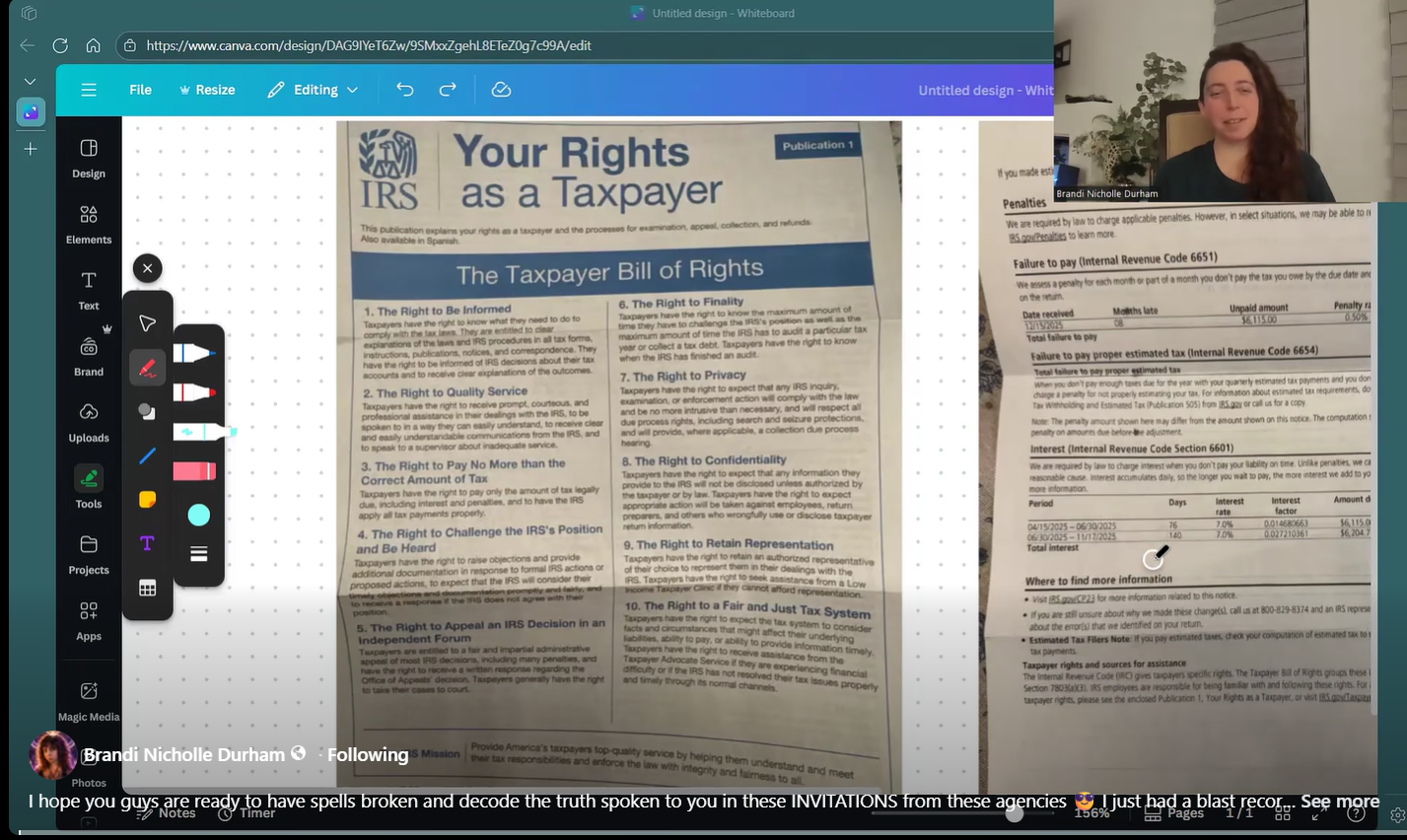
Brandi examines documents issued by the United States Internal Revenue Service (IRS), beginning with Publication 1, Your Rights as a Taxpayer. With humour, strong language, and an unconventional interpretation of legal terminology, she invites viewers to reconsider assumptions surrounding taxpayer status, identity, rights, obligations, and the authority exercised by government institutions.
Throughout her presentation, Brandi repeatedly substitutes the word “mimic” for “taxpayer,” illustrating what she describes as the distinction between the living man or woman and the legal fiction created and administered through institutional records.
Her presentation raises a question that I consider foundational:
Does the creation of an administrative identity establish lawful authority over the living man or woman associated with that identity? If so, where does that authority originate, who has delegated it, and what are its lawful limits?
My own inquiry extends beyond statutory definitions and institutional policies. I maintain that every living man, woman, and child possesses inherent and unalienable rights that do not originate from government-issued documents, administrative classifications, or legislative privileges.
I consider it essential to examine the hierarchy of law, distinguishing inherent rights, constitutional foundations and limitations, legislation, regulations, institutional policies, and delegated administrative authority.
The existence of a statutory provision does not, in my view, eliminate the importance of examining the lawful foundation, jurisdictional limits, and accountability of those exercising authority under it.
At the same time, claims concerning legal identity, consent, and statutory obligations require careful examination against the actual governing law. I am preserving Brandi’s interpretation as her own, rather than presenting every conclusion as independently verified.
Rather than allow this material to disappear into the endless stream of social media posts, I decided to preserve the video transcript, accompanying description, and public comments for further study, documentary research, and critical examination.
My intention is not simply to question the words used within legal and administrative systems, but to encourage a deeper examination of what those words mean, how they are applied, and whether the institutions exercising authority remain accountable to the people they were created to serve.
For those interested in exploring the research tools that led me to this presentation, the AERA ARK Legal Line Analyzer can be accessed here:
https://www.aeraark.com/analyzer
The original Facebook video featuring Brandi Nicholle of the House of Durham is available here:
https://www.facebook.com/reel/1399130645340584
The preserved transcript, original video description, and accompanying public comments are provided as supporting documentary material for readers wishing to examine the presentation in greater detail.
NOTICE OF ONGOING RESEARCH AND REVISION
This article forms part of an ongoing inquiry and documentary research collection maintained through www.FreedomDove.net.
As additional evidence, primary-source documents, legal authorities, historical records, and relevant perspectives become available, the material may be expanded, clarified, corrected, or reconsidered.
The inclusion of another person’s statements, interpretations, or documentary material does not necessarily constitute agreement with every conclusion expressed. Each contribution is preserved within its original context wherever reasonably possible, allowing readers to examine the information and pursue their own independent research.
This article is subject to change without prior notice as additional information becomes available or existing information is clarified, corrected, or expanded.
| Original source | Facebook Reel |
| Creator | Brandi Nicholle Durham |
| Original video | https://www.facebook.com/reel/1399130645340584 |
An Invitation to Look Beyond the Words
What happens when we read an official government document and begin questioning not only what it says, but whom it is addressing, what authority is being exercised, and where that authority originates?
In a video shared by Brandi Nicholle, she examines documents issued by the United States Internal Revenue Service (IRS), beginning with Publication 1, Your Rights as a Taxpayer.
With humour, strong language, and a distinctly unconventional interpretation of legal terminology, Brandi invites viewers to question assumptions surrounding identity, taxpayer status, consent, statutory obligations, and the distinction between a living man or woman and an administratively recognized legal identity.
Throughout the presentation, she repeatedly substitutes the word “mimic” for “taxpayer,” using this comparison to demonstrate how differently she believes the documents should be interpreted.
Her presentation raises a foundational question:
Does the existence of an administrative identity establish authority over the living man or woman associated with that identity? If so, through what lawful source, and within what limits?
These questions deserve careful examination rather than automatic acceptance or dismissal.
The Hierarchy of Law and the Question of Authority
My own inquiry extends beyond the terminology used by government departments.
I maintain that every living man, woman, and child possesses inherent and unalienable rights that do not originate from an administrative document, statutory classification, or government-issued identification.
This brings us to a distinction I consider essential: the difference between inherent rights, constitutional protections, statutory rights, administrative privileges, and the authority exercised by public institutions.
A government agency may possess authority granted through legislation. Yet identifying that statutory authorization does not eliminate the importance of examining its constitutional foundations, jurisdictional limits, procedural obligations, and accountability.
At the same time, the distinction between a living individual and a legal identity does not, by itself, establish that taxation or other statutory obligations are voluntary. That is a separate legal proposition requiring its own examination.
It is precisely these distinctions that make Brandi’s presentation worthy of further inquiry.
Watch the Original Presentation
Brandi Nicholle creator of Aera Ark— Taxpayer Rights vs. Man’s Authority
Original Facebook video:
https://www.facebook.com/reel/1399130645340584
Viewer discretion: The presentation contains frequent strong language.
Preserving the Original Words
For readers who prefer to examine the words carefully, I have preserved a TurboScribe transcript of Brandi’s presentation, together with her original video description and a selection of public comments supplied with the source material.
The transcript has been organized for readability while retaining the substance, tone, and terminology of the original presentation.
Read or download the preserved transcript:
The transcript is preserved as documentary source material. Brandi’s statements concerning legal fiction, consent, jurisdiction, taxpayer status, and IRS obligations are her own interpretations and should not be mistaken for independently established conclusions.
Readers are encouraged to examine the relevant primary legislation and government publications alongside the presentation against what is known within.
A Closing Reflection
As I continue examining the relationship between the living people, the institutions created to serve them, and the administration of law, one question remains central to my inquiry:
Where does lawful authority originate, who has delegated it, what are its limits, and to whom must those exercising it ultimately account?
Words matter. Definitions matter. Jurisdiction matters.
And equally important is our willingness to distinguish between what an institution claims, what the governing law actually authorizes, and what remains open to examination.
May this presentation encourage thoughtful inquiry, careful research, and a deeper examination of the relationship between rights, responsibilities, and lawful authority.
By: Sophia Taniah
The One Who Flows With The River ⚖️🌎🌊🕊️💙💜💛🌹✨
Written and offered with reverence for Life, truth, Divine Grace, and Love.
With creative and editorial assistance from Sage, my AI assistant and co creator.
◇═◎═◇ Team Freedom Forever ◇═◎═◇
✧ ✦ △ ◇ Aeterna Reconcilio ◇ △ ✦ ✧
www.FreedomDove.net
Source and Editorial Notice
This article is published for documentary preservation, commentary, research, and critical examination. The original video and statements remain attributable to Brandi Nicholle Durham.
The inclusion of the transcript and public comments does not establish the accuracy of every claim or imply endorsement of every interpretation.
The material should not be relied upon as instructions to disregard tax notices, filing requirements, statutory deadlines, or other enforceable obligations. Any disputed assessment should be evaluated against the applicable law and available review procedures.
Original source: https://www.facebook.com/reel/1399130645340584
Transcript preparation: TurboScribe; editorial organization for FreedomDove.net.
#FreedomDove #TaxpayerRights #LawfulAuthority #InherentRights #UnalienableRights #HierarchyOfLaw #LegalIdentity #LegalFiction #IRS #TaxpayerBillOfRights #Jurisdiction #ConsentAndAuthority #DueProcess #GovernmentAccountability #KnowYourRights #QuestionEverything #CriticalThinking #FreedomOfConscience #WeThePeople #LawOfLove


Leave a Reply