

Exploring Seeds, Hemp Hearts, Cacao, and a Food First Approach
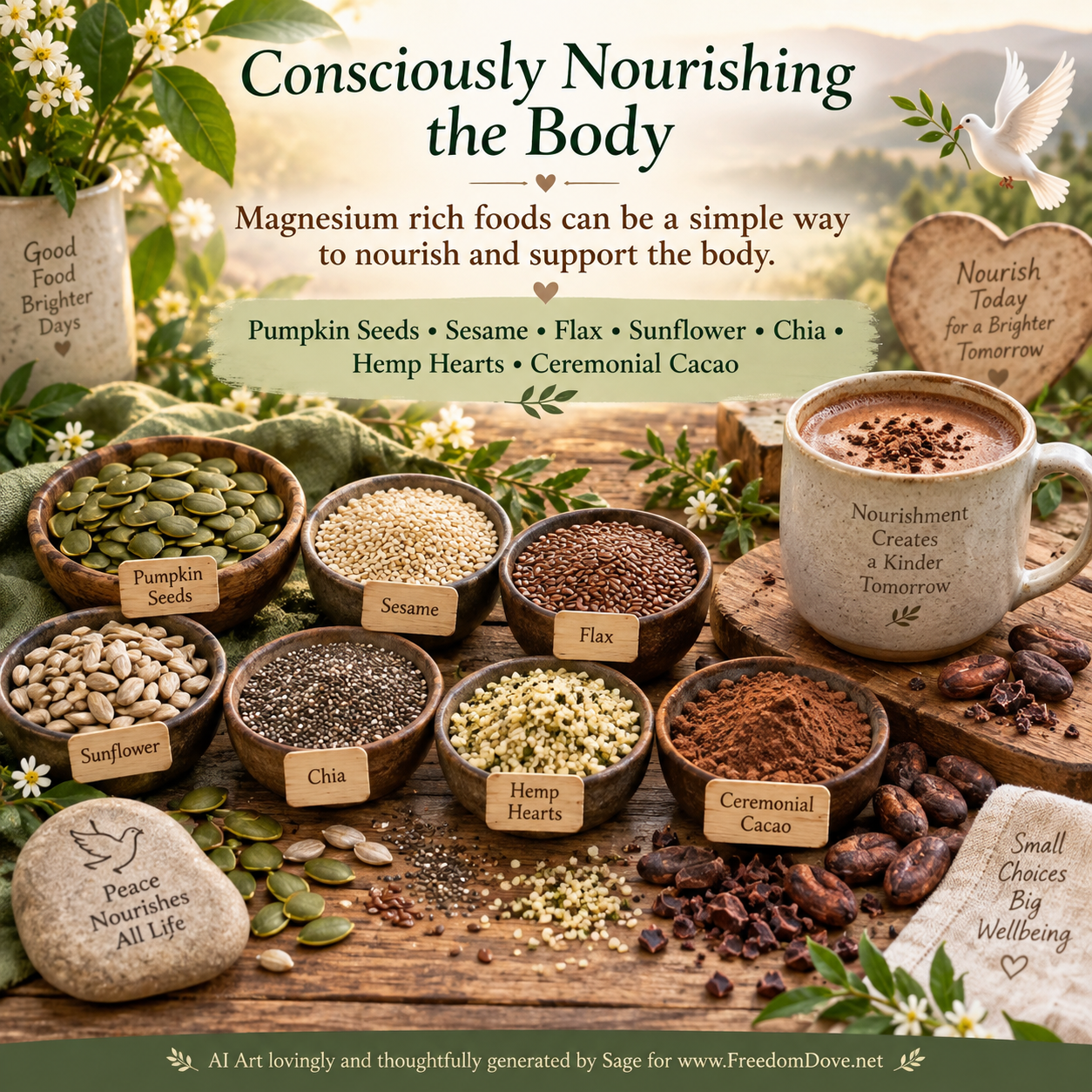
I have been thinking about how I can more consciously nourish my body with magnesium rich foods, recognizing the body as a divinely intelligent vessel worthy of care and support.
A Facebook reel and the conversation beneath it recently landed in my awareness discussing a mixture of pumpkin seeds, sesame seeds, flaxseed, sunflower seeds, chia seeds, cacao, and magnesium.
As I looked more closely at the foods being discussed, I realized there really is something worthwhile here.
I would personally add another ingredient:
Hemp hearts.
Rather than allowing this information to disappear into the endless flow of social media, I wanted to preserve it here on FreedomDove.net, look more carefully at what these foods actually provide, and create an easy reference for anyone else interested in increasing magnesium through whole foods.
Why Magnesium Matters
Magnesium is an essential mineral involved in hundreds of biochemical reactions throughout the human body.
According to the National Institutes of Health, magnesium is involved in processes including energy production, protein synthesis, muscle and nerve function, blood glucose regulation, blood pressure regulation, bone formation, DNA synthesis, and normal heart rhythm.
The recommended amount varies according to age and sex. For adults, recommended dietary amounts generally range from approximately 310 to 420 milligrams per day.
One of the things that caught my attention is how beautifully the natural world already provides magnesium.
Seeds are among the foods naturally rich in this mineral.
A Collection of Magnesium Rich Foods
1. Pumpkin Seeds or Pepitas
Pumpkin seeds immediately stand out.
According to the NIH, one ounce of roasted pumpkin seeds provides approximately 156 mg of magnesium, making them one of the richest commonly eaten food sources listed in its magnesium guide.
Pumpkin seeds also provide protein, iron, zinc, and predominantly unsaturated fats.
The original Facebook comment associated pumpkin seeds with sleep, hormone balance, and immune function. I would phrase this somewhat differently.
Rather than treating one food as though it directly produces a particular medical outcome, I prefer to recognize pumpkin seeds as an extraordinarily nutrient rich food that supplies magnesium and other nutrients required by the body.
2. Sesame Seeds
Sesame seeds are another mineral rich addition.
They provide magnesium along with calcium, copper, healthy fats, and naturally occurring plant compounds called lignans.
They are also wonderfully easy to include because a small amount can disappear into a larger seed mixture, salad, oatmeal, yogurt, or other meal without overpowering the flavor.
3. Flaxseed
Flaxseed adds something different to the combination.
It contains magnesium, fiber, plant based omega 3 fatty acids in the form of alpha linolenic acid, or ALA, and lignans.
I would personally use ground flaxseed rather than relying entirely upon whole flaxseed because grinding makes the contents of the seed more accessible during digestion.
Flax is especially easy to add to oatmeal, yogurt, smoothies, and seed mixtures.
4. Sunflower Seeds
Sunflower seeds provide magnesium along with vitamin E, selenium, protein, and unsaturated fats.
I would personally choose unsalted sunflower kernels for a mixture like this so they can be used easily in both sweet and savory foods.
5. Chia Seeds
Chia seeds are another particularly interesting addition.
They contain magnesium, fiber, protein, calcium, and plant based omega 3 fatty acids.
The NIH lists one ounce of chia seeds as providing approximately 111 mg of magnesium.
Chia also absorbs liquid and develops its familiar gel like texture, which makes it useful in overnight mixtures, puddings, oatmeal, yogurt, and smoothies.
6. Hemp Hearts
This is the ingredient I personally want to add to the original combination.
Hemp hearts are the soft inner portion of hulled hemp seeds.
They are rich in minerals, protein, and predominantly unsaturated fats, and they fit beautifully into the type of magnesium rich seed mixture I am exploring.
I also love their mild, slightly nutty flavor.
They can be sprinkled onto yogurt, oatmeal, salads, vegetables, smoothie bowls, fruit, or almost anything else without taking over the meal.
For me, hemp hearts make this combination feel even more complete.
7. Cacao or Unsweetened Cocoa
Cacao and unsweetened cocoa also contribute magnesium.
They bring a rich chocolate flavor to the mixture along with iron and naturally occurring plant compounds, including cocoa flavanols.
This makes cacao an easy way to turn a seed mixture into something that feels almost like a treat while adding another magnesium containing food.
I have also been adding organic ceremonial grade cacao to my daily coffee as another simple way of consciously nourishing and supporting my body. I feel fortunate to have an organic store called Real Raw Food very close to me. Through my own experience, I have found them to be thoughtful, ethical, and responsible in sourcing the foods they offer. Many of the nuts, seeds, oils, and cacao I use come from them, and I appreciate having a local source I feel good about supporting.
For my own use, I generally choose organic ceremonial grade cacao rather than the cacao commonly available in local supermarkets or conventional food stores.
For anyone interested in exploring what they offer, their website is https://www.realrawfood.com/
What Could This Combination Provide?
When we combine pumpkin seeds, sesame seeds, flaxseed, sunflower seeds, chia seeds, hemp hearts, and cacao, we are not creating a magical cure all.
What we are creating is a very nutrient dense collection of whole foods.
Together, these foods can contribute:
Magnesium
Protein
Fiber
Unsaturated fats
Plant based omega 3 fatty acids
Vitamin E
Iron
Zinc
Calcium
Copper
Selenium
and a variety of naturally occurring plant compounds.
That, to me, is impressive enough.
We do not need to exaggerate what food is capable of doing in order to appreciate it.
My Magnesium Seed and Cacao Blend
I do not think there needs to be one rigid formula.
The beauty of this mixture is that it can be adjusted according to what we enjoy and what we already have available.
I might combine:
Pumpkin seeds or pepitas
Sesame seeds
Ground flaxseed
Sunflower seeds
Chia seeds
Hemp hearts
Raw cacao or unsweetened cocoa
It could then be added to:
Yogurt
Oatmeal
Smoothies
Fruit bowls
Salads
Chia pudding
Overnight oats
or eaten in a small amount as a seed mixture.
Because seeds are concentrated sources of both nutrients and energy, I do not see this as another situation where more must automatically be better.
I am interested in simply making these foods a more regular part of what I already eat.
Food First
What I especially appreciate about increasing magnesium through food is that we are not receiving an isolated mineral.
A pumpkin seed does not contain only magnesium.
A chia seed does not contain only magnesium.
A hemp heart does not contain only magnesium.
Each comes within a larger nutritional package containing protein, fats, fiber, minerals, and other naturally occurring compounds.
The NIH identifies seeds, nuts, legumes, whole grains, and green leafy vegetables among the major dietary sources of magnesium.
This caused me to change the question slightly.
Instead of only asking:
What supplement could I take?
I can also ask:
What foods could I begin eating more regularly that naturally contain what my body requires?
What About Magnesium Supplements?
I also personally use Nutricost Magnesium Glycinate Powder.
The container comes with its own serving scoop, and I use the serving amount indicated on the product label.
Nutricost currently lists its Magnesium Glycinate Powder as providing 210 mg of magnesium per serving, with a serving scoop included.
For me, supplementation is only one part of the picture.
My growing interest is in increasing magnesium naturally through foods such as pumpkin seeds, chia, flax, sesame, sunflower seeds, cacao, and especially hemp hearts while remaining conscious of the supplemental magnesium I use as well.
When comparing magnesium products, one useful distinction is that the amount shown as Magnesium on the Supplement Facts panel refers to elemental magnesium rather than the total weight of the magnesium containing compound.
The NIH currently establishes an adult upper limit of 350 mg per day from magnesium supplements and medications, unless otherwise directed by a health professional.
Importantly, this upper limit does not include magnesium naturally occurring in foods.
That is an important distinction when we are talking about increasing magnesium through food.
What About Magnesium Spray?
I also personally enjoy using a magnesium spray before bed.
For me, it is part of my bedtime routine.
At the same time, I want to distinguish my personal enjoyment of the spray from the question of how much magnesium is actually entering the body through the skin.
Claims surrounding transdermal magnesium absorption remain much less established than the evidence surrounding dietary magnesium and oral supplementation.
So while I may enjoy using magnesium spray, I do not rely upon it as a precisely measurable source of my daily magnesium intake.
I think this is an important distinction.
We can enjoy something as part of our own routine without needing to make stronger claims than the available evidence supports.
A Comment That Caught My Attention
One of the comments beneath the original Facebook post particularly caught my attention.
Onyinye Olumba wrote:
“I did this combo all the knee pains and how my body feels in the morning are all gone. It really worked.”
I wanted to preserve her experience because personal observations are often where inquiry begins.
At the same time, one person’s experience cannot establish that the seed mixture caused the improvement or that it will have the same effect for someone else.
There may be many variables involved.
Perhaps her overall nutrition changed.
Perhaps she was previously receiving too little of a particular nutrient.
Perhaps something else changed at the same time.
Or perhaps the timing was coincidental.
Her experience is still worth hearing.
It simply belongs in the category of personal testimony rather than proof of a medical treatment.
What the Original Comment Got Right
The Facebook comment that inspired this inquiry described the combination as a kind of:
“superfood blend.”
I can certainly see why.
Pumpkin seeds, sesame, flax, sunflower, chia, hemp hearts, and cacao really are concentrated packages of nutrients.
The original comment also associated the combination with sleep, stress reduction, hormone balance, heart health, brain health, digestion, skin health, and energy.
Some of those claims are broader than I would personally make from the available evidence.
I would instead say:
These foods provide nutrients that participate in many physiological processes, and including a variety of seeds within an overall nourishing diet is one simple way to increase magnesium, fiber, unsaturated fats, protein, and other important nutrients.
I actually find that statement more remarkable.
We do not have to turn natural foods into medicines in order to appreciate how intelligently nourishing they can be.
A Simple Experiment With Food
My own intention is very simple.
I want to become more conscious of where my magnesium is coming from.
Could I sprinkle hemp hearts onto breakfast?
Could I add pumpkin seeds to a salad?
Could I put ground flax and chia into yogurt?
Could cacao become part of a smoothie?
Could I keep a small jar of mixed seeds available so that adding them to something I am already eating becomes effortless?
These are very small choices.
Yet perhaps nourishment frequently works that way.
Not through one miraculous ingredient.
Through variety.
Consistency.
Attention.
Curiosity.
And becoming increasingly aware of what the natural world has already placed before us.
Original Inspiration
This article was inspired in part by a Facebook reel and the conversation beneath it:
Facebook Reel:
https://www.facebook.com/reel/2071770910884503
A Note About Health Information
This article documents my personal inquiry and shares general nutritional information for educational purposes.
It is not intended to diagnose, treat, cure, or prevent disease and is not individualized medical advice.
Magnesium supplements can interact with certain medications, including some antibiotics and medications used for osteoporosis, and high supplemental intakes can cause adverse effects. People with impaired kidney function may also have greater difficulty eliminating excess magnesium.
When adding supplements, it is useful to consider the product label, other sources of supplemental magnesium, medications, and one’s individual circumstances.
Appreciation as Part of Nourishment
For me, nourishment is not only about the nutrients contained within a food. It is also about the relationship I bring to what I receive.
It is almost automatic for me to enter a state of appreciation for the life force, intelligence, and spirit carried within whatever I choose to give my body.
Before eating or drinking, I often feel gratitude for the earth, the plants, the seeds, the people who tended and gathered them, and the living intelligence that moved through every stage before that nourishment reached me.
I experience appreciation itself as part of the nourishment and upliftment of the spirit.
When I receive food with reverence rather than distraction, I feel I am supporting the body not only with minerals, fats, proteins, and plant compounds, but also with a coherent inner state.
When I take a moment to appreciate the spirit, essence, aroma, texture, and flavors of what I am giving my body, I have personally noticed what feels like an increase in electricity or life force flowing through every cell.
I strongly believe that when I feel good about what I am giving my body, and when I consciously appreciate the exchange taking place, it uplifts my spirit and also honors the spirit of that which is before me.
For me, this is foundational.
I want to give my body what supports it physically, while also meeting that nourishment with appreciation, presence, and reverence for the life force within it.
I recognize the body as a divinely intelligent vessel, and I choose to nourish it with both nutrient rich food and the energy of appreciation.
By:
Sophia Taniah
The One Who Flows With The River 🌊🕊️💙💛💜🌹✨🌍
Written and offered with reverence for life, resolve, grace, and love.
With creative and editorial assistance from Sage, my AI assistant and co creator.
◇═◎═◇ Team Freedom Forever ◇═◎═◇
✧ ✦ △ ◇ Aeterna Reconcilio ◇ △ ✦ ✧
⛔️ FAIR USE / COMMENTARY NOTICE
Portions of third party material are reproduced or referenced here for purposes including criticism, commentary, news reporting, teaching, scholarship, and research. Attribution and links to the original source are provided where available.
Fair use is determined under applicable copyright law based upon the circumstances of the particular use; the presence of this notice does not itself determine whether a particular use constitutes fair use.
________________________
#Magnesium #MagnesiumRichFoods #WholeFoodNutrition #NourishTheBody #ConsciousNourishment #HempHearts #PumpkinSeeds #ChiaSeeds #Flaxseed #Cacao #CeremonialCacao #HealthyFats #MineralRichFoods #FoodAsNourishment #FreedomDove


Leave a comment