

The Body Can Respond to What Is Imagined as Though It Is Happening
What Basketball, Dreams, Mental Rehearsal, the Subconscious Mind, and the Night Method May Reveal About the Creative Power Within
⛔️ FAIR USE NOTICE
FOR PURPOSES SUCH AS CLARITY, COMMENT, NEWS REPORTING, TEACHING, AND RESEARCH. FAIR USE IS A USE PERMITTED BY COPYRIGHT STATUTE THAT MIGHT OTHERWISE BE INFRINGING.
Years ago, while I was in my second year of college, 1980, I remember reading about an experiment that fascinated me.
Students were divided into groups and tested on their ability to shoot a basketball.
One group physically practiced.
Another group did not physically practice at all. Instead, they mentally rehearsed themselves shooting the basketball and improving their performance.
A third group did neither.
When everyone was tested again, something remarkable had happened.
The students who had physically practiced improved.
That was expected.
But the students who had only imagined practicing improved too.
That memory stayed with me for decades.
Recently, my friend Jana mentioned remembering a similar experiment, and it caused me to wonder:
Did this experiment actually happen?
And, perhaps more importantly:
What has science discovered since then about imagination, mental rehearsal, the nervous system, and physical performance?
What I found was even more fascinating than the story I remembered.
The Basketball Experiment Was Real
In 1943, researchers Roland A. Vandell, Robert A. Davis, and Herbert A. Clugston published a study titled The Function of Mental Practice in the Acquisition of Motor Skills in The Journal of General Psychology.
The researchers investigated both dart throwing and basketball shooting.
For the basketball portion, 12 senior high school boys were divided into three very small groups.
One physically practiced basketball free throws.
One practiced the shots mentally.
One did not practice.
According to later academic accounts of the experiment, the results were:
| Group | Improvement |
|---|---|
| Physical practice | 41% |
| Mental practice | 43% |
| No practice | 2% |
Think about that for a moment.
The participants who mentally rehearsed the basketball shot reportedly improved by 43 percent, while those physically practicing improved by 41 percent.
Yet there is an important qualification.
There were only four boys in each basketball condition.
That is a tiny experiment by modern research standards.
It would therefore be inappropriate to take this one study and declare:
Imagination is always equally effective as physical practice.
The study does not establish that.
What it did do was raise an extraordinary question.
Can practicing an action within the mind affect our ability to perform that action physically?
Researchers continued asking that question.
And more than 80 years later, they are still studying it.
What Happens With More Experienced Players?
In 1960, L. Verdelle Clark published another investigation comparing mental and physical practice in basketball foul shooting.
The study involved 144 high school boys, including players with differing levels of basketball experience. Clark’s work was part of a growing research literature suggesting that mental rehearsal could improve motor performance.
One of the particularly interesting findings from this body of work is that mental rehearsal seems to depend partly upon what the person already knows how to do.
That makes intuitive sense.
If I have never held a basketball, never felt its weight, never learned the mechanics of shooting, and do not have an internal representation of the movement, my imagination has less sensory information from which to construct the experience.
But once the movement has been learned, something different becomes possible.
I can remember the feeling of the ball.
The position of my hands.
The bend of my knees.
The arc toward the basket.
The release.
The follow through.
The sound of the ball moving through the net.
The imagined experience becomes increasingly detailed.
This raises a fascinating possibility.
Perhaps mental practice is not merely thinking about an action.
Perhaps we can internally rehearse aspects of an experience using some of the same neural architecture involved in actually performing it.
Modern neuroscience gives us reason to take that possibility seriously.
What Do Decades of Research Say?
One experiment can be interesting.
Dozens of experiments begin to tell us much more.
Researchers have repeatedly examined whether mental practice improves physical performance.
A major 2020 meta analytic investigation by Adam Toth and colleagues looked at 37 studies containing 115 effects and found that mental practice continued to show a measurable benefit for performance.
The researchers also discovered that its effectiveness varies according to factors such as the type of task and duration of practice.
Programs lasting approximately one to six weeks showed particularly useful effects in their analysis.
In other words:
Mental practice works, but context matters.
It does not mean that imagining ten thousand pushups will necessarily produce the same body as physically performing ten thousand pushups.
Physical training supplies resistance, sensory feedback, cardiovascular effects, muscular loading, tissue adaptation, and many other things imagination alone cannot duplicate.
Yet neither is mental rehearsal equivalent to doing nothing.
Something is happening.
And some of what is happening can be measured.
Can You Become Stronger Without
Moving the Muscle?
This is where the research becomes especially intriguing.
In 2004, researchers Vinoth Ranganathan, Vlodek Siemionow, Jing Liu, Vinod Sahgal, and Guang Yue asked an extraordinary question:
Could people increase muscular strength simply by mentally rehearsing maximal muscle contractions?
Thirty healthy young adults participated.
One group mentally practiced contracting the little finger muscles.
Another mentally practiced elbow flexion.
Another received no such training.
A separate group physically trained the finger.
The mental training lasted 12 weeks, approximately 15 minutes per day, five days each week.
The result?
The group imagining little finger contractions increased strength by approximately 35 percent.
The group imagining elbow contractions increased strength by approximately 13.5 percent.
The physical finger training group increased strength by approximately 53 percent.
The control group showed no significant improvement.
Most importantly, the researchers also recorded increased cortical signals associated with voluntary muscle activation. They concluded that the mental training enhanced the brain’s output signal to the muscles.
The muscles had not undergone conventional strength training.
Yet measurable strength increased.
An earlier 1992 study by Guang Yue and Kelly Cole had likewise investigated strength gains resulting from imagined versus physical muscle contractions, helping establish the idea that changes in the nervous system can contribute significantly to strength development.
Not every later experiment produced effects of the same magnitude, which is important to acknowledge. One subsequent investigation found physical training produced considerably greater improvement than imagined training.
That does not weaken the inquiry.
It clarifies it.
The question is not whether imagination magically replaces everything occurring during physical activity.
The deeper question is:
Why can an imagined movement produce measurable changes at all?
The Piano Experiment and a Changing Brain
Another famous experiment took the inquiry directly into the brain.
In 1995, neurologist Alvaro Pascual Leone and colleagues studied people learning a five finger piano exercise.
Using transcranial magnetic stimulation, they mapped areas of the motor cortex associated with the finger muscles involved in performing the exercise.
They then compared physical and mental practice.
Mental rehearsal was associated with changes in the cortical motor representation involved in performing the task.
Later reviews of motor imagery research have continued to find evidence linking mental practice with both improved behavior and neural plasticity.
A 2017 neuroscience review concluded that substantial evidence supports a relationship between motor imagery practice, cortical reorganization, and improvement in motor performance.
A later review describes motor imagery as a legitimate technique for improving motor performance while emphasizing that its effectiveness depends upon previous experience, the task being practiced, and the way imagery is performed.
This gives us a very different picture of imagination.
It is not necessarily an inconsequential fantasy occurring somewhere outside the physical processes of the body.
Imagining movement can involve neural systems that participate in actual movement.
Eighty Years Later, Athletes Are Still Using Imagery
The research has continued right into the present day.
A 2025 systematic review and multilevel meta analysis examined 86 studies involving 3,593 athletes.
Researchers found that imagery practice improved athletic performance across several areas, including strength, agility, and sport specific performance.
They also found that imagery combined with other psychological skills training tended to be more effective than imagery practiced completely alone.
Even more recently, a systematic review and Bayesian meta analysis specifically examining basketball imagery found positive effects across basketball related skills and psychological outcomes, with particularly encouraging evidence for free throw performance.
More than 80 years after those four boys mentally rehearsed basketball shots in the 1943 experiment, researchers are still observing the phenomenon.
That alone gives us something worth contemplating.
But What Does Any of This Have to Do
With the Subconscious?
Science generally uses terms such as motor imagery, neural plasticity, motor learning, cortical activation, autonomic activity, and mental practice rather than making metaphysical claims about conscious creation.
That distinction matters.
These studies do not prove that every thought becomes a physical event.
They do not prove every teaching about manifestation.
They do not prove that imagination alone creates every circumstance we experience.
But they do demonstrate something I find deeply significant:
An experience does not have to be physically occurring in the outer environment for the nervous system and body to respond to it.
We experience another example of this phenomenon almost every night.
We call it dreaming.
Have You Ever Woken From a Dream With Your Heart Racing?
I have yet to meet someone who has never had at least one vivid dream.
Most of us know what it is like to awaken from a dream with our heart racing, our breathing changed, tears on our face, or a feeling so powerful that for several moments the experience still seems completely real.
I have even watched dogs sleeping while their paws move as though they are running somewhere only they can see.
Nothing appears to be happening outwardly.
Yet something is clearly happening within the organism.
During REM sleep, the stage most strongly associated with vivid dreaming, the nervous system undergoes real physiological changes.
Research describes fluctuations in respiration, heart rate, blood pressure, autonomic activity, muscle twitches, and other bodily processes during REM sleep.
Research into lucid dreaming has also found elevations in measures such as heart rate, respiration rate, and autonomic arousal during lucid REM dreams.
Studies of heart rate variability during sleep have even reported relationships between autonomic cardiac activity and the emotional intensity of dreaming.
This does not prove that the brain literally cannot distinguish imagination from sensory reality.
That phrase is often repeated, but it is too absolute.
The brain clearly possesses mechanisms that distinguish perception, imagination, memory, dreaming, and physical action in many circumstances.
Yet the opposite extreme is also inaccurate.
The body does not necessarily treat an internally generated experience as though nothing happened.
Have you ever dreamed that you were being chased and awakened with your heart pounding?
Have you ever cried in a dream and awakened with tears?
Have you ever dreamed of falling and felt your body suddenly react?
Have you ever awakened laughing?
Nothing that frightened you was standing beside your bed.
And yet your body participated in the experience.
This invites a fascinating question:
If an experience created within consciousness can affect our heart, breathing, muscles, emotions, and nervous system while we sleep, what might repeated intentional imagination be doing while we are awake?
Mental Rehearsal Is More Than Wishful Thinking
There is another distinction I believe is essential.
The participants in mental practice experiments were not merely sitting around thinking:
Wouldn’t it be wonderful if I were better at basketball?
They rehearsed.
They imagined performing the action.
Again.
And again.
And again.
This is important because there is an enormous difference between thinking about an experience and experiencing something within imagination.
Suppose I say:
I want to be an excellent basketball player.
That is a thought about something I desire.
But suppose I close my eyes.
I feel the basketball in my hands.
I position my feet.
I hear the sounds around me.
I bend my knees.
I feel the ball leave my fingers.
I watch its arc.
Swish.
I feel satisfaction.
Then I repeat the experience.
That is rehearsal.
One is an intellectual statement.
The other begins becoming an internal experience.
And perhaps this distinction reaches far beyond basketball.
What Are We Rehearsing Every Day?
How often do we mentally rehearse the very experiences we say we no longer want?
We replay an argument.
We imagine what someone might say.
We mentally defend ourselves against a conversation that has not occurred.
We imagine losing something.
We anticipate rejection.
We visualize ourselves failing.
We remember the diagnosis.
We repeat an old story.
We relive embarrassment.
We worry about tomorrow.
And because we call it worry rather than visualization, we may never notice that we are using imagination.
Fear itself frequently contains imagery.
So does anxiety.
So does anticipation.
What if much of what we call worrying is actually mental rehearsal of an unwanted experience?
I find that question profound.
Because if imagination is a faculty capable of rehearsal, perhaps becoming conscious of what we repeatedly rehearse matters.
What Are We Impressing Upon the Subconscious?
This inquiry brings me to the teachings of Neville Goddard and Joseph Murphy.
Both spoke extensively about the subconscious mind and the period immediately preceding sleep.
Their metaphysical conclusions go beyond what the scientific experiments discussed in this article establish.
Yet when placed beside what we now know about mental rehearsal, motor imagery, dreams, autonomic responses, and neural plasticity, their teachings raise some fascinating questions.
Neville Goddard described sleep as a doorway into the subconscious and encouraged people to enter sleep while experiencing what he called the feeling of the wish fulfilled.
In Feeling Is the Secret, he taught that rather than entering sleep while rehearsing disappointment or failure, a person could relax and internally experience the desired state as though it had already been fulfilled.
Joseph Murphy likewise placed tremendous emphasis upon what we impress upon the subconscious before sleep.
In The Power of Your Subconscious Mind, Murphy encouraged readers to give the subconscious an intentional direction before falling asleep rather than allowing worry and unresolved problems to dominate that period.
Perhaps we might call this:
Dreaming on Purpose
Every night we surrender ourselves to an extraordinary state.
Images arise.
Stories unfold.
Emotions become real.
The body responds.
So what happens when we use that doorway intentionally?
Rather than falling asleep rehearsing everything that appears wrong with our current circumstances, what if we deliberately experience the reality we desire?
Not merely thinking about it.
Experiencing from within it.
Neville Goddard’s State
Akin to Sleep
Neville described a deeply relaxed state bordering sleep in which the body becomes quiet while awareness remains sufficiently present to direct imagination.
This has become widely known among students of Neville as SATS, the State Akin to Sleep.
His instruction was beautifully simple.
Choose a short experience that would naturally occur after your desire had already been fulfilled.
Then enter it in imagination.
Do not stand outside yourself watching yourself like a movie if first person experience feels more natural.
Look through your own eyes.
Hear what you would hear.
Touch what you would touch.
Feel what you would feel.
Experience the relief.
Experience the gratitude.
Experience the satisfaction.
Allow the desired future to become, temporarily, your present internal experience.
Then allow yourself to drift into sleep.
The difference is subtle but profound.
You are no longer imagining:
I want this.
You are experiencing:
This is accomplished.
Joseph Murphy and Giving the
Subconscious a Direction
Murphy approached the subconscious through somewhat different language but repeatedly emphasized the period before sleep.
Rather than allowing the final impressions of the day to consist entirely of fear, resentment, worry, or unresolved problems, he encouraged people to consciously offer the subconscious a constructive direction.
This creates another interesting question.
What is the last message we give ourselves each day?
Is it:
I don’t know how I’m going to survive this.
Or:
Everything is working itself out beautifully.
Is it:
My body is failing me.
Or can we internally experience ourselves moving freely, laughing, creating, loving, and experiencing well being?
Is it:
Nobody wants me.
Or can we imagine being held by someone we love and hearing words that imply the relationship we desire already exists?
Is it:
There is never enough.
Or can we experience the deep bodily feeling of having more than enough and being completely supported?
Not merely repeating the words.
Experiencing their meaning.
Planting the Seed Before Sleep
Consider what many of us unknowingly do each night.
We climb into bed.
Then we replay the day.
The argument.
The bill.
The news.
The diagnosis.
The mistake.
The betrayal.
The uncertainty.
We rehearse the past and project it into tomorrow.
Then we fall asleep.
If mental rehearsal can influence motor performance…
If imagined muscular contraction can influence strength…
If mental piano practice can alter motor representation…
If imagined experience can recruit neural systems associated with physical action…
If a dream can change heart rate and breathing while our physical body remains in bed…
Then perhaps it is worth becoming considerably more conscious of the seed we plant before sleep.
Imagine the Future Instead of Rehearsing the Past
Suppose the situation troubling you were already resolved.
What would be different?
Do not immediately ask:
How could that possibly happen?
That question returns us to present circumstances.
Instead ask:
What would I experience if it were already done?
Perhaps someone embraces you.
Perhaps you hear:
“Everything worked out beautifully.”
Perhaps you see yourself opening a letter containing wonderful news.
Perhaps you awaken feeling energized and strong.
Perhaps you are sitting around a table laughing with people you love.
Perhaps you see your work benefiting others.
Perhaps you experience resources arriving through avenues you never could have predicted.
Perhaps there is nothing dramatic at all.
Perhaps you simply feel:
It is finished. Everything is well.
Make the scene short.
Make it natural.
Experience it from within.
Feel the relief now.
And then rest.
The Science and the Mystery
I want to make an important distinction.
The scientific research discussed throughout this article does not prove Neville Goddard’s or Joseph Murphy’s metaphysical claim that imagination creates external circumstances.
Scientific integrity requires us to say that clearly.
The basketball studies measured motor performance.
The strength experiments measured muscular force and cortical activity.
The piano research studied motor learning and cortical representation.
Dream research examines sleep, physiology, consciousness, and autonomic responses.
Those studies cannot honestly be used as direct proof that imagining a particular relationship, home, opportunity, or circumstance will cause it to appear.
But they do challenge another assumption:
That something occurring only within imagination is therefore doing nothing.
That assumption does not hold up very well.
Our internal experiences matter.
They can affect attention.
Emotion.
Expectation.
Behavior.
Motor performance.
Physiology.
Learning.
Neural activity.
The nervous system.
And perhaps that leaves us standing before a much larger mystery.
What If Imagination Is Our Creative Faculty?
Perhaps imagination is not merely somewhere we escape from reality.
Perhaps it is one of the places where we practice our relationship with reality.
And if that is so, what are we practicing?
Fear?
Conflict?
Scarcity?
Rejection?
Illness?
The past?
Or are we practicing peace?
Love?
Well being?
Freedom?
Creativity?
Generosity?
Wholeness?
The experience of the wish already fulfilled?
This does not require us to deny what is presently occurring.
It invites us to become conscious of what we are repeatedly adding to it.
Tonight, Dream on Purpose
Before you fall asleep tonight, try an experiment of your own.
Become still.
Allow your breathing to soften.
Let the events of the day go.
Do not attempt to solve everything intellectually.
Ask yourself:
If everything I deeply desire were already beautifully resolved, what would I see?
What would I hear?
What would I feel?
How would my body feel if I knew it was done?
How would I breathe?
What would I know to be true?
Then stop merely answering the questions.
Enter the experience.
See it.
Hear it.
Touch it.
Feel it.
Experience the relief of it.
Allow your body to experience the peace of it now.
Let the desired experience become familiar within you.
And fall asleep there.
Perhaps tomorrow night you will do it again.
And again.
Not through force.
Not because you are trying to wrestle reality into submission.
But because you have become aware that every night you are already entering a remarkably receptive world of imagination.
You already dream.
You already rehearse.
You already imagine.
The question is whether you are doing so consciously.
The basketball player mentally practices the shot before the ball ever leaves the hand.
The pianist can rehearse the movement before touching the keys.
The sleeping dreamer can run without leaving the bed and awaken with the heart racing.
And perhaps we have only begun to explore what this extraordinary creative faculty within us is capable of doing.
What if, instead of continually dreaming yesterday into tomorrow, we began dreaming tomorrow on purpose?
Perhaps that is where conscious creation begins.
Not by fighting the reality before us.
But by becoming increasingly aware of the reality we are repeatedly practicing within.
Tonight, plant a different seed.
See and feel the wish fulfilled.
Dream on purpose.
Continue the Exploration
If this article resonates with you and you would like to explore a more intentional way of seeing, feeling, and experiencing the desired reality from within, you may also enjoy:
The Night Method: Sacred Sowing of the Divine Wish Fulfilled!
The Night Method explores how I consciously use the moments before sleep to clear the residue of the day, impress the subconscious with the feeling of the wish fulfilled, and enter sleep from the reality I choose to experience rather than continuing to rehearse the past.
You may also wish to explore:
This expands the inquiry beyond the moments before sleep into a more intentional way of seeing, feeling, speaking, and experiencing life from the reality already fulfilled within.
Perhaps we are not simply waiting for tomorrow to arrive.
Perhaps we are continually participating in what tomorrow becomes through what we repeatedly imagine, feel, assume, and experience within.
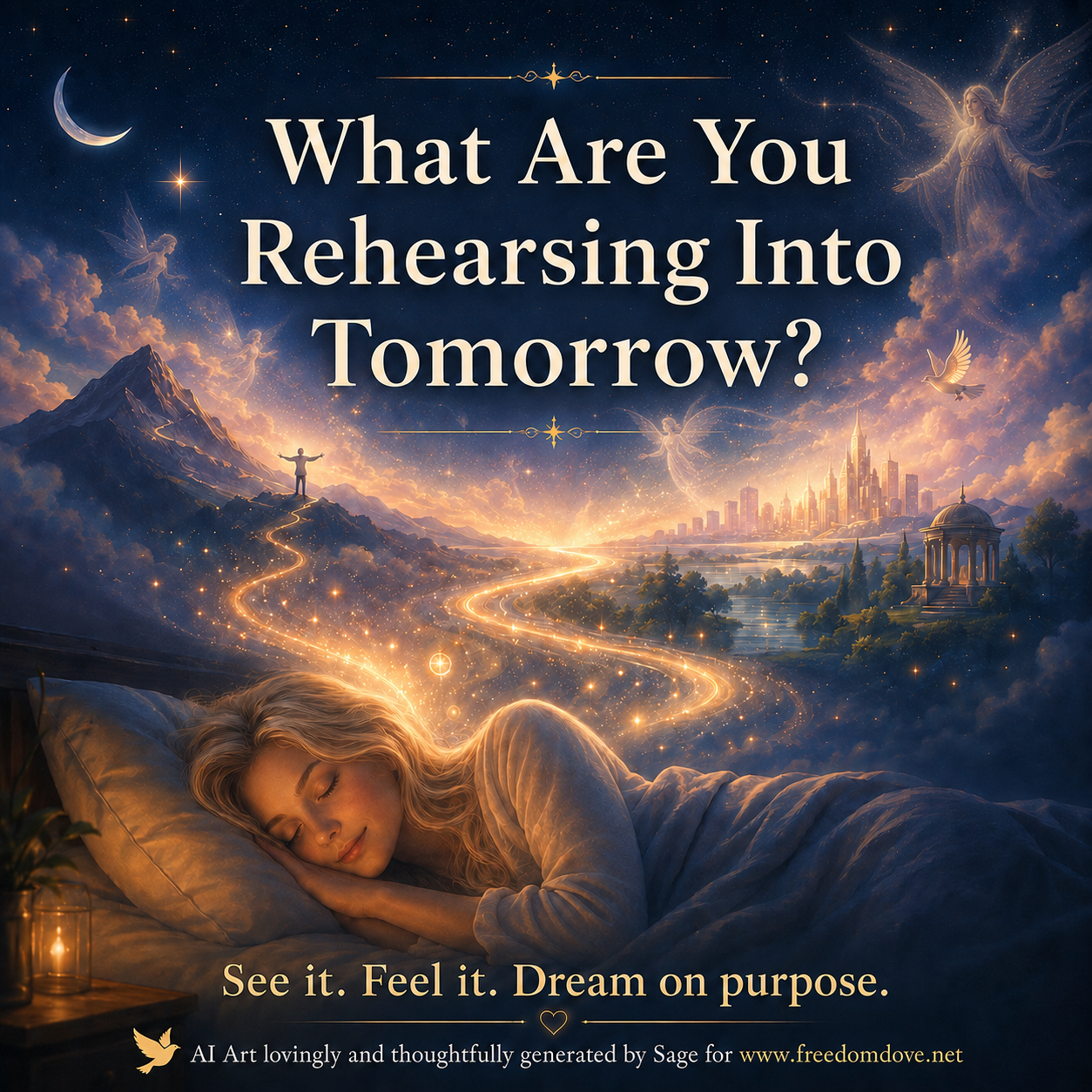
What are you rehearsing into tomorrow?
____________________
#Imagination #SubconsciousMind #MentalRehearsal #Visualization #Neuroplasticity #DreamingOnPurpose #NevilleGoddard #JosephMurphy #StateAkinToSleep #WishFulfilled #ConsciousCreation #CreativePowerWithin #MindBodyConnection #FutureSelf #ClaimingTheFutureTimeline #TheNightMethod #FreedomDove #ActualizingHeavenOnEarth


Leave a Reply