
Notice:  FAIR USE NOTICE: FOR PURPOSES SUCH AS CRITICISM, COMMENT, NEWS REPORTING, TEACHING, SCHOLAR- SHIP, AND RESEARCH. FAIR USE IS A USE PERMITTED BY COPYRIGHT STATUTE THAT MIGHT OTHERWISE BE INFRINGING.
August 2nd, 2026,
https://www.facebook.com/reel/1337108135217116
Is the Right to Travel a Mere Privilege?
Jean Carol Ward
This is nothing compared to all the law information I have researched and have in print. Legal and lawful are not the same thing.
Part 3
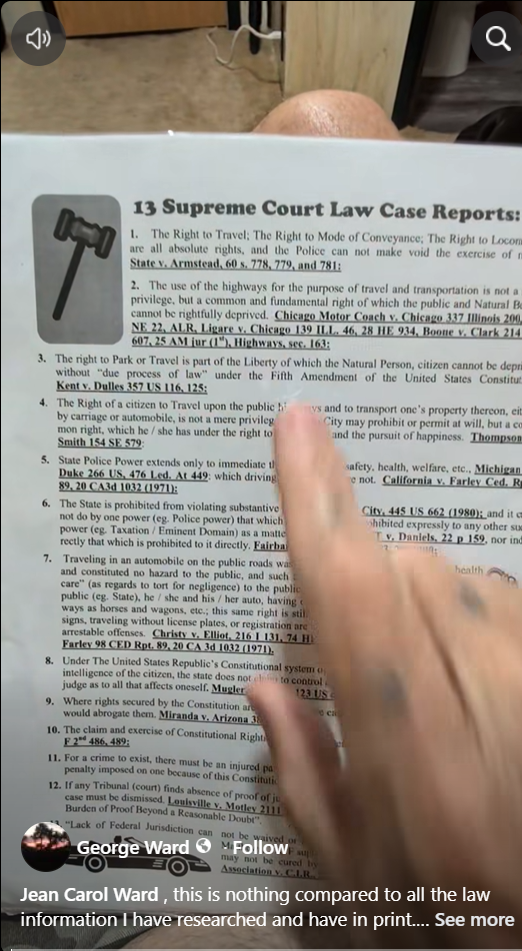
These are thirteen Supreme Court law case reports. I have more. We are going to try to go through these really quickly, so please bear with me.
The right to travel, the right to a mode of conveyance, and the right to locomotion are all absolute rights, and the police cannot make void the exercise of rights.
Anytime these people tell you that you must have a licence, registration, tags, and all of that, no, you do not. Do not fall for that bullshit.
If they arrest you for it, that is called kidnapping.
Again, I am going to try to refrain from using foul language. Sometimes it is difficult.
Supreme Court Case Law
This is Supreme Court case law. These are facts and conclusions of law:
The use of highways for the purpose of travel and transportation is not a mere privilege, but a common and fundamental right of which the public and natural beings cannot rightfully be deprived.
Do not worry. We are going to go over some of this. I have more concerning this right.
You can see where it says “American Jurisprudence.” I have that too.
The right to park or travel is a part of liberty.
The right to park.
They cannot tell you where to park on our public streets. We own them. We paid for them. They are ours. They belong to the public.
The right to park or travel is part of the liberty of which the natural person or citizen cannot be deprived without due process of law under the Fifth Amendment of the United States Constitution.
See how they do that? They add language and make sure there is more because the Fourteenth Amendment citizen is not the same as the American national or state national.
Natural person. You and I. Citizen.
It is the Constitution for the United States of America, not the United States Corporation from the Eleventh Amendment through the Fourteenth Amendment.
The first ten amendments in the Bill of Rights are the Constitution of these United States of America.
Please pay attention to the nuances and caveats I provide here.
The Right to Use the Public Highways
The right of a citizen to travel upon the public highways and to transport one’s property thereon, either by carriage or automobile, is not a mere privilege which a city may prohibit or permit at will, but a common right which he or she has under the right to life, liberty, and the pursuit of happiness.
The Fifth Amendment.
If it is the supreme law of the land, how can they make anything against it when it concerns your right to life, liberty, and the pursuit of happiness?
Are you paying attention?
This is the supreme law. How can they make any law regarding travel that violates your right to life, liberty, and the pursuit of happiness?
They cannot.
State Police Power
This is for the people in Kentucky.
Carol Ward, I have you.
State police power extends only to immediate threats to public safety, health, and welfare.
If you believe travelling is an immediate threat, it is not.
Even travelling a little over the speed limit is not. I will show you that as well.
It is up to you to adopt a reasonable speed and apply basic road etiquette for yourself and your fellow travellers.
They are not in charge of any of this because there must be an immediate threat to public safety, health, or welfare.
Driving and speeding are not immediate threats.
Did we just clarify and verify that?
There it is. That is the ruling. That is the law because it applies to the Fifth Amendment, the supreme law of the land.
The state is prohibited from violating substantive rights.
Owens versus City.
What the state cannot do through one power, including police power, it cannot do through another power.
How much more do you need?
That which is expressly prohibited to one power is also prohibited to every other power.
They do not have the authority to exercise eminent domain in the manner they claim.
They do not have the taxation authority they claim.
Stop obeying, kneeling, and complying because when you do, you are aiding and abetting their criminality.
We are not about that.
Private Automobile Travel
As a matter of law, United States and Utah versus Daniels:
Nor may the state accomplish indirectly that which is prohibited to it directly.
More case law:
Travelling in an automobile on public roads was not a threat to public safety or health and constituted no hazard to the public.
The officers who chase people are the hazard to the public.
Officers travelling with emergency lights, running red lights, hitting people, and killing people are the hazard to the public, not the people.
Such a traveller owed nothing more than due care regarding torts for negligence to the public.
The owner owed no other duty to the public or the state.
The people and their automobiles have equal rights to and upon the roadways and highways as horses, wagons, and other conveyances that have no licence requirement.
The same substantive right remains.
Speeding, running stop signs, travelling without licence plates, and travelling without registration are not threats to public safety and therefore are not arrestable offences.
If they previously arrested any of you, that is kidnapping under:
18 U.S.C. § 241, conspiracy against rights; and
18 U.S.C. § 242, deprivation of rights under colour of law.
It is a federal crime and violates the Civil Rights Act of 1866.
The Individual as Sole Judge
Under the constitutional system of government of the American Republic, and based upon the individuality and intelligence of the citizen, the state does not claim to control one’s conduct toward others.
The state leaves one as the sole judge of everything affecting oneself.
I am an American under the Act of May 3, 1940, 54 Stat. 178.
We are sovereign American nationals of a self-governing republic.
Under the constitutional system of government of the American Republic, and based upon the individuality and intelligence of the citizen, the state does not claim to control one’s conduct toward others.
The state leaves one as the sole judge concerning everything affecting oneself.
Constitutional Rights Cannot Be Abrogated
Where rights secured by the Constitution are involved, there can be no rulemaking or legislation which would abrogate them.
Miranda v. Arizona.
This has never been overturned.
Neither has:
Marbury v. Madison
Cruden v. Neale
Norton v. Shelby County, 118 U.S. 425
An unconstitutional act is not law.
All traffic codes and traffic laws are criminal when enforced by police officers against people who are not engaged in commerce.
The people are not committing the crime unless they are engaged in commerce and being paid a fee, fare, rate, or other consideration to transport people or their property.
The burden of proof is upon the officer to demonstrate that you were engaged in commerce before requiring you to possess a driver’s licence, tags, or registration for your private automobile.
Automated Cameras and Constitutional Rights
All automated cameras are unconstitutional. They are unlawful.
The claim and exercise of a constitutional right cannot be converted into a crime.
More case law:
For a crime to exist, there must be an injured party.
Corpus delicti.
The state cannot be the injured party.
The state cannot be the victim.
The police officer cannot be the complainant.
There can be no sanction or penalty imposed upon someone because of the exercise of a constitutional right.
If any tribunal or court finds that proof of jurisdiction over the person and subject matter is absent, the case must be dismissed with prejudice.
Make sure that is noted.
The prosecution bears the burden of proof beyond a reasonable doubt.
The officer must have proof, and the court cannot rely merely upon the officer’s interpretation of the law.
Period.
Jurisdiction Cannot Be Created by Consent
Lack of federal jurisdiction cannot be waived or overcome by the agreement of the parties.
Griffin v. Matthews.
A lack of jurisdiction cannot be cured by the consent of the parties.
We do not consent.
I was going to present more, but this material alone should say enough.
Application of Title 75
This will be included in the Right to Travel Bible package. I promise you.
I have a letter discussing this.
The central issue is whether Title 75 can properly be applied to an individual.
An individual’s right to liberty includes the inherent right to travel.
I have more.
Everything I provide in the Right to Travel Bible may exceed 300 pages.
Be ready.
I have already completed the research for you.
It is up to you to follow through, cross-reference the materials, research them, and find the authorities for yourself.
You will already have the materials prepared for you.
All you need to do is cross-reference and apply them.
I just read the law.
The courts, the state, and the legislature do not possess the authority they claim.
We the people must stop participating in their system and stop being compliant and obedient concerning things for which obedience or compliance is not required.
Arrest, Force, and Self-Defence
If they attempt to harm you or unlawfully arrest you, which constitutes assault and battery, you have every lawful right to defend yourself using any of the modern conveniences of the day.
Why do you think they do not want you armed?
Why do you think they tell you that you cannot have a gun in your automobile?
That is discrimination.
It allows them the opportunity to kill and removes your ability to defend yourself if killing an officer becomes necessary.
You have every lawful right.
Do not think otherwise.
“Officer safety” is a fallacy.
Closing
Get your constitutional information together.
Learn the law.
If you want my Right to Travel Bible, continue contacting me.
It is coming.
I am trying to send it to you by fax, so be ready and have your fax numbers available.
I showed the material to you.
This is only part of it.
I could continue, but I will not.
I want you to begin with what I have presented here because I have another document that is fourteen pages and another that is between twenty-one and twenty-four pages.
All of those documents will be included in the Right to Travel Bible packet.
Period.
Peace, everyone.
I am out.
____________________
Top comment(s):
Jeremy Foster Here are the key cases from your citations, cleaned up and summarized. They all deal with municipal power over streets/highways in Illinois (especially Chicago), public use, and limits on city authority versus state regulation or private rights.
1. Chicago Motor Coach Co. v. City of Chicago
337 Ill. 200, 169 N.E. 22 (Ill. 1929) (rehearing denied Dec. 17, 1929)
Core issue: Could Chicago prohibit (or require special city permission for) the operation of motor buses as common carriers on its streets when the operator already held a certificate of public convenience and necessity from the Illinois Commerce Commission?
Holding: No. The city lacked power to prohibit the use of its streets by such motor buses. Cities can regulate the use of streets (under the Cities and Villages Act), but they cannot prohibit automotive vehicles entirely unless the legislature has expressly authorized that power. The Public Utilities Act vested comprehensive regulatory authority over public utilities (including motor buses) in the Commerce Commission, withdrawing that power from municipalities.
Outcome: Circuit court decree dismissing the bus company’s injunction suit was reversed and remanded with directions to overrule the demurrer. (Stone and Heard, JJ., dissented.)
Significance: Classic limitation on home-rule-style street control when state utility regulation is involved. The company (successor to earlier bus operators) had been running routes on Chicago boulevards/parks without a traditional city franchise.
2. Ligare v. City of Chicago
139 Ill. 46, 28 N.E. 934 (Ill. 1891)
Core issue: Validity of city ordinances and a related condemnation proceeding that effectively widened Archer Avenue and turned large portions of it (and additional land) over to railroad companies for multiple tracks, with the railroad paying all costs/damages.
Holding: The ordinances were ultra vires and void. The city had no power to surrender an established public street (or newly condemned land) to the exclusive or dominant use of private railroad companies in this manner. Condemnation must be for a genuine public street purpose, not a thinly veiled grant of street space to railroads. The two ordinances formed one interdependent scheme and fell together.
Outcome: Condemnation judgment reversed (no remand). Later related proceedings (e.g., Ligare v. Chicago, M. & N. Ry. Co.) referenced this decision when railroads tried work-arounds.
Significance: Strong early statement that municipalities cannot convert public streets into private railroad corridors under the guise of “street improvement” or condemnation. Protects the public character of highways.
3. “Boone v. Clark” + Am. Jur. (1st) Highways reference
Your citation (“boon v clark 214,607,25,AM Jur ,(1st) highways, see , 163”) appears to be a secondary-source pointer rather than a clean primary case cite.
American Jurisprudence (1st series), Highways treatise (around §163 or nearby sections) discusses municipal and public rights in highways, easements, uses consistent with the public right-of-way, and limits on private appropriation of highway land.
A Texas case Boone v. Clark, 214 S.W. 607 (Tex. Civ. App. 1919) involved a county oil-and-gas lease on public roads and the nature of the county’s interest (mere easement; county did not own the minerals). It is sometimes cited in highway/easement discussions, but it is not an Illinois decision matching “214 Ill. 607.”
No exact Illinois match for “Boone v. Clark, 214 Ill. 607” turned up in standard reporters under that styling in the highways context. It is likely the Am. Jur. section is collecting authorities on the public nature of highways, the limited easement held by the public/municipality, and restrictions on non-highway uses (railroads, private commercial exploitation, etc.). That theme ties directly into both Ligare (no conversion of streets to railroad use) and the broader principle that streets remain open for public travel and cannot be substantially monopolized.
Connecting theme
These authorities limit what a city (especially Chicago) can do with its streets:
It may regulate traffic and use.
It generally may not prohibit public-utility motor carriers that have state authorization.
It may not effectively privatize or dedicate street space to railroad tracks under the pretense of street widening/condemnation.
Highways remain primarily for public travel; secondary private uses are constrained.
If you need the full reasoning from any specific opinion, the Am. Jur. excerpt language, or how these were later applied/cited, just say which one.
Reply
Jeremy Foster So what you have is in fact wrong and will get a lot of people in some legal trouble why don’t you do your research and find out before you tell people a bunch of hogwash
Michael Wagner The document shown provides summaries of Supreme Court Law Case Reports primarily used by the “sovereign citizen” movement to argue that driving is an absolute right that cannot be regulated by the state.Key Claims and ContextThe text lists several legal citations to support the following arguments:Right to Travel: Points 1 and 3 argue that “The Right to Travel” and the “Right to Mode of Conveyance” are absolute rights that cannot be “voided” by the police or the state.Common Right vs. Privilege: Point 2 asserts that the use of highways for travel is a “common and fundamental right” rather than a privilege, citing Chicago Motor Coach v. Chicago.Police Power Limits: Points 5 and 7 claim that police power only extends to immediate threats to public safety and that driving without a license or registration is not an “inherent threat.”Important Legal RealityWhile the cases cited are real, the interpretations presented in this document are not legally accurate in modern American law.Regulation is Legal: Courts consistently rule that while the right to travel between states is a constitutional right, the operation of a motor vehicle on public roads is a regulated activity (a privilege) subject to licensing, registration, and insurance laws.Misapplied Citations: Many of the cited cases (like Thompson v. Smith) have been superseded by later rulings or are taken out of context. Relying on these arguments in court or during a traffic stop is generally unsuccessful and can lead to increased legal penalties.
Steve Perrette I been telling people this for 10yrs
It’s so sad to see that it took this long
For people to realize this you have a right to travel if you’re not doing commercial or are in a business capacity if you’re driving your kids to school going to the store you are in a private capacity
George Ward John Wesley Conwell NEVER HIRE A LAWYER ATTORNEY, they operate under Corpus Juris Secundum chapter 7 section 76 subsection 4 their duty to the court is superior than their duty to the client being they are an officer of the court.
Assistance of Counsel, I can be. A man who has done his homework n wanting to help all my brothers n sisters.
___________________
Tony Filichia Kyle Pierce no, a driver’s license is not considered a legal contract. Legally, it is defined as a privilege or a legal authorization granted by the state, rather than a right or a private agreement.While it may feel like a contract because you agree to follow certain rules (like sobriety testing or traffic laws) in exchange for driving privileges, it lacks the essential elements of a formal contract:Legal Nature: A license is a “unilateral grant” of permission from the government. It is governed by administrative law and statutes, not the private law of contracts.
____________________
Dean Davis Jay Porter any judge that does not comply to the constitution can be arrested.
Reply
Brett Coffell Jay Porter look up Carl Miller, look up Trezevant vs City of Tampa, the courts hide cases won.
Trezevant v. City of Tampa is a genuine published federal appellate decision, but the Facebook comment leaves out important details about what the case actually decided.
The proper substantive citation is:
Trezevant v. City of Tampa, 741 F.2d 336 (11th Cir. 1984).
It was decided by the United States Court of Appeals for the Eleventh Circuit on September 6, 1984. A later one-line reporter entry appears at 746 F.2d 815, dated October 11, 1984, but it contains no additional reasoning. The full decision is publicly reported, so I found no evidence that the court “hid” this particular victory.
What actually happened
On April 23, 1979, James Trezevant was travelling from his home to his office in Tampa. Two vehicles stopped suddenly in front of him, requiring him to brake sharply. Several blocks later, an officer stopped him and issued citations for:
- reckless driving;
- failure to produce a vehicle-registration certificate;
- refusal to sign a traffic citation.
The parties later agreed that the third citation was a nullity because there was no such offence under the applicable law.
Trezevant was told he could either sign a promise to appear or post a bond. He elected to post the bond and had enough cash with him. Nevertheless, he was:
- taken through the prisoner entrance at central booking;
- frisked;
- deprived of his valuables, belt, and shoes;
- placed in a holding cell with people arrested for criminal offences;
- denied an opportunity to contact counsel before incarceration;
- and held for approximately 23 minutes.
He also suffered serious back pain, and his requests for medical assistance were ignored.
What the jury and appellate court decided
Trezevant brought a civil-rights action alleging improper arrest and incarceration. The jury awarded him $25,000 against the City of Tampa and the Hillsborough County Board of Criminal Justice. Interestingly, the individual officer and deputy were not held personally liable.
The Eleventh Circuit affirmed the judgment. It concluded that sufficient evidence supported the finding that the unconstitutional incarceration resulted from the agencies’ joint policies and procedures. The court emphasized that each official was participating in a sequence of events implementing an official policy and that the inadequacy of that policy directly caused the deprivation of Trezevant’s rights.
The $25,000 was not simply an automatic award of $25,000 for 23 minutes of detention. The court considered:
- the loss of liberty;
- the incarceration itself;
- his physical back pain;
- the refusal to provide medical assistance;
- and the mental anguish arising from the entire episode.
The court held that the compensatory award was not grossly excessive.
Its importance at the legal line
This is where I believe the case is genuinely useful within the framework we have discussed.
The officer and booking personnel occupied legal roles containing limited delegated powers. The existence of their offices did not authorize everything they chose to do. Nor did an internal policy become lawful merely because public employees routinely followed it.
Trezevant had selected one of the procedures the legal system itself made available: posting bond. The agencies nevertheless converted that procedure into an incarceration. The court examined the actual source and limits of the delegated authority, rather than accepting “official policy” as its own justification.
In that sense, the case demonstrates:
An official title does not create unlimited authority, and an administrative policy cannot lawfully enlarge the delegated power of the office when the resulting conduct deprives a man of his protected liberty.
It also shows that several officials cannot avoid responsibility merely by dividing the process among themselves. The officer could not say the jail caused the harm, while the jail claimed it was merely accepting what the officer delivered. The court examined the complete chain of actions and the policy directing them.
That point may be particularly meaningful in your Oroville matter, where four officers participated in the September 22, 2022 encounter and the subsequent records appear to involve several agencies, officers, citations, warrant entries, and administrative processes.
What the case does not establish
Trezevant did not decide that:
- a man may travel in an automobile without a licence;
- vehicle-registration requirements apply only to commerce;
- traffic laws are contractual;
- every traffic stop violates the constitutional right to travel;
- or refusing to sign every citation is protected.
In fact, the opinion states that Trezevant could potentially have been arrested because he did not produce his vehicle registration. His successful claim was directed toward the incarceration resulting from the bond-processing policy, not toward the general validity of registration requirements or the initial stop itself.
Therefore, I would not place it in your documents as authority for the broad proposition that Raymond and you had an unrestricted right to travel without regulatory interference.
How it may relate to the Oroville stop
Trezevant can be useful as supplementary authority for several narrower propositions:
1. A brief detention can still produce compensable harm
The fact that his incarceration lasted only 23 minutes did not make the deprivation meaningless. Liberty can be violated in a short period, particularly where there is humiliation, physical suffering, fear, denied assistance, or unnecessary custodial treatment.
2. An official procedure must protect constitutional rights
When officers or agencies carry out a standard procedure, the procedure itself can be examined. A public body may be liable under 42 U.S.C. § 1983 where its official policy or custom causes the deprivation of federally protected rights. Section 1983 creates a civil action when someone acting under colour of state law causes such a deprivation.
3. Officers cannot divide responsibility to conceal the complete transaction
Your Oroville documentation should identify the complete chain:
- who initiated the stop;
- what information was communicated between the officers;
- who ordered or prolonged each action;
- who generated each citation or record;
- who entered the warrants;
- what policy governed the conduct;
- and which official or agency possessed final decision-making authority.
Trezevant supports examining the combined process rather than isolating every official act from the acts preceding and following it.
4. The stop’s scope and duration must have an articulated basis
Washington’s statutory framework states that a traffic detention may continue for a reasonable period necessary to identify the one stopped, check warrants, review licence, insurance, and registration information, and complete the notice of infraction. That language can be used to demand a factual account of what each officer was doing and why four officers were necessary.
Washington decisions also recognize that a traffic stop is a seizure and must be based upon specific, articulable facts supporting suspicion of an offence or infraction. Washington’s constitutional protection further prohibits a traffic justification from being used merely as a pretext for an unrelated investigation.
Those Washington authorities are more directly connected to the lawfulness of the initial Oroville stop than Trezevant is.
Its jurisdictional weight
Trezevant arose in the Eleventh Circuit, which includes Florida. Your Oroville matter falls within Washington and the Ninth Circuit. Consequently, Trezevant is not controlling appellate authority over a Washington court or federal district court in Washington.
It may nevertheless be cited as persuasive authority, particularly for:
- damages from a short but unconstitutional detention;
- examining the complete chain of official conduct;
- and municipal responsibility for an inadequate policy that causes a deprivation.
The nationwide foundation would be 42 U.S.C. § 1983 and the municipal-policy principles originating in Monell. Ninth Circuit materials likewise state that a municipality may be liable when an official policy, longstanding practice, failure to train, or qualifying decision by a policymaker causes the constitutional violation.
A careful paragraph for your Oroville documentation
In Trezevant v. City of Tampa, 741 F.2d 336 (11th Cir. 1984), the United States Court of Appeals affirmed a $25,000 civil rights judgment arising from the unnecessary incarceration of a man for approximately twenty-three minutes during the processing of traffic citations. Although Trezevant had sufficient funds and had elected to post the bond permitted by the applicable procedure, he was frisked, deprived of his personal effects, placed in a holding cell, denied medical assistance, and subjected to unnecessary custodial treatment. The court examined the complete chain of official conduct and concluded that the deprivation resulted from inadequacies in the joint policies and procedures of the participating public bodies. The decision is relevant here not as authority concerning the general validity of traffic licensing, but as persuasive authority that a brief detention may still constitute a serious deprivation of liberty, that public employees cannot avoid accountability by dividing a single course of conduct among several offices, and that an official policy cannot excuse conduct exceeding the lawful bounds of delegated authority.
The reference to Carl Miller in the Facebook comment is different. “Carl Miller” is a man’s name, not a judicial citation. Without an actual case name, court, date, docket number, and decision, claims that he personally won particular right-to-travel cases cannot be independently verified from that comment alone.
___________________________
Bernard Conrad Special Edition: My response to those who argue the Supreme Court decided we have no right to privacy from Government AI database cameras on public roads
Burnie Thompson Jun 02, 2026
Yes, in United States v. Knotts (1983), the Court said a person traveling on public roads has no reasonable expectation of privacy in his movements from one place to another in the context of short-term, limited tracking (a beeper). But the Court has never endorsed mass, automated, long-term, database-archived tracking of everyone.
In United States v. Jones (2012), the Court held that installing a GPS device on a vehicle and monitoring its movements (even on public roads) constituted a search under the Fourth Amendment (trespass on an “effect”). Justice Alito’s argued that longer-term GPS monitoring of public movements impinges on reasonable expectations of privacy.
The Burnie Thompson Show® is a reader-supported publication. To receive new posts and support my work, consider becoming a free or paid subscriber.
Subscribe
This is the mosaic theory: the whole reveals far more than the sum of individual public observations.
Carpenter v. United States (2018) reinforced this in the digital age. The Court required a warrant for historical cell-site location information (CSLI) precisely because it creates a “detailed, encyclopedic” and “all-encompassing record” of a person’s past movements.
The third-party doctrine (you “voluntarily” gave data to your carrier) has limits when the surveillance is comprehensive, retrospective, and inescapable in modern life. ALPR databases raise the same concerns: they do not record one public moment—they create a persistent, time-stamped catalog of where your vehicle has been.
A single cop with a cellphone taking one photo of one car on one occasion is not the same as thousands of high-resolution AI cameras feeding a centralized, queryable system that lets any authorized user rewind and review anyone’s movements over weeks or months. Conflating a snapshot with a database is like comparing a footprint to an ankle monitor.
Conflating a snapshot with a database is like comparing a footprint to an ankle monitor.
A cellphone picture is a moment. Flock is a movement history. The scale, automation, retention, and ease of access transform it from a snapshot into a digital dragnet.
The Fourth Amendment rejects general warrants and suspicionless searches, which is akin to the colonial writs of assistance that allowed officials to rummage through lives without particularized cause. James Otis called them “the worst instrument of arbitrary power.”
These systems are their modern, AI-enhanced equivalent. And the totalitarian effect is compounded by its ability to remember, index, and share the whole of our movements.
Elected officials with integrity wouldn’t wait for the next court ruling to strike down the latest surveillance technology. They should act on principle and show respect to the people they swore an oath to represent under the Constitution.
____________________
“You do not require counsel merely because an officer wrote words on a ticket. The claimant still bears the applicable burden. Counsel is one possible tool for navigating the system’s procedures, not the creator of your rights, not your superior, and not a substitute for proof of authority, applicability, capacity, jurisdiction, and every element alleged.” this still doesn’t address the fundamental problem. Why are the officers able to get away with forcing a controversy? Why hasn’t this problem been resolved? Worked for 42s
You are right. My earlier statement still accepted the system’s starting point instead of naming the structural problem:
The accusation itself has coercive force before the officer has proven that any lawful obligation attaches to the living man or woman.
The officer writes words on paper, files them through an official role, and thereby initiates a proceeding that requires the recipient to respond. In Washington, a “notice of infraction” is expressly defined as the document that initiates the case. If the recipient does not respond, the court is directed to enter an order finding that the infraction was committed and impose the resulting consequences.
That is not a neutral invitation to resolve a disagreement. It is a compulsory controversy:
- The officer selects the legal classification.
- The officer alleges that the classification applies.
- The living man or woman must respond within the system’s deadline.
- Silence is treated as default rather than nonconsent.
- The burden of time, comprehension, travel, paperwork, and defence initially falls upon the accused.
- Additional consequences arise from refusing to participate.
Why is an officer allowed to initiate it?
Within the present institutional structure, the legislature delegates enforcement authority to an office called “police officer.” The man or woman occupying that office is permitted to stop someone when the legal standard for an investigative detention is allegedly satisfied and to issue a citation without first obtaining a ruling from a neutral court. The constitutional system generally tests the officer’s justification after the seizure or citation, rather than requiring the officer to prove the entire matter before initiating it.
The institution therefore separates two things:
- Initiating the accusation, which the officer may do.
- Proving the accusation, which is supposed to occur later if it is contested.
That separation creates the imbalance you are identifying. The officer may be mistaken about the facts, the meaning of the enactment, the capacity being regulated, or even the existence of an offence, yet the recipient still has to act to prevent the accusation from becoming an enforceable default.
The system calls this due process because it provides notice and a later opportunity to be heard. Procedural due process doctrine generally focuses on notice, an opportunity for a meaningful hearing, and a neutral decision maker before the deprivation becomes final.
But that formal description can conceal the lived reality:
An “opportunity” is not equally meaningful when one side created the language, controls the records, employs the officials, knows the procedures, and can escalate nonparticipation into additional penalties.
Why do officers appear to “get away with it”?
Because the legal system does not ordinarily require the officer to resolve the foundational legal-line questions before acting.
The officer is generally not required at the roadside to prove:
- that the living man or woman knowingly entered the legal role named in the enactment;
- that a contract was formed;
- that the activity was commercial;
- that the legislature had rightful authority to regulate peaceful private movement;
- or that the official classification is morally legitimate.
Instead, officers are trained to determine whether the facts appear to satisfy an enacted provision. The courts then regard objections to the enactment’s meaning or validity as questions to be raised later.
This means the officer is protected by the very presumption being challenged:
The enactment is treated as applicable unless and until a court with recognized authority rules otherwise.
Accountability is also difficult after the event. Although 42 U.S.C. § 1983 allows an action against someone who, under colour of state law, deprives another of federally secured rights, qualified immunity may protect an officer from civil damages unless the violated right was sufficiently clearly established in the particular circumstances.
The result is a system in which an officer can sometimes act wrongly without personal liability because:
- the enactment appeared valid;
- the law was considered unclear;
- the officer’s mistake was treated as reasonable;
- the harm was considered insufficient;
- or the injured party could not sustain the expense and procedural demands of litigation.
That does not mean officers have absolute immunity or unlimited authority. It means that the available remedy is narrower and more difficult than the original act of accusation.
Why has the foundational problem
not been resolved?
Because the current legal order rejects the foundational premise that individually proven consent or contract is necessary before generally enacted laws may bind someone physically present within the territory.
That is the unresolved divide.
Your position begins here:
No man or woman possesses an inherent right to compel another peaceful man or woman into a created legal capacity without proving consent, relationship, delegated authority, applicability, and an actual injury or threatened injury.
The institutional position begins somewhere else:
The political community may enact generally applicable rules under its asserted police power, and those rules do not depend upon each affected human being’s individual consent.
State police power has long been treated within constitutional doctrine as authority retained by states to legislate for matters including safety, health, welfare, and public order.
Because courts accept that second premise, they usually ask whether the particular stop was reasonable or whether proper procedure was followed. They ordinarily do not reopen the foundational question of whether one group may create a legal society and compel every living man or woman within a mapped territory to participate.
Other forces keep the structure in place:
The cost imbalance: Paying a modest ticket is usually cheaper than conducting constitutional litigation, even when the recipient believes the charge is wrong.
Procedural default: Many people pay, fail to respond, accept a plea, or lose through a missed deadline. Those outcomes produce no decision concerning the deeper question.
Fragmented responsibility: The officer writes the citation, a clerk files it, a court processes it, a licensing agency records the outcome, and another officer later enforces the consequences. Each office claims to be performing only its assigned function.
Institutional self-reference: The legislature authorizes the officer, the officer invokes the enactment, and the court interprets the enactment under doctrines created within the same legal society.
Public acceptance: Many people accept licensing and traffic enforcement as necessary for safety. Because the system retains broad political support, courts and legislatures have little incentive to reconsider its entire foundation.
What would actually resolve it?
A single man or woman’s roadside refusal is unlikely to resolve this architecture. It usually allows the system to classify the refusal as an additional violation.
A structural resolution would require one or more of the following:
- A legislature expressly distinguishing peaceful private movement from commercial transportation and limiting licensing accordingly.
- A controlling appellate decision holding that a particular licensing or enforcement scheme exceeds constitutional authority.
- A successful constitutional challenge supported by a complete factual record.
- Transparent statutory language identifying exactly who is bound, in what capacity, through what activity, and upon what source of authority.
- A broad public demand that no accusation create penalties until authority, applicability, and the material facts have been independently demonstrated.
So the problem persists not because the question is meaningless. It persists because the present system has answered it in its own favour:
It treats participation as compulsory through territorial presence and regulated activity, while treating consent, contract, legal capacity, and the legal-line distinction as unnecessary to ordinary enforcement.
That is the fundamental conflict—not whether a living woman knows how to hire counsel or use the proper form.
__________________________________
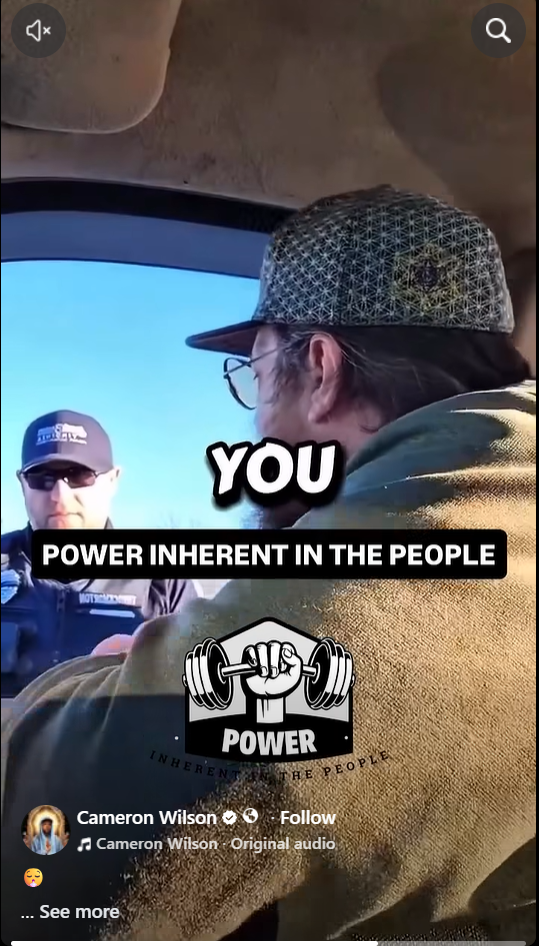
Cameron Wilson · Original audio
https://www.facebook.com/reel/1529937142205323😮💨
Comment(s)
Joseph Parham Facts.

Hopi Daze Attention ALL Police Agents
1, There are only 2 Jurisdictions, one of the “dead by consent/threatened CROWN/CRONE dead mother” and one
of, by, for the living where the dead corporate fiction is the CROWN CORPORATION/CORPSE, and the living is I, the
WITNESS to your pre-crimes/crimes via your INTENT,
2, Your obedient and willful consent to wear a corporate uniform is prima facie evidence of your INTENT to commit
crimes via omission/commission, knowingly/unknowingly where your ignorance is not and never will be a defense
in any living court where you WILL be privately prosecuted in your LIVING status by all who WITNESS your actions
that you are known by,
3, Any/all times you ask, with INTENT, to procure a LEGAL NAME you are, in fact, committing pre-meditated murder
with intent to kill a living being by means of a dead LEGAL NAME to gain a false jurisdiction where these
frauds/crimes are already well known to millions and where these actions are a crime against humanity and your
spiritual suicide,
4, Your master, the dead CROWN corporation (owners thereof) that you are in spiritual contract with via your
obedient willful intent to consent via sworn oaths renders you dead by consent and without voice in any/all courts
of the living where you CAN and WILL be prosecuted for your crimes in a living court of record,
5, The Birth Certificate is proof and prima facie evidence of the CROWN owners/your master’s INTENT to defraud
and commit crimes against humanity that you, by your sworn oath are fully party and liable to, for, of YOUR actions
by, of, for commission/omission, knowingly/unknowingly inasmuch as you now have evidence to the contrary of
your “beliefs” and are the last “holder in due course” and under living contract with me, the living witness whereas
you have given your seal on this document via DNA covenant,
You have now a choice to make and one that will define your very existence regardless of your programmed beliefs,
opinions, training, indoctrinations etc, since your birth;
You can choose to be the slave of another where any/all who are your superiors are your masters;
You can claim to be free where we know otherwise and you are bound by this contract you are now holding where
your choice has made you the holder in due course without return, it is now yours and you are fully liable
henceforth for any/all actions taken to harm others via your now non-ignorant actions;
As a living WITNESS without LEGAL NAME/S you are without jurisdiction, without claim, without authority where
your crimes are fully visible and your “dead by consent” LEGAL OFFICE titles/names etc, verifies your consent to be
such a thing, without voice and your “licences” (from “licentiousness” which means “one who is a sexually and
morally depraved criminal”) confirm your nature;
You stand now in the jurisdiction of the COMMON LAW as a PEACE OFFICER and all/any actions of harm, threats,
coercions, deceptions, fraud attempts etc, et al renders you a BELIGERANT; See Law of Nations/Nuremberg
Principles/Apostolic Letter/s inasmuch as you falsely claim to be Law Enforcement where you are ACTING as a
POLICY/POLIC-E STATUTE PIRATE working for a PRIVATE CORPORATION and are hereby WITNESSED as such where
forfeiture of your property is common law under Law of Marque in satisfaction of any/all wronged by your actions
forthwith; You are duly noticed;
“Have a nice day”
Reply
Kathy Mancarella by author
Yeah buddy but I got a question for you that I don’t comprehend does anybody have an answer for me here it is…
How can the officer take your criminal complaint if it is in regards to himself isn’t that a conflict of interest? Sounds good though and you certainly made that guy politely uncomfortable 


Stephen R. Zoretic Kathy Mancarella let’s make them rudely uncomfortable
Ian Jacob FridgeKathy Mancarella exactly the point! That means any and all contact with the driver must end immediately and no further action should be taken
Ben Powell Kathy Mancarella the first thing you have to understand that we are protected under the constitution to travel unencumbered. Police can only ticket municipal employees, IE govt employees. As a private citizen you are not obligated to pay a traffic ticket and no court in any state has jurisdiction over any of us unless there is an injured party to complain, and that injured party has to be a living person and cannot be employed by the govt. govt employees also cannot be witnesses it’s a conflict of interest. All traffic cases are criminal in jurisdiction and all traffic cases are meant to be held in the Supreme Court, states don’t have authority to pursue traffic cases against private citizens. In the Declaration of Independence private citizens are known as sovereign citizens meaning we are above any law set in place by the govt bc we arent employed by the govt we are private citizens. Understand your rights , research your rights it will save you money and a headache later.
Philant Nelms Ben Powell back in the day before 1933 everyone was soviergn but something changed and we all became us citizens which have no constitutional rights the only ones who do are white citizens that live in DC and government employees..u have to change your status
Ben Powell Philant Nelms wrong, you create an estate and living irrevocable trust that holds all your assets and use the trust ein instead of social and you operate in private. I understand I can create as many trusts as I want to and I can contract at an unlimited capacity.
Todd Hailey You realize that’s not what she asked, right?
Jason Lynch Ben Powell yeah I have a court date coming up in a couple weeks and I’m trying to defend myself by saying pretty much that I hope it goes well we’ll see I need a lot of help nobody seems to be offering any though
Ben Powell Jason Lynch look into subject matter jurisdiction, figure out if it’s civil or criminal. If it’s a traffic court then it technically is criminal. So unless they are operating in maritime law they cannot do anything bc they lack jurisdiction. Do not by any means answer the judges question period! Once you answer their question you are consenting to their jurisdiction. It’s up to them to prove you are guilty, keep the ball in their court and press jurisdiction.
Ben Powell Ron Bartels I said the Declaration of Independence buddy
Ron Bartels Ben Powell ~ I graduated last school, did you? Obviously not

Brett Coffell Jason Lynch if the state is a party to the case against a man/woman then the supreme court has original jurisdiction, look up Tanawah Downing.
Jason Lynch Ben Powell they kept giving me more time to get my license back and after finding out why my license was suspended I’m not going to get it back there they had a judgment against me and I never even got served I got into an accident with insurance 6 years ago and my insurance company for some reason or another never paid I have insurance I have proof I had insurance but they didn’t pay so 6 years later I’m driving I get pulled over and I have suspended license and they had a I guess civil matter against me and said that they served me which they never did cuz I would have been at court so they put a judgment against me on my license so I owe 44,000 and there’s no way in hell I’m paying that. But this is my second driving on a suspended and they’re trying to give me jail time and I don’t want to lose everything and have my family out on the streets I’ve been to court about five times already the judge keeps giving me more time to get my license which I was just trying to prolong it to figure out what to do but I can’t come up with $3,000 to pay the lawyer to get away to get my license back because then I have to pay another $1,500 to the DMV so a total of $4,500 to get my license back but this next court hearing is going to be sentencing or plea is what it says and I don’t know what the hell to do I’m almost 50 years old I’ve got a 10 year old daughter and two teenage boys I bust my ass all week at work I’ve been trying to look up laws and read the Constitution understand it it’s very hard but I’m getting a grasp on it any help I could get would be greatly appreciated
Michael Cashman Ben Powell i saw something the other day that rhe constitution is commercial/public however the bill of rights is private.
Roy Marchesseault Kathy Mancarella that why he said I can’t talk about that until you take my report
Tony Godwin Jr. Kathy Mancarella therfore him writing a ticket is conflict of interest. Therefore the traffic stop must stop. He isn’t allowed by law to write the ticket at that point. I mean, he can and most likely will but it won’t uphold in court. A judge sees this and will dismiss more than likely because he doesn’t want a room full of people to know the truth.
Anthony Shepherd Kathy Mancarella aall government positions are in the position of servitude to the populace not governance which they are pulling.
Goes for all levels of government.
Stéphane Labelle Kathy Mancarella They abused our rights during the last 8 years. They will face real military justice soon.
Stéphane Labelle Kathy Mancarella yes it is but his job is to do it anyways. Your job is to let him get deeper, so we can all learn from it.
Rich Reed Kathy Mancarella Citizens arrest is legal 
Eric Slafter Kathy Mancarella in theory that’s the reasoning why a supervisor is supposed to be asked for….. but since supposedly that’s only provided as agency policy there becomes another issue. Because by black and white latter of the law if the citzen can support the charges properly he would be able to arrest the criminal in costume on the spot.
But without the supervisor on site he can’t effectively turn him directly over to law enforcement without the obvious fight that won’t go his way….
The other argument comes in with the grand jury indictment.
Grand jury’s according to previous supreme courts dicta is NOT A CREATURE of the courts or any branch of government but is supposed to be open to the people. I’m told a few states have them open to being convined. By citzens.
But most have a unlawful gatekeeper in the clerk of court.
But where it is open an grand jury indictment bypasses the protections they would have in a .d.a. simply refusing the charges and forces the case forward.
Joseph Marcak Kathy… I’ve read the comments to your question … and nobody really answered it.
Here’s the breakdown of what this citizen is stating:
— LEO only duty is to enforce the law as defined by the Constitution {issued: under the Constitution, traffic citations are not criminal; ergo not within their authority of LEO}
— As per their only responsibility, LEO are required to take all criminal reports and investigate in accordance with the Law.
— Any crime potentially committed by a member of law enforcement, or the entire agency itself, that individual/agency required to RECUSE themselves from the case immediately.
In short, this citizen is stating that this public servant is being deemed being involved in criminal activities (racketeering) and therefore has zero authority until the criminal case has been concluded.
Greg Baehring Joseph Marcak switch law with statutes
Wendy Yeargain Kathy Mancarella that’s why asking for an unbiased third party like a supervisor is probably a safer route to take in this situation 
Steven Winchester Wendy Yeargain why would you help them create a witness against you?
Wendy Yeargain Steven Winchester exactly.That’s what’s happening. No one is obligated to testify or provide documents that could be used against them.
But as for a supervisor, they’re not party to the accusation so they have no standing in the cause.
Douglas Lindsey Kathy Mancarella established reasonable doubt .
Mike SmithKathy Mancarella I guess that went WAY over your head
Kathy Mancarella Mike Smith yes it did which is why I’m asking. Do you have a problem with people seeking answers?
Mike Smith Kathy Mancarella so…. The “officer” is a government official… ANY complaint there is …. THEY HAVE TO TAKE. It doesn’t matter if it is the official you are talking to or not. That is their MAIN DUTY. It isn’t a job but a DUTY! Lots of Americans have forgotten that.
Kathy Mancarella Mike Smith thank you it was confusing to me. And I’m trying to find the words to explain what my brain was thinking as far as conflict of interest but I understand now thank you.
Mike Smith Kathy Mancarella sorry… I didn’t mean to sound rude
Kathy Mancarella Mike Smith apology accepted thank you
Honewmp Honewmp Kathy Mancarella it wasn’t a question more a typical women trying to deflect a point she thought she had caught her fish
Kathy Mancarella Honewmp Honewmp why would you think this when I clearly stated
“I don’t comprehend does anybody have an answer for me here it is…”
Apparently I’m not the only one here having a hard time comprehending things.
Thomas A Teschler Jr. Kathy Mancarella Mike Evolution thats the America is know! Love love love this!
Jake Browne Kathy Mancarella the agent is guilty of the agency’s policy being complicent if he takes the report he doesn’t participate in the racketeering
“Most relevant” is selected, so some replies may have been filtered out.
Wendy Yeargain Criminal complaint takes precedence over a civil infraction lol
Bruce Speirs Wendy Yeargain Not on a traffic stop. The driver is automatically detained and the complaint from the driver was no more than an accusation, meritless as it was. He can make his complaint after the traffic stop at a police station, which is where he could end up if he fails to comply with the cops directives.
Mind Evolution Oh that cop wasn’t ready! 
Andrew Avallone Mind Evolution Yeah he didn’t have his waders on and that bullshit was getting deep.
Kathy Mancarella Mike Smith  Well I’ve been living in fight flight mode for many years. It’s been scientifically proven that it hinders brain capacity.
Lisa Vaughn Kathy Mancarella that’s why they do it
William Boisclair Kathy Mancarella definitely
Mac Doogle Kathy Mancarella I know the feeling, I have been attacked by my city for over 12 years. So many illegal actions against me and it is absolutely debilitating. They’ve dragged me into court three times on made up charges. They are a mafia and it affects every aspect of your life trying to protect yourself against they’re constant assaults
Gabe Kincaid Kathy Mancarella Yes it does. I’m at the point where I can’t take in any more information until I unload some. It definitely sucks flying solo and doing this stuff by yourself. The court crap takes so much out of you because you basically have to learn a new language to comprehend what these bar Gypsies are pushing. Then you learn just how screwed up the English language is and how we Languish in THEIR language. I just got done two months ago fighting my case in Federal Court trying to use bills of exchange like we’re lawfully supposed to be doing in the beginning after they took our gold and silver back in 1933. It’s tough and definitely takes the Give-0-Phuck out of you.
Kathy Mancarella Ben Powell it’s the people’s right to remove the g0√
Kathy Mancarella Ben Powell my ass is staying in the house that’s man’s job. meanwhile I’m over here 
Ben Powell Kathy Mancarella it’s our duty as Americans.
·
Gabe Kincaid its designed like that , to feed the aristocratic puffed up dimwit class . Few attorneys know their place, an …
See more
Reply
·
·
by author
The look on his face every question went closer and closer to looking at his feet
Reply
·
·
by author
He’s a smooooth operator 


Reply
·
·
 Author
Angel Mustang traveler, operator emphasizes commercial use
Reply
·
Angel Mustang he’s a slick talker but at the end of the day he will pay that ticket and he’ll also be referred to the city hal…
See more
Reply
·
Steven Winchester constitutional rights .. he knows enough rights that he have he wont pay any tickets.. Police dont have jurisdiction over you neither does the courts unless your apart of the united states corporation
Reply
·
·
by author
Mike Smith Jake Browne … I been thinking about this all morning since I’ve been informed. I’m so thankful for this knowledge. I wish I had this comprehension when I was handling my case in 2021. Well actually it ended in 2021 I fought that case for three and a half years. It took three and a half years to win that case. And I spent two and a half years writing my counterclaim
This is an aha moment for me. Brick on the head moment and I am just so grateful to have this understanding. Thank you
Reply
Edited
·
Kathy Mancarella congrats on winning, i fought made up charges shy of 3yrs and ended pleading to a charge i wasn’t guilty of just to end it.
Reply
·
Kathy Mancarella you are very welcome!! Sorry it took sooo long. That’s awful!
Reply
·
Kathy Mancarella that’s child play darlin, although I’m glad you won! Took me a decade of my life to hold the Avoyelles parish sheriff responsible and beat false felony charges where they arrested me, beat me, got me in jail, strapped me down and tortured me with mace and tazers, feed me once or twice a day, kept me on lockdown, never gave me my phone calls. The best and worst part is I beat my charges ONLY because the same arresting officers killed a 6 year old boy the following year. Sad shit that my freedom will always be tied to that little boys death. Makes me hate them.
Reply
·
Ian Jacob Fridge that’s fucked up. Hope that dude gets what hedeserves
Reply
·
Kathy Mancarella there is a stautue of limitations, if it runs out your case is over.
Reply
·
Bruce Carlisle yeah I’m pretty sure that’s not how that works lol
Reply
·
Steven Winchester it is
Reply
·
·
by author
I don’t think either of them understood what he said
Reply
·
·
Author
Grant Wolfenden most are lost for sure.
Reply
·
Grant Wolfenden the driver most definitely knows what he is saying.
Reply
·
Ace Monasco It just holds no water legally.
Reply
·
Adam Cameron it absolutely does and it’s why people have sued and won.
Reply
·
Ace Monasco Your sources sound solid. lol
Reply
·
Adam Cameron you haven’t presented anything hypocrite
Reply
·
Ace Monasco Virginia code 46.2-104 gives the officer authority to pull someone over and request identification. The officer wouldn’t be allowed to take a criminal report that he is a part of , big conflict of interest there. Just because a guy used big words and speaks quickly doesn’t mean that he is correct.
Reply
·
Ron Bartels a flip of the script? Do unto others as you’d have others do unto you!!? Thou shalt not?
Reply
·
Jason Calhoun just spewing a bunch of b******* that doesn’t really mean anything. He still got tickets
Reply
·
He probably doesn’t even understand half the words you just said to him.
Reply
·
Sabrina Beutel and that’s why they cal it legalize…. no lay person was ever supposed to know.
Reply
·
Sabrina Beutel nobody could.
Reply
·
·
by author
that cop looked dumbfounded
Reply
·
Lumerial Shazam IQ REQUIREMENTS ARE DEMANDED BY THE PEOPLE
Reply
·
I don’t use a Massachusetts driver license or license plate ! I only identify using a USA passport card ! The USA passport card is a federal ID which does not contain your address !
Reply
·
·
Author
D-sharp Wilson it’s also owned by the USA government
Reply
·
D-sharp Wilson I’m impressed Massachusetts sucks I’m from there and now that I know my rights I still would be hesitant to do what you’re doing but im impressed with you. 


Reply
·
D-sharp Wilson so this would be the way to go over gettin an id right?
Reply
·
Eric Brown not for driving.
Reply
·
That pig was fried
Reply
·
Driver teaches ticket writer the law FUNNY
Reply
·
I wonder how that worked out for him….lol
Reply
·
The Angry Vet Legend says Officer is still standing there on the side of the road till this day staring at his boots while blinking slowly…. Trying to understand what he just heard…
Reply
·
The Angry Vet because you like payng doesn’t mean everybody else like to pay
Reply
·
Justin Edwards clearly you dont know me….lol
Reply
·
The Angry Vet he got a ticket and paid it after wasting everyone’s time
Reply
·
Steven Winchester ive never once seen that sovereign citizen schitt work on anything…
Reply
·
Now check out his hat lol I have watched this video several times and now I see it.
This Mans’ head is covered by the flower of life
Reply
·
My man fired off from the hip. He wasn’t ready!!!
Reply
·
Boom. Cocked and loaded. Perfect delivery
Reply
·
He lit that mf up !- lol
Reply
·
·
by author
It totally changes when you go into court and you ask the judge is this criminal jurisdiction or non-criminal jurisdiction because if it’s criminal jurisdiction for my traffic violation, you have to produce a living breathing human being as the victim if you cannot produce a victim, then it admissible and you can’t even charge me court cost according to our constitution and the state, and the police officer cannot be a victim or the plaintiff end of story
Reply
·
Where’s the whole video
Reply
·
Rob Rowland yes please!
Reply
·
Dennis Lapaglia did the OFFICER have a WARRANT describing the property to be seized? Did he provide you a copy for your emplo…
See more
Reply
Edited
·
Annie McShane yeah . Shoe me one single case won by the “Traveling” argument….
Reply
·
Annie McShane the Police simply hand them back their papers. And the vehicle gets towed. Because the only people that recognize the travelers rules. Are the idiots that call themselves travelers. When they are driving sn automobile. Neither I or my employer have ever been sued by one of these idiots. They usually just abandon the vehicle. Although a few have actual showed up with the real registration and plates and insurance to claim their vehicle. That is the only way that a vehicle has Ever left the lot.
Reply
Edited
·
INFRACTION means that he broke a part of the law.
Reply
·
·
Author
Paiva Jorge wrong. 
Reply
·
Paiva Jorge administrative is code…. period. Law is criminal and these administrative courts love to pretend unlawful that they are courts and everyone has accepted it for a long time is the problem . The law of we always did it this way is often stronger than actual law.
But these courts have been put on notice multiple times at multiple levels …. to the point even justice Kavanaugh was discussing how unconstitutional they are…..
While scotus just keeps lending legimacy by accepting cases brought up from them instead of just dismissing.
Reply
·
·
by author
Let’s go !!
Reply
·
Yes sir 
 smart but the city will cover up
Reply
·
Mack Ramirezthey always try
Reply
·
·
by author
Knowledge is so powerful
Reply
·
Whats the guys channel name?
Reply
·
·
Author
Josh Hankins not sure.
Reply
·
Can anyone put me in touch with this man ? Please
Reply
·
·
Author
Gary Graffeo nope, but I can give you the playlist that is directly applicable.

YOUTUBE.COM
THE CORPORATE CAPTURE OF THE REPUBLIC
THE CORPORATE CAPTURE OF THE REPUBLIC
Reply
·
·
by author
Someone who actually knows what he is talking about unlike all you cringey fringe goofies who think they’re actually gna win a lawsuit
Reply
·
·
Author
Dustin Dean Price there are many ways to make a dinner plate.
Reply
·
Cameron Wilson I feel you I just can’t stand these people who see one tiktok video and all of a sudden their the sovereign road king
Reply
·
Dustin Dean Price There’s more than one way to skin a walker…
Reply
·
·
by author
Love this guy
Reply
·
·
Author
Dan Curtis me too.
Reply
·
Dan Curtis do you know his name
Reply
·
·
by author
Boom 
Reply
·
You can literally see the moment when the cops mind exploded….
Reply
·
The officer just got back from lunch and he just wants to take a nap
Reply
·
Lmao prolonging the stop and recording yourself saying nonsense priceless!
Reply
·
We are not a dead foreign entity of the sea we are not tied to our mother’s birth canal the boat  is docked with the roap around the pole and on land.
Reply
·
·
by author
Amazing
Reply
·
·
Author
James Hess understanding his thoughts can be found articulated here – https://donate.stripe.com/8x2cN55l9dou2NrbHIffy0r
DONATE.STRIPE.COM
donate.stripe.com
donate.stripe.com
Reply
·
Word salad, still got the ticket.
Reply
·
Also on a lighter note this Man is so well oiled he,could probably bring the devil to Jesus lol… Do you know there is forgivenessa! in the repentancea! ofa Sina!
Hallelujah.(my best preacher voice)
Reply
·
Massachusetts
Reply
·
Wow big words.
Reply
·
·
Author
Jameson Duffy deep comprehension
Reply
·
Dang he owned this cop the tyrants of the bar/US corporation of washington dc foreign entity british associate regulatory british laws of the sea of 1871. Have no jurisdiction in america fake false courts not real judges lawyers UN police force.
Reply
·
My birth certificate was in small lower case letters until my mom signed the birth certificate not knowing that we would be sold into slavery to that state you were born in sold as commodity/stock on the stock market given a ss# the mark of the beast. Your parent didn’t know this when you were born don’t sign the birth certificate when your old enough you go to work with your straw man name/ficticous name and they take out taxes you work and they get your money.
Reply
·
They have no common ground or common law they use us as the ficticious person as the straw man which doesn’t exist. We are the alive man and woman of the republic constitution common laws of the land from 1776. They have no right power or authority to detain or arrest american sovereign nationalist human beings whatsoever that is treason and crimes against humanity.
Reply
·
We are the mark of the beast.
Reply
·
·
by author

Reply
·
You basically use the non existent straw man against us/to accuse us falsely so you can get our nesara money from our birth certificate account they want you to plead guilty or not guilty so they can steal your money it’s all true folks.
Reply
·
·
by author

Reply
·
That’s what I’m going to do next time I get pulled over file my own criminal report
Reply
·
Dereliction of Deputized Duties…
Reply
·
Just some prep school plabber,
Reply
·
Can’t quit shaking my head.
Reply
·
He has to get a supervisor or other officer…
Reply
·
I always ask the officer why the touched my car and then let him know he is safe around me and my passengers.
Reply
·
Not many people understand the term “color of law”. The more that people educate themselves the less power the police have over them.
Reply
·
Of couse we don’t see the rest of the video which usually happens when the interaction ends badly for the driver. Cops would j…
See more
Reply
·
100% Historically, why were legal definitions changed/redefined..?…
See more
Reply
·
THIS COP AFTER THIS TOOK A 1 YEAR VC TO DR. LMAOOOO
Reply
·
·
by author
Pew pew
Reply
·
Are you trying to traffic my person officer?
Reply
Edited
·
It’s not the police officer it’s those above the police department to state the government. He’s just trying to do his job for what it’s meant to be and it’s not to protect us as designed to protect the law so if you really wanna go after I wanna go after the damn state, the other one violating the right to Travel and strong arming communities. When people get rid of these bullshit laws and get rid of quotas, then the police will change too.
Reply
·
Nazi soldiers were just following orders too. Still too many cop suckers in this country
Reply
·
We always assume that the police are trained with the law that they are supposed to uphold but unfortunately they are not  they’re literally just working for a law that they don’t even know
Reply
·
Ya he just did a total legal loophole with him in regards during the traffic stop. A total script flip. Good for you. I love a good legal loophole.
Reply
·
If only more people wouldn’t wake up to this power.
Reply
·
they think when they demand you should bow
Reply
·
Any follow up to this?
Reply
·
What is a mercenary an independent contractor to protect the corrupt
Reply
·
Brah! This is on point
Reply
·
We’res the rest of the video?
Reply
·
·
I love it.
Reply
·
I love it! 
Reply
·
Love it!
Reply
·
Hell yeah brother
Reply
·
So what happened. I looked for the rest of the video but couldn’t find it
Reply
·
Love it!
Reply
·
Way to go dude!
Reply
·
Love it!
Reply
·
That is awesome. How you handle that
Reply
·
Got the cop looking like

Reply
·
Smooth
Reply
·
This guy should be an attorney for the people
Reply
·
God damn this good
Reply
·
Beautiful
Reply
·
Man i would like to have seen the rest of this .
Reply
·
He’s 100% right we gotta get behind this now. This changes the paradigm of what law-enforcement was supposed to be for not for these petty stupid things…
Reply
·
This is absolutely priceless!
Reply
·
Oh man! That was a mouthful…
Reply
·
Wheres the rest of this video?
Reply
·
Well how’d it go lol
Reply
·
Damn right man. Be smart y’all.
Reply
·
That’s hilarious! jajajajajaja
Reply
·
·
Let me try that 
Reply
·
I love people like him put them in their place
Reply
·
Love this man 
Reply
·
I love you bro non-commerce operator in play. So awesome
Reply
·
What was the outcome
Reply
·
The people have the power and authority not the one hired to protect the people’s rights
Reply
·
So what was the outcome?
Reply
·
We need more people like him!!!
Reply
·
Now this is interesting. This might actually be quite valid….. 
Reply
·
they hate it when people know the laws
Reply
·
These cops laugh but they have no idea what’s coming
Reply
·
So everybody’s making fun of the guy in the truck but what he’s saying is actually true because by law unless you are making Commerce on your vehicle and for the ones that don’t know what that means making money at the time you’re in your vehicle then yeah you have to have a tag and a driver’s license because then you’re considered commercial as the actual loss state
But if you’re just traveling around picking up your kids going to groceries store and stuff like that then no you’re not required by law to have a driver’s license or a tag on your vehicle if people go and actually read the law it states in the law commercial
People need to wake up these law enforcement officers do not have as much as Authority as they seem to think the only reason why they get away with it because people allow it
Then they try to just sue them instead of having them charged and convicted of their crimes first then you’re able to go sue them that’s where people mess up at they go and try to straight sue you can’t do that you have to have them found guilty first
Plus stop using all these regular attorneys to fight the state when they violate your rights because they are part of the same scam you need a civil rights attorney to fight your case not a regular attorney because it’s your civil rights they’re violating the most attorneys are not practiced under civil rights laws that’s why they fail and lose so many cases
Reply
·
 drop I’m so proud of people stand up for their right
Reply
·
Damn that is Strong.. !
Reply
·
I have court for willfully reckless driving but am still in public with a dl. Can I still use jurisdiction?
Reply
·
That’s not how you do it.
Reply
·
Wow great job
Reply
·

Reply
·
Tax collectors are out of control
Reply
·
Love that talk country brother… hit’em hard break them all down…. Great stuff keep going and thx
Reply
·
All that guys doing is just wasting time. He’s still got the tickets , maybe even went to jail
Reply
·
I really sincerely need to see the entire video. Fb has shadow banned me from even responding to comments or receiving notifications on comments. Please send the link directly to my inbox and/or post it on one of my comments. This is a new profile due to my last one being completely deleted yet again.
Reply
·
And it’s under threat coz he also has a  so it’s also puts him in fear coz he really doesn’t know if he is legit
Reply
·
I’m happy for these operations 

 no more abuse of oath
Reply
·
He destroyed him
Reply
·
If a crime is committed, ie harm done, civil law broken, federal law broken, documented by my report and the police and sheriff’s office refused to even investigate or take the report, legal?
Reply
·
Trying to settle constitutional questions on the side of the road almost always fails because you’re arguing with the wrong branch of government. Law enforcement officers enforce the laws that have been enacted. They do not write them, repeal them, or declare them unconstitutional.
As James Madison wrote in The Federalist No. 51, “If men were angels, no government would be necessary.” The Framers understood that liberty requires both limited government and an engaged citizenry—not roadside debates.
The Mayflower Compact (1620) began with a remarkable commitment to self-government. The signers “covenant and combine ourselves together into a civil body politic” for the common good. The principle was simple: free people govern themselves through ordered, lawful institutions and active civic participation.
John Adams observed, “Liberty cannot be preserved without a general knowledge among the people.” Thomas Jefferson likewise wrote, “The government closest to the people serves the people best” (paraphrasing a theme found throughout his writings on local self-government). The Founders consistently emphasized that the ultimate safeguard of liberty is an informed and active citizenry.
That’s why genuine self-governance does not begin when the blue lights come on. It begins long before that:
• Learning the Constitution. • Holding local officials accountable. • Attending city council and county quorum court meetings. • Speaking during public comment. • Using public records laws. • Organizing neighbors. • Supporting principled candidates. • Participating in lawful citizen oversight.
A little humor: Trying to convert a traffic stop into a constitutional convention is like arguing with the cashier because you don’t like Congress. The cashier didn’t write the tax code, and the deputy didn’t pass the statute.
Reply
·
The criminal report that he wants him to write up is in regards to the department of motor vehicles. Only that the cop is involving currently involving himself in and has the ability to stop.
Reply
·
This is absolutely 100% right across the country. If we did this to them, they would be out of business and then be going to court. Let’s see how many court cases we can get done in one month you’re gonna see a change in this country you never saw before… we’re using the same law as they try to use on you, but he did it the right time because now he has to do it the cop has to do it and he has to file that he has to be reported and if he doesn’t do it then he’s soliciting, wowwow…
Reply
·
Cop got Wreckdddd!
Reply
·
Where’s all the boot lickers crying “jUZ gIv tHe CoP yoUr liScenSe”
Reply
·
Adrian Pizana say it again for the dummies
Reply
·
There is an important distinction, however: an officer might mechanically receive or document an initial report, but he should not investigate or adjudicate allegations concerning his own conduct. When the complaint concerns that officer, calmly request a supervisor and ask that the matter be referred to internal affairs, professional standards, an outside law-enforcement agency, the prosecutor, or another appropriate independent authority.
As a practical rule, never place your substantive complaint directly into the hands of the alleged offender and expect an impartial result. Preserve the evidence, record the names, time, location, witnesses and report number, and let competent counsel determine where and how the complaint should be filed. Depending upon the facts, police misconduct may also be reported through state authorities or the U.S. Department of Justice. Federal law even treats attempts to obstruct reporting, fabricate evidence or conceal misconduct as serious matters.
This is also why people should consider obtaining legal protection before trouble begins. A reputable legal-service or legal-insurance plan may provide access to counsel, discounted or covered legal services, and, in some plans, 24-hour emergency attorney access for situations such as arrest, detention or service of a criminal warrant.
But read the policy carefully. Some plans limit pre-existing disputes or impose eligibility periods; others advertise immediate coverage or no waiting period. Prices also vary substantially: some workplace plans are around $20 per month, while individual retail plans may cost considerably more. Legal protection is much like a fire extinguisher: it works better when purchased before the kitchen is smoking.
And yes, the gentleman remained polite, but visibly uncomfortable. That often happens when someone realizes the citizen knows the difference between lawful accountability and roadside theater.
Reply
·


Reply
·
Reply
·
Know your rights. Most don’t even take time to learn
Reply
·
For educational purposes…
Natural rights en-dowed by a Creator, makes these rights inherent, in-a-lien-able/unalienable/un-ab-a-lien-able, and beyond the authority of government to grant or revoke.
Govern-ments are created to protect these pre-existing rights deriving their (power/authority/jurisdiction) from the consent of the (governed/controlled) , which requires one to be ad-equate-ly in-form-ed before consent can be given, otherwise it is vitiated consent / coercion, fraud/deception.
(Color/hue/shadow) of (Law/light) often GRANTS (hue-man’s/artificial/hypothetical personas/persona ficta/corpirations) similar (rights/privileges) to inherent inalienable rights natural persons possess SIMPLY by EXISTENCE, however they do not possess the same natural inherent (IN-A-LIEN-ABLE/unalienable) rights, given to all living by our creator such as the RIGHTS to LIFE/protection, LIBERTY, or PURSUIT of Happiness/peacefulness.. Pursuit includes the natural right to travel…
Void vs. Voidable: A judgment rendered without subject matter jurisdiction is generally void, not merely voidable, because THAT AUTHORITY CANNOT BE WAIVED or CONFERRED by CONSENT.
Black’s Law Dictionary (8th ed. 2004).
COMMERCIALIZATION CORPO-RATION
AB. abbr.See able-bodied seaman under SEAMAN.
5 U.S. Code § 3331 – Oath of office.
“An individual, except the President, elected or appointed to an office of honor or PROFIT in the civil service or uniformed services, shall take the following oath: “I, (AB), do solemnly swear (or affirm) that I will support and defend the Constitution of the United States against all enemies, foreign and domestic; that I will bear true faith and allegiance to the same; that I take this obligation freely, without any mental reservation or purpose of evasion; and that I will well and faithfully discharge the duties of the office on which I am about to enter. So help me God.”
(Pub. L. 89-554, Sept. 6, 1966, 80 Stat. 424.).
Able-Bodied Seaman. An experienced seaman who is qualified for all seaman’s duties and certified by an inspecting authority> the living.
Abbr. AB; ABS. Also termed Able Seaman; [Cases: Seamen 11, 29. C.J.S.
Seamen §§ 113-121, 123, 132-133, 148.] “The traditional seaman is a member of the crew of a MER-CHANT VESSEL….
Ad-mir-alty and Mar-it-i-me Jurisdiction: Article III of the Constitution and the Judiciary Act of 1789 grant federal district courts jurisdiction over (CIVIL) cases IN ADMIRALTY and MAR-IT-I-ME matters.
This jurisdiction extends to IN-JUR-IES CAUSED by VESSELS on navigable waters, EVEN if the injury occurs ON LAND. Not vice-versa..
18 USC Ch. 81: PIRACY AND PRIVATEERING. §1658. “Whoever holds out or shows any false light, or extinguishes any true light, with intent to bring any vessel sailing upon the sea into danger or distress or shipwreck”.. June 25, 1948, ch. 645, 62 Stat. 774; Pub. L. 103–322, title XXXIII, §330016(1)(L), Sept. 13, 1994, 108 Stat. 2147…
18 USC Ch. 81: PIRACY AND PRIVATEERING. §1654 “Whoever takes the command of or enters on board of any such vessel with such intent; or Whoever purchases any interest in any such vessel with a view to share in the profits thereof”… June 25, 1948, ch. 645, 62 Stat. 774; Pub. L. 103–322, title XXXIII, §330016(1)(L), Sept. 13, 1994, 108 Stat. 2147…
18 USC Ch. 81: PIRACY AND PRIVATEERING..§1652. (June 25, 1948, ch. 645, 62 Stat. 774.) “Whoever, being a citizen of the United States, commits any murder or robbery, or any act of hostility against the United States, or against any citizen thereof, on the high seas, under color of any commission from any foreign prince, or state, or on pretense of authority from any person, is a pirate, and shall be imprisoned for life”.
18 USC Ch. 81: PIRACY AND PRIVATEERING. §1653. “Whoever, being a citizen or subject of any foreign state, is found and taken on the sea making war upon the United States, or cruising against the vessels and property thereof, or of the citizens of the same, contrary to the provisions of any treaty existing between the United States and the state of which the offender is a citizen or subject, when by such treaty such acts are declared to be piracy, is a pirate, and shall be imprisoned for life. (June 25, 1948, ch. 645, 62 Stat. 774.)
18 USC Ch. 81: PIRACY AND PRIVATEERING. §1657. “Whoever fits out any vessel knowingly and, with a design to trade with, supply, or correspond with any pirate or robber upon the seas; or Whoever consults, combines, confederates, or corresponds with any pirate or robber upon the (seas) knowing him to be guilty of any (piracy or robbery); or >>(Whoever, being a seaman), (confines the master of any vessel)<< June 25, 1948, ch. 645, 62 Stat. 775; Pub. L. 101–647, title XXV, §2527(b), Nov. 29, 1990, 104 Stat. 4877; Pub. L. 103–322, title XXXIII, §330016(1)(H), Sept. 13, 1994, 108 Stat. 2147.) Based on title 18, U.S.C., 1940 ed., §498 (Mar. 4, 1909, ch. 321, §307, 35 Stat. 1148).
18 USC Ch. 81: PIRACY AND PRIVATEERING. §1661. Robbery ashore “Whoever, being engaged in any piratical cruise or enterprise, or being of the crew of any piratical vessel, lands from such vessel and commits robbery on shore, is a pirate, and shall be imprisoned for life”. (June 25, 1948, ch. 645, 62 Stat. 775.)
John 8:44… Revelation 17:4>5>16…
Void AB initio…
The living breathe, and exist.
Hypothetical persona ficta does not..
The living are not mer-chan-dise..
qui facit per alium, facit per se.
COLOR/hue OF AUTHORITY.
That sem-blance or (presumption of authority) sustain-ing the ACTS of a public officer which is de-rived from his apparent title to the office or from a (writ= governing authority> constitution, the living) or other process in his hands apparently valid and regular. State v. Oates, 86 Wis. 634, 57 N. W. 296, 39 Am. St. Rep. 912; Wyatt v. Monroe, 27 Tex. 268.
(COLOR/Hue) OF LAW).
The appearance or semblance, without the substance, of legal right. McCain v. Des Moines, 174 U. S. 168, 19 Sup. Ct. 644, 43 L. Ed. 936.
COLOR OF OFFICE. An act
unjustly done by the countenance of an (office/corpiration), being grounded upon corruption, to which the office is as a shadow and color. Plow. 64.
A (claim) or (assumption) of RIGHT to do an ACT by (virtue) of an (office/constitution), made by a (person/fictional/corPiration) who is legally destitute of any such (RIGHT/privilege) .
Feller v. Gates, 40 Or. 543, 67 Pac. 416, 56 L. R. A. 630, 91 Am. St. Rep. 492; State v. Fowler, 88 Md. 601, 42 Atl. 201, 42 L. R. A. 849, 71 Am. St. Rep. 452; Bishop v. Me-Gillis, 80 Wis. 575, 50 N. W. 779, 27 Am. St. Rep. 63; Decker v. Judson, 16 N. Y. 439; Mason v. Crabtree, 71 Ala. 481; Morton v. Campbell, 37 Barb. (N. Y.) 181; Luther v. Banks, 111 Ga. 374, 36 S. E. 826; People v. Schuyler, 4 N. Y. 187.
“The phrase implies, we think, some official power VESTED in the ACTOR, he must be at least officer de (facto = honored oath).
We do not understand that an ACT of a mere (pretender) to an office, or false personator of an officer, is said to be done by COLOR of OFFICE.
And it implies an illegal claim of authority, by virtue of the office, to do the act or thing in question. Burrall v. Acker, 23 Wend. (N. Y.) 606, 35 Am. Dec. 582.
Piratical: Definition and Citations.
“Where the act uses the word ‘piratical, it does so in a general sense; importing that the aggression is unauthorized by the LAW of NATIONS, hostile in its character, wanton and criminal in its commission/oath, utterly without any sanction from any public (authority/constitution) or sovereign power.
In short, it means that the ACT belongs to the class of offenses which pirates are in the habit of perpetrating, whether they do it for purposes of plunder, or for purposes of hatred, revenge, or wanton abuse of power.” U. S. v. The Malek Adhel, 2 How 232, 11 L. Ed. 239.
Reply
·

Reply
·
It’s just a damp shame
Reply
·
Wheres the rest of the video
Reply
·
Worthington Minnesota Noble’s county 56187 you can’t file a criminal report on a cop fact
Reply
·
Brent Kolander each state is different but I’m sure you knew that
Reply
·
Because what the cop is doing is violating your constitutional rights to travel unicumbered .. Any State that has made it policy for you to have a license has violated that right. which is not lawful to follow in the first place.. Your neighborhood friendly cop doesn’t even know that what he’s doing is punishable by law.. It’s time we turn the tables back on them.. This video is fire…!
Reply
·
Woooo get them fookers
Reply
·
Move along now
Reply
·
Good job
Reply
·
WOW
Reply
·
Beautiful
Reply
·
Reply
·
Point of impact…
Reply
·
Coolest fking hat ever
Reply
·
Fake lawyers fail both at the roadside and in court. Get a real legal eagle. If you can’t afford one get legal insurance. It is cheap and you will have flocks of legal eagles in every state and the prevention costs less than a decent dinner out once per month. You’ll need coverage for at least thirty days before the next time you need help. Even legal eagles buy this coverage because they can’t afford to be licensed in all 50 states and by the way, federal court is another expensive license fee.
Reply
·
State and Federal courts have separate jurisdiction from Maritime statutes. You seem very confused or misinformed about jurisdictions.
Reply
·
Boss
Reply
·
Love this guy 
Reply
·
Boss
Reply
·
Awesome 
Reply
·
Fuc.yea
Reply
·
anyone here remember Detroit 1967 ? when it was open season on cops . Hey cops your time is coming ! 

Reply
·
Wow
Reply
·
It’s really not their fault if they’re not educated on the law or required to know these things. Their bosses throw them out t…
See more
Reply
·
“STOP REACHING!”
*POP POP POP!!!*
Reply
·
Slavery still is up and going, the words and meanings were changed, thats all.
Example > Tort/fraud/slavery > Driver (“ONE EMPLOYED”) A SLAVE..
Black’s Law Dictionary (8th ed.
2004) Pg 1593… EMPLOYMENT 1. The relationship between master and servant.
See MASTER AND SERVANT / slave .
Black’s Law Dictionary 2nd Ed. “Driver” — “One EMPLOYED” in “conducting” a coach, carriage, wagon, or OTHER (VEHICLE/ vessel / mer-chant ship… “> part-ner-ship, See Davis v. Petrinovich, 112 Ala. 654, 21 South. 344, 36 L. R. A.615; Gen. St. Conn. 1902.
29 CFR § 782.3 Defines a “D-River” as one who operates a (vessel / mer-chant ship) “motor vehicle” in Interstate or Foreign COM-MER-CE.
Regis-tration, Reg-u-lation,
regis = tyrant/king/foe-reign Mer-ch-Ant…
TRANSPORTATION. “The (removal / trafficking) of (goods / products in commerce) or (persons / slaves) from one place to another, by a carrier..
Railroad Co. v. Pratt, 22 Wall. 133, 22 L.Ed. 827; Interstate Commerce Com’n v. Brimson, 14 S.Ct. 1125, 154 U.S. 447, 38 L.Ed. 1047; Gloucester Ferry Co. v. Pennsylvania, 5 S.Ct. 826. 114 U.S. 196, 29 L.Ed. 158.
In Criminal Law: A species of punishment consisting in removing the criminal from it’s own country to another…
The TERM “PER-SON” 18 U. S.C. § >2510< (6) “any (EMPLOYEE/SLAVE), A-gent of the U S, State, sub-di-vision of, and any in-di-vi-dual, Part-Ner-Ship, association, >Joint STOCK<, COM-P-ANY, TRUST, COR-POR-A-TION”, Any individual “Per-son” “NATURAL” and (“FICTIONAL Entity”) “LEGAL ENTITY”, “legal “person” (“legal name”), the NAME written in all CAPS. A “fictional” “entity/immage” >CREATED< forged/counterfeited) BY or under the authority of the (laws/statutes of a (state/Corpiration).
State v. Armstead, 60 So. 778 (Miss. 1913) Mississippi Supreme Court decision struck down a (“labor / slave) (contract / in-dent-ure) law / statute “).
The case ruled that penalizing an agricultural worker for breaching an (employment /servitude) (contract / in-dent-ure) and LEAVING their (job = masters estate/plantation) violated the Thirteenth Amendment’s prohibition against involuntary servitude.
Mississippi Supreme Court Citation: 103 Miss. 790, 60 So. 778 (1913)
Mose Armstead, a sharecropper, was prosecuted under a Mississippi STATUTE that made it a (crime for a (laborer / slave / employee) to breach a (contract / in-dent-ure) to perform agricultural services while receiving advances, and subsequently enter into a (contract / in-dent-ure) with another party without paying back the (employer / slavemaster).
A local circuit judge dismissed the charges, ruling the law unconstitutional.
The Mississippi Supreme Court affirmed the dismissal. The Court found the statute unconstitutional, aligning with United States Supreme Court precedent (e.g., Bailey v. Alabama), which established that such (laws/statutes) essentially trapped (workers/slaves) in systems of (forced/involuntary) (labor/servitude), PEONAGE to repay debts.
Under 18 U.S.C. § 1581, holding or returning a person to a condition of peonage-defined as involuntary servitude to pay off a debt-is illegal and punishable by up to 20 years in prison, or life if death or certain crimes occur. This statute, along with § 1582, prohibits forcing labor through debt, force, or legal coercion.
Definition: Peonage is a system where a person is forced to work against their will to liquidate a debt or obligation.
Illegal Acts: Holding, returning, or arresting someone with the intent to place them in peonage is a federal crime.
Penalties: Violators face heavy fines and imprisonment for up to 20 years, with higher penalties if death, kidnapping, or sexual abuse results from the violation.
qui facit per alium, facit per se.
Under this principle, the actions, agreements, or even wrongful acts of an agent or employee—when performed within the scope of their authority or employment—are legally treated as the actions of the principal or employer.
Treason to the Constitution: While the legal definition of treason is narrow (levying war or adhering to (enemies/tyranny), Chief Justice John Marshall famously declared in Cohens v. Virginia (1821) that it “would be treason to the Constitution” for a court to refuse to exercise proper jurisdiction, or to usurp it when not given.
Void vs. Voidable: A judgment rendered without subject matter jurisdiction is generally void, not merely voidable, because THAT AUTHORITY CANNOT BE WAIVED or CONFERRED by CONSENT.
Constitutional and legal reality regarding treason is narrowly defined as levying war against the (U.S./Constitution) or adhering to their (enemies/tyranny), giving them aid and comfort.
Two-Witness Rule: Convictions for
treason require the testimony of at least two witnesses to the same overt ACT or a confession in open court.
A judge’s knowing refusal to hear a challenge regarding their subject matter jurisdiction violates due process and the judicial oath of office, acting in the clear absence of all jurisdiction.
Subject matter jurisdiction is mandatory, not waivable, and ACTing without it renders a judgment a NULLITY or VOID.
Ad-mir-alty and Mar-it-i-me Jurisdiction: Article III of the Constitution and the Judiciary Act of 1789 grant federal district courts jurisdiction over (CIVIL) cases IN ADMIRALTY and MAR-IT-I-ME matters.
This jurisdiction extends to IN-JUR-IES CAUSED by VESSELS on navigable waters, EVEN if the injury occurs ON LAND. Not vice-versa..
Void Judgment: Subject matter jurisdiction is the authority of a court to hear a specific class of cases.
Because it cannot be waived, a judge’s refusal to hear a proper challenge renders any resulting judgment a “nullity” or void.
Black’s Law Dictionary (8th ed. 2004).
COMMERCIALIZATION CORPO-RATION
AB. abbr.See able-bodied seaman under SEAMAN.
5 U.S. Code § 3331 – Oath of office: “An individual, except the President, elected or appointed to an office of honor or PROFIT in the civil service or uniformed services, shall take the following oath: “I, (AB), do solemnly swear (or affirm) that I will support and defend the Constitution of the United States against all enemies, foreign and domestic; that I will bear true faith and allegiance to the same; that I take this obligation freely, without any mental reservation or purpose of evasion; and that I will well and faithfully discharge the duties of the office on which I am about to enter. So help me God.” (Pub. L. 89-554, Sept. 6, 1966, 80 Stat. 424.).
Able-Bodied Seaman. An experienced seaman who is qualified for all seaman’s duties and certified by an inspecting authority> the living. Abbr. AB; ABS. Also termed Able Seaman; [Cases: Seamen 11, 29. C.J.S.
Seamen §§ 113-121, 123, 132-133, 148.] “The traditional seaman is a member of the crew of a MER-CHANT VESSEL….
Natural rights en-dowed by a Creator, makes these rights inherent, in-a-lien-able/unalienable/un-ab-a-lien-able, and beyond the authority of government to grant or revoke.
Govern-ments are created to protect these pre-existing rights deriving their (power/authority/jurisdiction) from the consent of the (governed/controlled) , which requires one to be ad-equate-ly in-form-ed before consent can be given, otherwise it is vitiated consent / coercion, fraud/deception.
“Un-a-LIEN-able” vs. “In-alienable”: While some interpretations focus on the etymology “un-able-to-lien” to suggest these rights cannot be pledged as collateral, the strict legal definition focuses on the impossibility of transferring OWNERSHIP.
However, the result is similar: an inalienable right cannot be transferred, and therefore, cannot be attached as property for a debt.

John Choas They cant prove jurisdiction either
Ronald Jessie Rhoades brother
Dragan Obradovic Amazing
The Angry Vet Ghey
Tom Gamble Damn!!!!!!
“Most relevant” is selected, so some comment
__________________________
I found the following post adding to the topic:
The Badwolf Unincorporated
https://www.facebook.com/share/p/1CaXF9uRLT
Tracy Mayowski Van Steinburgposted toLand Patents and The Right To Travel
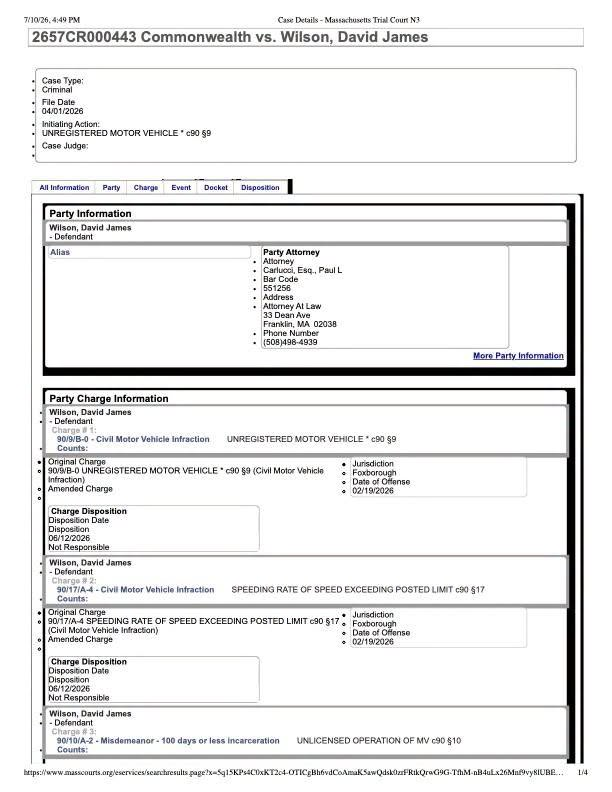
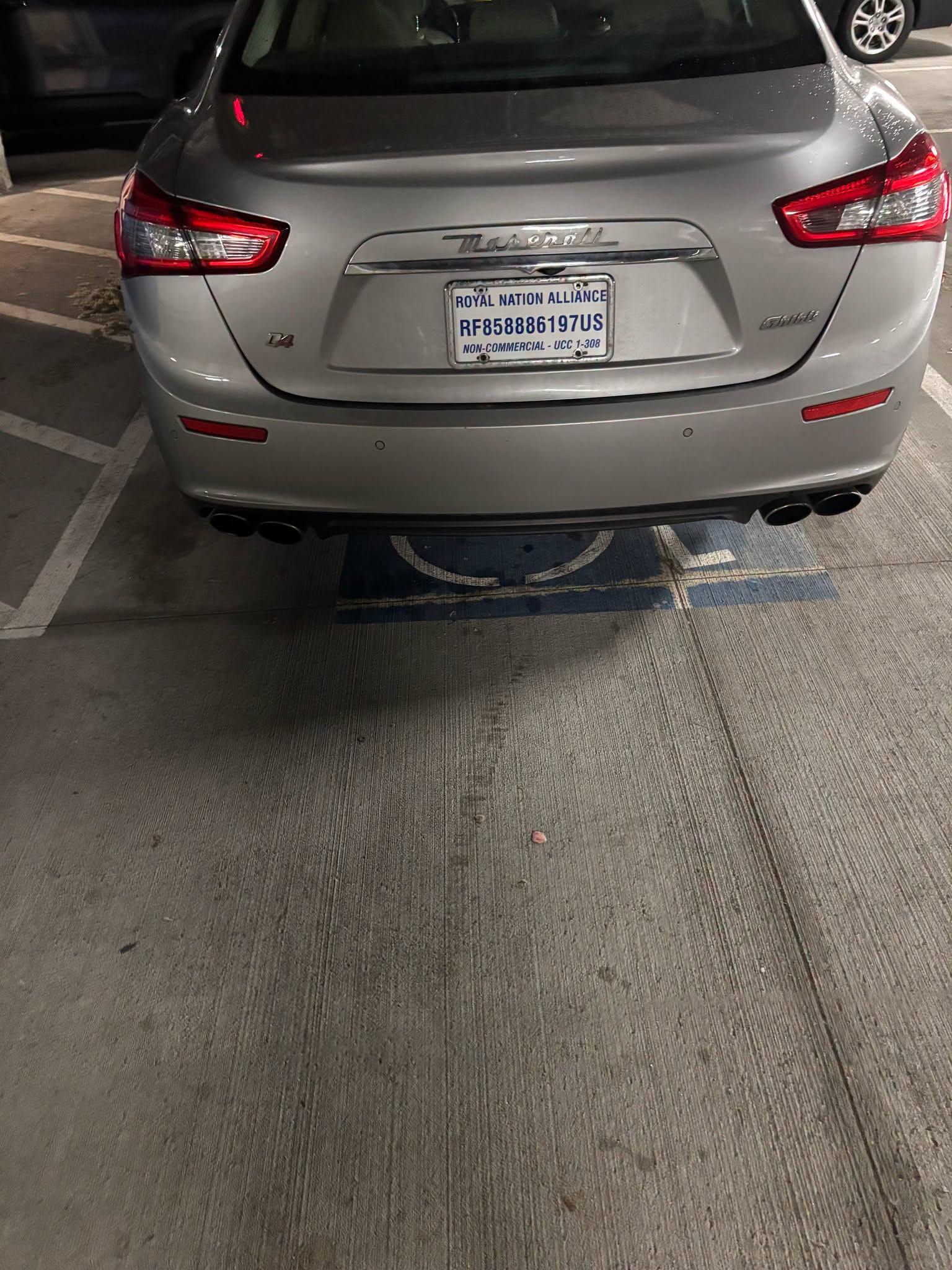
D-sharp Wilson MY RIGHT TO TRAVEL CASE WAS CLOSED! ALL 4 CHARGES CLOSED!
People have asked how I got my Massachusetts motor-vehicle case dismissed.
The first point is that I did not wait until I was standing on the side of the road to raise my position. Long before the citation, I gave written notice to the Commonwealth of Massachusetts and relevant municipal officials concerning my sincerely held religious beliefs and my objection to being identified or enumerated through a Social Security number, driver’s license, and registration system.
My religious position is grounded in the Book of Revelation and its warning concerning the “mark of the beast.” In my faith and conscience, accepting and using a Social Security number as a required identifier conflicts with those beliefs. I do not ordinarily use a Social Security number, and I had already placed the government on notice of that position.
When I was stopped, I did not attempt to hold court on the roadside or argue with the officer. I calmly explained that I had already notified the officer’s superiors and the Commonwealth of my position with proof of mail (travel binder) The officer nevertheless issued four motor-vehicle charges, including allegations involving operation without a license, registration, and insurance.
I then addressed the matter through the court process. Before trial, I filed written motions, supporting notices, and a proposed stipulation so that my position and the prior record were formally before the court.
The result is what matters: all four charges were dismissed. I don’t attempt to embarrass the court!
I will be posting the court record because the disposition is public. I am not claiming that a person can simply announce a “right to travel” and disregard the law. My point is that I created a written record in advance, acted peacefully, preserved my objections, appeared in court, and used pretrial procedure rather than roadside confrontation.
There is also developing litigation concerning access to federal identification documents without a Social Security number, including the passport litigation commonly referenced as Carmichael v. Rubio. That issue concerns whether the government may condition access to an identification document upon disclosure or use of a Social Security number.
My case was resolved through notice, documentation, motions, stipulation, and court procedure. The charges were filed, I answered them through the lawful process, and every charge was dismissed.
#love#moneymindset#money#finance#happy
_______________
Comment(s) as of September 1st, 2026 at 1:36 AM PDT
Deborah Dugger My plate will say what God promises to everyone full dominion over all the earth
D-sharp Wilson Deborah Dugger I love it
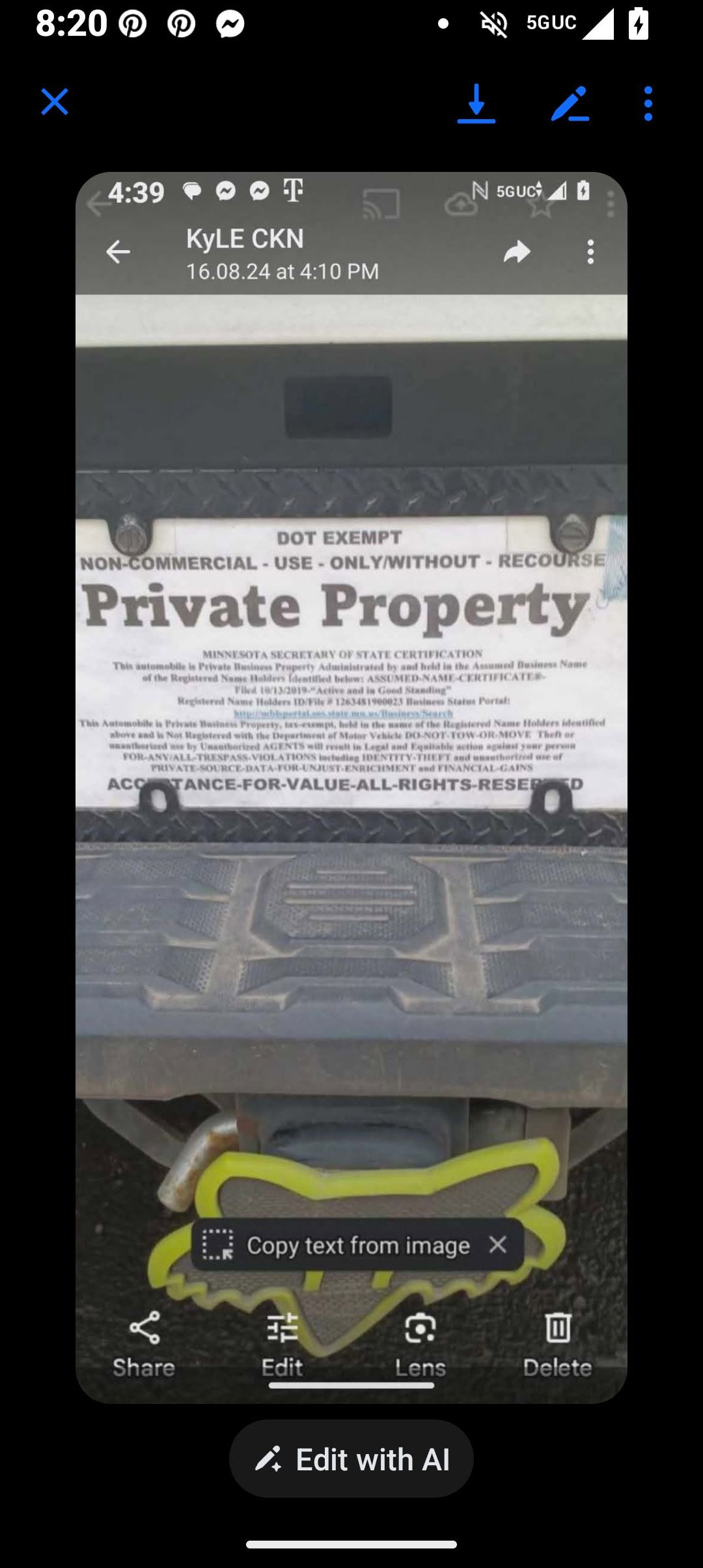
D-sharp Wilson C-Kyle Ckn I love it !
__________________
New post:
https://www.facebook.com/photo/?fbid=122303581142240971&set=a.122096438120240971
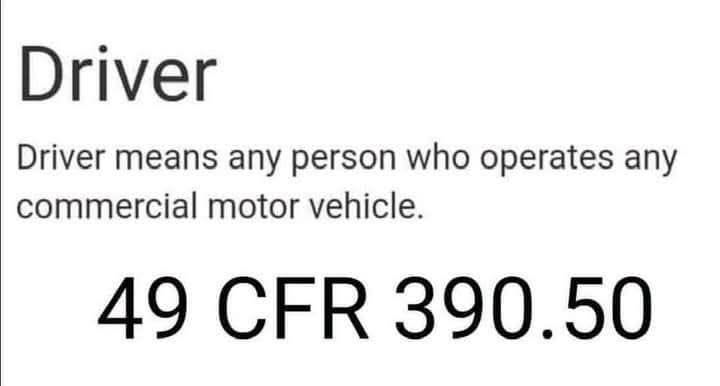
Comment(s) as of September 1st, 2026, at 1:44 AM PDT:
Steven Mitch If you look at the definitions in the motor vehicle code. Driver is anyone that is transporting goods or people for hire. Receiving a rate, fair, fee, or pay to do so.
James Austin  i messaged you on tik tok bro
Rich Peters Now define K I D N A P P E R ai.
Jefferey Lay Federal law makes this clear, but they supposedly say the supremacy clause doesn’t apply here(within states) because of judge made law and police power doctrines. Why are they so lawless?
Steven Mitch Jefferey Lay there is a supreme court case that states “no state or municipality may enact legislation that diminishes or abrogates the rights of the people secured and protected by the constitution.”. Therefore they cannot regulate the travel of people in their private capacity.
Jefferey Lay Steven Mitch That’s a rewording of the supremacy clause and it says “Federally protected rights.” The idea of police powers doctrines is claimed to be a 10th amendment delegated authority where the states can exert sovereign power against the people regardless of what federal law says in issues that pertain to public safety. I don’t agree with the states. it seems like some made up judge law; like the idea of qualified immunity. No legislature ever wrote qualified immunity into law, but since the legislatures didn’t address the issue and stop that judge made law it is presumed that the legislatures have agreed that it is not unlawful due to their silence on the matter.
Steven Mitch Jefferey Lay which the Supreme Court had no authority to give such power to the states. You need to understand what the definition of state at the time of the writing was which fall back to the people.
Jefferey Lay Steven Mitch I don’t disagree with you at all. I’m merely presenting what todays administrative state has to say about the issue. The supreme court hasnt overturned these generally accepted doctrines.
Jefferey Lay Steven Mitch and the legislatures have not addressed the issues at hand.
Steven Mitch Jefferey Lay that is because it is addressed in article 6 clause 2 of the constitution. Any laws repugnant to the constitution is not withstanding.
Mark Kloer Steven Mitch what state are they referring to? The state land, the corporate state or the state of mind? Just food for thought, not arguing or anything, just putting that on the table for everyone to think about.
Steven Mitch Mark Kloer I understand but if you can stay within the legal realm of common law the better you are once you get into maritime and Admiralty law is gets very tricky to navigate and very hard to get back out of.
Dingy Bell Stop being SLAVES
 Freedom Dove
Leave a comment