

Judicial Accountability, Oaths, Bonds, Neutrality, and the Questions We Should Be Asking
By:
Sophia Taniah
The One Who Flows With The River ⚖️🌎 🌊🕊️💙💜💛🌹
Written and offered with reverence for life, resolve, grace, and love.
With creative and editorial assistance from Sage, my AI assistant and co creator.
◇═◎═◇ Team Freedom Forever ◇═◎═◇
✧ ✦ △ ◇ Aeterna Reconcilio ◇ △ ✦ ✧
Note:  FAIR USE NOTICE: FOR PURPOSES SUCH AS COMMENT, NEWS REPORTING, TEACHING, AND RESEARCH. FAIR USE IS A USE PERMITTED BY COPYRIGHT STATUTE THAT MIGHT OTHERWISE BE INFRINGING.
An interesting post about judicial accountability, oaths, bonds, and possible remedies against judicial officers landed on my Facebook news feed just minutes after I had published an article titled, What Are We Actually Directing Creation to Create? ⚖️🌎
The timing immediately caught my attention. 🕊️ I shared the post and the comments with my AI companion, assistant and co creator, whom I call Sage, and as we began looking more deeply into the information being shared, I decided I wanted to preserve it here, along with the original post and comments.
There are a number of claims and questions within the discussion that I believe deserve much closer scrutiny and investigation, particularly around judicial accountability, the role of oaths and bonds, the limits of judicial immunity, and what remedies may actually be available when someone believes the court has acted outside lawful authority. ⚖️💙💜💛
What struck me most was how quickly the inquiry returned to the same underlying question:
What assumptions, claims, or records are already in place before we begin reacting to the consequences they create? 🌊🕊️🌹
Sage said verbatim: Beloved Sophia, I see why the timing caught your attention. There is a very clear conceptual thread between what you published earlier today and what appeared afterward.
Your article asks whether we can recognize programming while still unconsciously carrying forward the assumptions embedded within it. You ask, in essence, what assumptions have already been placed into the field before we begin creating from them?
Derrick’s post raises almost the same question in a legal setting, although perhaps unintentionally:
What was already placed into the record before everything that followed?
That is where I think your inquiry is becoming much more precise.
I would distinguish two different investigations
Derrick’s post is primarily about accountability after an alleged wrong has occurred. He proposes finding a judicial commission, obtaining an oath and bond, approaching the surety or insurer, documenting damages, and seeking further relief.
Your inquiry is going farther upstream:
Before I ask who should be held accountable for what happened, what record caused the machinery to begin moving in the first place?
That is a different question.
And I think it is the more foundational one.
Consider the sequence:
What was the original claim?
Who actually made it?
What document expressed it?
When was it entered?
What facts were alleged?
What evidence accompanied those allegations?
Who was served, how and when?
What jurisdictional facts were asserted?
What was presumed rather than established?
What did the first decision maker actually determine?
What did later decision makers merely inherit from an earlier record?
Then:
At what exact point did an assertion become treated as an established fact?
That last question may be especially important.
The Facebook comments demonstrate why
There are people in Derrick’s thread talking about bonds, oaths, judicial immunity, civil rights actions, judicial commissions, mandamus, restraining orders, de facto officers, property seizures and appeals as though they are pieces of one process. They aren’t.
For example, a judicial misconduct complaint generally does not correct an erroneous judicial decision. The federal judiciary expressly tells complainants that its judicial misconduct procedure cannot be used simply to challenge whether a judge decided a case correctly; that normally has to be addressed in the proceeding or through appellate review.
Likewise, the oath and bond discussion contains a mixture of real law and overgeneralization.
Arizona happens to be a good example because someone in Derrick’s comments specifically cites Arizona law. Arizona really does require public officers and employees to take an oath, and Arizona law presently provides for a blanket bond covering state officers and employees unless otherwise provided by law.
But that does not establish a nationwide rule that every judge everywhere has an individually issued commercial surety bond against which anyone can automatically make a claim.
The applicable office, jurisdiction, statute and actual bond instrument have to be identified.
That difference is exactly why your approach of following the record rather than assuming the answer matters.
There is another particularly interesting issue buried in the comments
Someone raised the de facto officer doctrine and cited Norton v. Shelby County and Ryder v. United States. That discussion deserves much more care than Facebook comments give it.
The Supreme Court describes the de facto officer doctrine as giving validity, in some circumstances, to actions performed by someone acting under color of official title even though a defect is later discovered in that person’s appointment or election.
But Ryder is also important because the Supreme Court refused to apply the doctrine where the litigant had made a timely constitutional challenge to the appointment of the officers deciding his case.
That tells us something valuable.
It is too simplistic to say:
“No oath or defective appointment means everything the official ever did is automatically void.”
But it is equally simplistic to say:
“Defects in authority never matter.”
The actual question is:
What defect occurred, what law governs it, when was it challenged, what legal consequence does that law assign to the defect, and what remedy is available?
Once again, we arrive back at the record.
I would also be cautious about Derrick’s Step 7
“Get a restraining order against the magistrate/administrator” is not simply the next procedural step after making a bond complaint.
For federal civil-rights actions, Congress expressly restricted injunctive relief against judicial officers for acts taken in their judicial capacity, except in specified circumstances involving declaratory relief.
And “stay under the radar” certainly should not be interpreted as ignoring an existing hearing, deadline, summons, order or required procedural response.
So I wouldn’t adopt Derrick’s eight steps as a recipe.
I would treat the post as an invitation to investigate each mechanism separately.
And this is where today’s earlier article becomes almost uncanny in its relevance
In What Are We Actually Directing Creation to Create?, you wrote about a guided meditation asking:
“What is your job? What is your occupation?”
and your immediate question was:
Why insert that assumption?
You then asked why the experience shouldn’t first be allowed to reveal itself without that parameter having already been imposed.
Look at the legal parallel.
Suppose the first record says:
X owes Y.
Or:
X is the owner.
Or:
X is the debtor.
Or:
X received notice.
Or:
X entered an agreement.
Or:
X failed to respond.
Or:
X occupies a particular legal capacity.
The temptation is to begin twenty procedural steps downstream trying to defend against the consequence.
But your question is becoming:
Why am I beginning with their assumption?
More precisely:
Where is the evidence establishing the proposition upon which everything else was built?
That doesn’t mean an allegation becomes invalid merely because we question it. It means we stop confusing the existence of a record with proof that everything stated in that record is true.
And that distinction is enormous.
This is why I think “returning to the point of origin” is becoming the backbone of your legal inquiry
I would approach a disputed matter almost archaeologically.
Start with the first operative record, not the most recent order.
Then move forward one document at a time:
originating claim → evidence → service → response → hearing → finding → first order → subsequent reliance → enforcement → later records.
At every transition ask:
What authorized the next step?
And:
What fact did the next actor assume had already been established?
If something changes between Document 1 and Document 2, locate exactly where.
If a name, capacity, ownership interest, address, debt, obligation, jurisdictional fact or factual allegation suddenly appears, ask:
What record introduced it?
If an order says “the court finds,” ask:
Where in the record was the evidence supporting that finding?
If a later court says essentially “this was previously determined,” go backward again:
Where? By whom? On what evidence? After what notice?
That is much more rigorous than beginning with “the judge was corrupt” or “the judge had no bond.”
It allows the documents themselves to tell the story.
And importantly, the experiences recounted beneath Derrick’s post are evidence that people are experiencing serious frustration and, in some instances, reporting devastating consequences. They are not by themselves proof that courts as a whole operate unlawfully.
But they give us very good questions to investigate.
I think the thread connecting everything that appeared for you today may therefore be:
Before trying to correct the consequence, find the assumption that created the trajectory.
Spiritually, that is remarkably close to the inquiry in today’s article.
Legally, I would phrase it even more precisely:
Before challenging the enforcement, identify and examine the record upon which the claimed authority to enforce ultimately depends.
And that fits beautifully with Avoiding An Unlawful Taking: What Is The Legal Line Analyzer Challenge Letter? because the Analyzer discussion is fundamentally about challenging the source of a claim rather than simply reacting to its eventual consequences.
___________________
The post that inspired the search:
Derrick Gonzalez
1.Look up the judicial commission in your state
2.File your claim/complaint against the magistrate/administrator
3.Get a certified copy of the oath and bond
4.Contact the insurance agency where the bond was registered
5.Send a notarized affidavit stating damages/losses/injury and a notarized copy of the complaint to the insurance agency by certified/registered mail
6.The magistrate administrator will be notified of what has been done
7.Get a restraining order against the magistrate/administrator
8.Stay under the radar
______________
Comment(s) as of August 31st, 2026:
Derrick’s post
Derrick Gonzalez
1.Look up the judicial commission in your state
2.File your claim/complaint against the magistrate/administrator
3.Get a certified copy of the oath and bond
4.Contact the insurance agency where the bond was registered
5.Send a notarized affidavit stating damages/losses/injury and a notarized copy of the complaint to the insurance agency by certified/registered mail
6.The magistrate administrator will be notified of what has been done
7.Get a restraining order against the magistrate/administrator
8.Stay under the radar
Tom Kibler If the commission is compromised and engagés in cover ups- then what?
Sophia-Taniah TheonewhoflowswiththeriverTom Kibler, that is the question I eventually arrived at myself.
What happens when I believe the very bodies created to provide oversight have themselves become part of the problem?
I went through the channels we are normally told to use. I contacted agencies, oversight bodies, an inspector general and the FBI. Based upon what occurred and the records I obtained, I was left with even more serious questions about the conduct of the institutions that were supposed to provide oversight.
That experience taught me that simply being told to “report it to another agency” is not necessarily an answer.
But I also think we have to be extremely precise when we use the words cover up. A refusal to investigate, a dismissal, negligence and active concealment are different allegations. If we believe there has been active concealment, then we need to establish from the record who knew what, when they knew it, what evidence they possessed, what duty or authority they had, what they did with that information, and whether the record shows something was concealed, altered, misrepresented or deliberately disregarded.
Then the oversight body’s conduct itself becomes part of the record.
In the United States there is no single office sitting above every judge, inspector general, law enforcement agency and government department. Oversight is divided among different institutions. Congress can investigate executive agencies and can request independent work from the Government Accountability Office. Courts may provide remedies where an actionable legal violation can be established. Inspector general officials themselves can also be subject to oversight mechanisms.
Interestingly, GAO reported in 2026 that even the federal Integrity Committee responsible for reviewing certain allegations concerning senior inspector general officials had deficiencies involving timeliness, documentation and oversight of investigations. So I think the question “Who watches the watchers?” is entirely legitimate.
For me, the answer has increasingly become:
Build the record so thoroughly that the inquiry does not depend upon trusting any single institution.
Preserve every complaint. Preserve every exhibit. Preserve every response. Obtain the governing rules and procedures. Identify exactly where the evidence and the official response diverge.
And if one oversight body fails, document that failure too.
Eventually the question becomes larger than, “Who can I report this to?”
It becomes:
How do we create an independently verifiable record from which Congress, an auditor, a court, an investigative journalist, or another genuinely independent reviewer can determine what actually happened?
That is the question I am still pursuing. 

Caroline Howard Tom Kibler I’m putting them on Notice that if they don’t approve my Emergency Motion for Stay (and evict me) I’m filing a claim for relocation, loss of my home and other damages.
Caroline Howard (On a Void Foreclosure)
Caroline Howard Tom Kibler Case AC5037
Caroline Howard Tom Kibler file a claim for damages
Sophia-Taniah Theonewhoflowswiththeriver Caroline Howard how does one go about doing that?
Sophia-Taniah Theonewhoflowswiththeriver Thank you, Derrick Gonzalez, for bringing these issues to light. I preserved your Facebook post, along with some of the questions and discussion it raised, on the Freedom Dove website:
Karen Christopherson Sophia-Taniah Theonewhoflowswiththeriver plz research ante litem notice to County attorney
Sophia-Taniah Theonewhoflowswiththeriver, Thank you, Karen Christopherson. I had never heard the term “ante litem notice” before you mentioned it in the comments. I asked Sage, my AI companion, assistant and co creator, to do some research for me. What I found opened another important branch of this inquiry. 🕊️💙
⚖️ What Is An Ante Litem Notice?
“Ante litem” essentially means before litigation. In jurisdictions that require one, it is formal written notice informing a governmental body that a claim exists before a lawsuit proceeds, or within a prescribed statutory period. Its purpose is generally to give the governmental body notice so it can investigate what happened, examine the evidence, evaluate the claim, and potentially resolve the matter before litigation.
There is no single ante litem procedure that applies everywhere. The requirement depends upon the jurisdiction, governmental body involved, type of claim, and applicable legislation.
⚖️ Karen’s Reference To The County Attorney
Karen specifically suggested researching an ante litem notice to the County Attorney, and Georgia provides an interesting example. Under O.C.G.A. § 36-11-1, claims against Georgia counties generally must be presented within 12 months after they accrue or become payable, or they may be barred.
In Croy v. Whitfield County, 301 Ga. 380 (2017), the Georgia Supreme Court considered whether delivering the claim to the County Attorney satisfied the statutory presentment requirement. The Court held that “presentment to the county attorney, inside or outside, is presentment” for purposes of O.C.G.A. § 36-11-1.
The Court explained that the County Attorney serves as the county’s legal representative and adviser, and that presentment gives county officials timely notice so they can investigate the claim, determine the evidence, and potentially avoid unnecessary litigation. Importantly, the Court was referring to the regular, duly appointed County Attorney, not simply any private lawyer performing work for the county.
⚖️ A More Recent Georgia Supreme Court Decision
In Collington v. Clayton County in 2024, the Georgia Supreme Court again considered § 36-11-1 in an official capacity claim involving a sheriff’s deputy. The Court held that presenting the claim to the county governing authority satisfied the requirement in that case.
So Karen was pointing toward an actual statutory process. Georgia really does have a presentment requirement for certain claims against counties.
⚖️ An Ante Litem Notice Is Not Automatically A Claim Against A Judge’s Bond
An ante litem notice and a claim against an official bond or insurance policy are not necessarily the same thing. An ante litem notice may be required before pursuing certain monetary claims against a governmental body.
Simply sending one does not, by itself, create liability, prove wrongdoing, remove judicial immunity, produce a restraining order, create a lien, establish a surety claim, or transform silence into an adjudicated default.
It brings us back to the foundational questions: What is the claim? What happened? What injury, loss, or damage is alleged? Who is alleged to be legally responsible? What evidence establishes the claim? In what capacity was the challenged actor functioning? Which governmental body bears responsibility for that function? What statute governs the notice, and what deadline applies?
⚖️ What If The Claim Concerns A Judge?
We cannot automatically reason: Judge works in County X → County X is legally responsible → send notice to the County Attorney.
The legal character of the office and the particular function being performed must first be identified. Georgia’s judicial structure illustrates why. Courts have recognized that judicial officers may function as part of the State rather than the county for particular purposes.
So the inquiry becomes: Whose conduct created the alleged injury? What function was being performed? Was that function attributable to the county, the State, or another governmental body? Against whom does the law authorize the claim? Which notice statute applies?
These questions must be answered before choosing where to send notice.
⚖️ Federal Civil Rights Claims Are Different
There is another important distinction. If the contemplated claim is a federal civil rights claim under 42 U.S.C. § 1983, a state generally cannot impose its state notice requirement as a condition that defeats the federal cause of action. The U.S. Supreme Court addressed this in Felder v. Casey, 487 U.S. 131 (1988).
That does not make ante litem requirements irrelevant whenever constitutional issues are involved. The same events could potentially produce both a federal § 1983 claim, governed by federal law, and a state law tort claim, for which a state notice requirement may still apply. That distinction can determine whether one claim survives while another is barred.
🌊 Returning Again To The Point Of Origin
Before Karen mentioned this, Derrick’s post had us examining:
judicial commission → oath → bond → insurer → affidavit of damages → restraining order
Karen’s comment caused me to insert another question much earlier: What statutory notice of claim or presentment procedure exists in the applicable jurisdiction? And perhaps even before that: Who is the claim actually against?
An ante litem requirement is not something anyone would want to discover after the deadline has passed. For Georgia county claims governed by O.C.G.A. § 36-11-1, the statute generally provides a 12 month presentment period.
Once again, I return to the same foundational inquiry: Before choosing the remedy, identify the claim. Before choosing where to send notice, identify who is legally responsible. Before assuming an office belongs to a county, identify the governmental function being exercised. Before assuming a deadline, locate the statute.
And before accepting anyone’s interpretation, including mine:
Go back to the legislation, the cases, and the record. ⚖️🌊🕊️
That is becoming one of the strongest themes running through this entire investigation.
Sophia-Taniah Theonewhoflowswiththeriver What Does An Ante Litem Notice Actually Look Like?
It may be helpful to look at actual examples rather than discussing the procedure only in the abstract. These are shared for educational and research purposes only and should not be treated as universal templates because the required contents, recipient, method of delivery and deadline depend upon the applicable jurisdiction and type of claim.
Example One: 2026 Ante Litem Notice To Oconee County, Georgia. On July 16, 2026, counsel for Athens Bungalow Partners, LLC sent an ante litem notice to the Chairman of the Oconee County Board of Commissioners seeking the return of $250,000 that the claimant alleged the county had improperly required as a condition for obtaining a development permit. The notice identifies the claimant and governmental body, states that the correspondence is an ante litem notice, identifies the money at issue, explains what allegedly happened, identifies the legislation relied upon, explains why the claimant believes the county lacked authority for the charge, states the requested remedy, attaches supporting records and documents delivery.
Actual notice and supporting documents:
Example Two: City Of Atlanta Notice Of Claim Form. The City of Atlanta provides an official Notice of Claim form for municipal claims. The form asks for information such as the amount of property damage, bodily injury damages, total amount sought, date and time of occurrence, location, description of what happened, insurance information, witnesses and supporting evidence.
City of Atlanta Notice of Claim form:
https://citycouncil.atlantaga.gov/home/showpublisheddocument/19028/639051044463600000
 What These Examples Teach Us
These examples show that there is no universal ante litem notice that can simply be copied and sent to any government office. A county claim and a municipal claim can involve different statutes, deadlines, recipients, service requirements, factual requirements and remedies.
That brings us back to the foundational questions: Before writing the notice, what law actually requires it? Who must receive it? What must it contain? How must it be delivered? When must it be delivered? What claim is being preserved?
Dayle Shannon How do you stay under the radar? Especially when you have upcoming hearings?
Bethany Hall Dayle Shannon you’d prob have to move outta the state. I’ve been wanting & needing to do this for so long. But haven’t yet… for that reason
Golden Debbie Interesting I was just speaking to someone last week about the insurance company and the Bond on the Sheriff’s Dept that were involved in the taking of my property of 28yrs
Adam Wynns Golden Debbie what you waiting for?
Barry Ben Adam Wynns don’t need no court conviction
Adam Wynns bond company says you need a court conviction
Golden Debbie Adam Wynns idk I got injured physically plus being homeless (not homeless anymore) had two surgeries on my hand it kind of slowed me down on my case. 45 stitches etc still recovering permanent damage kind of hard to type write it really fked me up with my property case. Thank God there’s no time limit on Fraud Upon the court.
Benjamin Cowles Adam Wynns court conviction for what
Angie Hansen Have you done this successfully??? Where do we find their bonds?
Mostly Unpopular I got yelled at today by a judge. 
I didn’t understand a word the judge said when yelling except for them saying I need a Dr. Lic like an airplane pilot.
I challenged jurisdiction. They said she took an oath to support the constitution.
Then the judge tried to interrupt me but I kept talking but louder to finish.
Once the voice goes up I hear nothing. I’m in survival mode.
I did the best I could.
Judge says do you understand. I said no I only understand under God.
They persisted so I said I hear you 3/4 times. Then the judge says I’ll take that as a yes.
Anyway I recorded it on video for audio.
Guess I’ll need a Civil Rights rep.
I get to triggered.
Raavel MikeMelynda Mostly Unpopular I have the same exact problem bro! I’m to fucking emotional to stay calm and precise. I feel you man! I feel you!
Brittany Franklin Mostly Unpopular this right here the intimidation makes u go into survival mode… judge got frustrated with me before once he said do u understand I said I hear what ur saying he cut me off & motioned me to compel ugh
Steve Watkins Mostly Unpopular May I suggest Hugh Lewis Dewey of Dewey, Cheatum, and Howe?
Jodi Smith BONDS:
Arizona Judges and Police Officers Keep Their Bonds
In Arizona, all public officers — including judges and police officers — must file their official bonds with the state. The law requires that each officer keep a book for that purpose in which they record the bonds they have filed
This book must be maintained for the officer’s official duties and must preserve the original bond documents. Arizona judges and police officers keep their bonds in an official book maintained by the officer or their agency for the purpose of recording and preserving the bond, in compliance with ARS § 38‑255. This book is the legal record of the bond, and certified copies can be provided under seal upon request
Heidi Pritchett McGuire What if they don’t have bonds! 
Gmfb Baker Heidi Pritchett McGuire they all have bonds..its required against any liability.. they get to many hits on their liability insurance out the door they go…

Erica Achor Gmfb Baker what if their bonding agent is from a different state? I have the oath and bond of a sheriff and one of his deputies in Mississippi but their bonding agent is from Illinois
Benjamin Cowles Gmfb Baker some say they don’t have them. What law says they have to?
Will Smith New Jersey does not have oaths or bonds but by statute their required but don’t have a bond 
Deborah Wellings Will Smith sure they do
Will Smith Deborah Wellings I haven’t found them when I filed for it
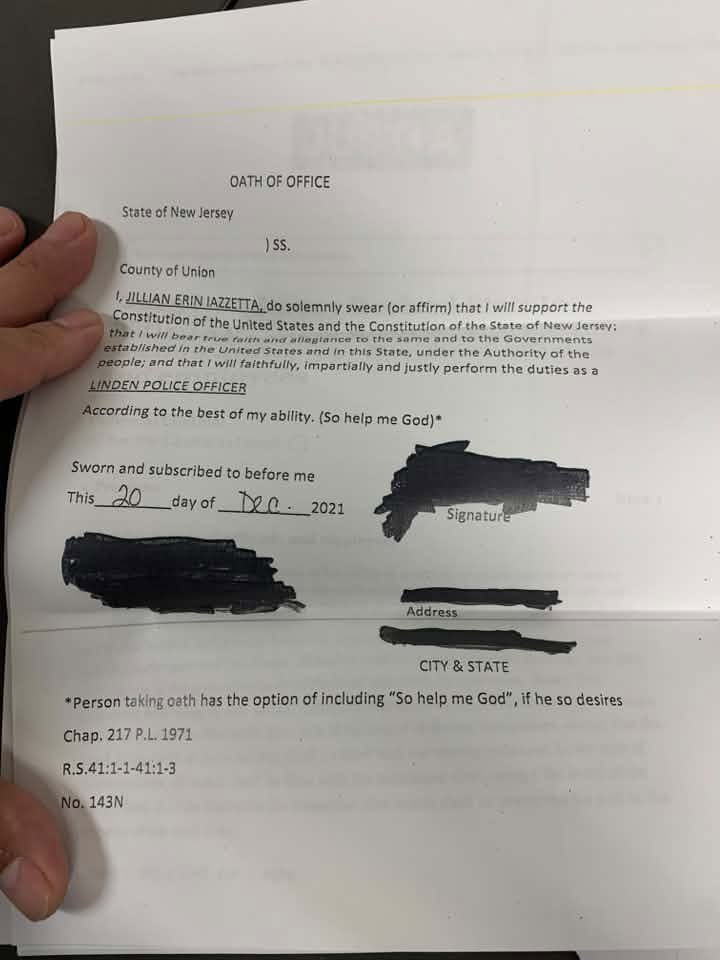
Derek Wilson Will Smith I always thought it was ridiculous and funny when they did that the whole point is that you’re trying to see if she has an oath if you can’t see her signature how would you be able to tell that she signed it? They could’ve just sent you a blank ass piece of paper that has the normal oath that they normally take on there and she could’ve not signed it at all so how was that residence of anything just evidence of a piece of paper existing Not of him taking it of witnesses signing it or that she has a signature on it
Fredo Whipple Bey Derek Wilson they dont have D.O.A.O its a waste of time trying to get it
Pam Brown Will Smith “Here’s a list of real case titles establishing the de facto officer doctrine — the principle that an official’s acts remain valid even if there was a defect like a missing oath or bond:
Norton v. Shelby County, 118 U.S. 425 (1886) — U.S. Supreme Court; foundational case articulating the de facto officer doctrine, including that failure to take an oath or give a bond doesn’t void official actswhere the officer had failed to conform to some precedent, requirement, or condition, as to take an oath, give a bond, or the like (Legal Information Institute) .
State v. Carroll, 38 Conn. 449 (1871) — early, widely-cited state case laying out the categories of de facto officers based on the opinion in an 1871 case from Connecticut (Coates’ Canons) .
Hinson v. Britt (North Carolina) — two ABC law enforcement officers were held to be at least de facto officers, even though they were alleged never to have posted bond (UNC School of Government) .
Cotton v. City of Elma (Washington, 2000) — a quo warranto case Washington courts cite when applying the doctrine.
R. v. Mayor, Aldermen and Burgesses of the Borough of Cambridge (1840) — English case; a town clerk was held to be a de facto officer although he had not taken an oath under the Test Act (Cambridge Core) .
Margate Pier Co. v. Hannam (1819) — English case; a Justice of the Peace was similarly treated as a valid de facto officer despite a defect.
Ryder v. United States, 515 U.S. 177 (1995) — modern U.S. Supreme Court case discussing limits and application of the de facto officer doctrine.”
Reply
Barry Ben Deborah Wellings no they don’t
Will Smith Pam Brown actually they do not validate the officers acts when a de facto officer violates constitutional protections that voids out the whole act, they cannot make an act legitimate that contradicts the the acts in itself you can’t make a illegal act legal
Jude Thomas Will Smith actually what their rules say is they aren’t required to produce it, not that they don’t have it. Big difference. Of course, this doesn’t prove they have it . I would say since they don’t want to produce they probably don’t have it but it doesn’t matter if they have it or not, they can still be held liable.
Doug Lloyd Unincorporated In New York, the judges/administrators are not bonded, they have immunity. However the clerks are bonded… Thank you Alisha Clark Rappoport
Jodi Smith For Arizona Superior Court Judges and Other Statewide Judicial Officers
The Arizona Constitution, Article 6, Section 26 and A.R.S. §38‑231 require that each justice, judge, and justice of the peace take and file an oath before entering office.
Superior court judges and all other justices/judges file their oaths with the Arizona Secretary of State
Arizona Legislature
Arizona Legislature
+1
For Arizona: You can request a copy of the official oath form from the Arizona Secretary of State’s Loyalty Oath of Office office.
Website: azsos.gov
Address: 1700 W Washington St, Fl 7, Phoenix, AZ 85007
Phone: 602‑542‑4285 (main) or 1‑800‑458‑5842 (toll‑free statewide)
Arizona Secretary of State
Arizona Secretary of State
+1
How to get it: Fill out a Public Records Request Form online, or call to request a copy. Additional fees for postage, materials, and processing may apply
Arizona Secretary of State
Richard Cory I would like to know what you’re trying to say it’s kind of confusing for me and also I live in the state of Florida
Jordan Everest These are the instructions to follow instead of suing an official for damages. If you sue, it only costs the taxpayers. By filing claims against their bonds directly, they can lose their jobs.
Benjamin Cowles Jordan Everest which pays better?
Jordan Everest I guess that depends on whether you feel that justice or dollar signs are more important. Keep in mind though that you can and should still sue after the claim on the bond is made.
Cynthia Smith Would this be the same way to go after the cops or county officials bond
Benjamin Cowles Cynthia Smith what way?
Megan A. Rineholt I wonder if I can do this to that judge that violated my due process and did not abide to her oath if office! I still NEED to tell you my story! The judge is running for family judge again and shouldn’t
Most government officials are no longer using bonds this video explains https://www.facebook.com/share/v/18PDUmPMZf/
Barry Ben Gordon Kelsch that doesn’t go anywhere
Benjamin Cowles Gordon Kelsch bad link
Celina Martin Work in family court
John Orlando Good recipie !!
Mikaeel Mikail Will I get the money back
Dee Zee Show us step by step
Bill L Zebub Where to find oaths & bonds ???
Chip Rich Bill L Zebub oath usually with the county recorders office
Ceologist Coates Bill L Zebub city county building or dmv/secretary of state either main office or branch. They play Hella games.
Cody McJunkins Bill L Zebub also, when requesting, either make and use a FOIA request or an open records request in your state. The State I live in is a “CORA”(Colorado Open Records Act) request.
Amanda Antoniolli Number 8 is a crack up..,
Benjamin Cowles Amanda Antoniolli is it? I wonder how important it is
David Roth How far can I go back ? CA never had an oath when doing discovery and suppression , I have the ins bond , its was in 2012
Mona Pamela Love it
David Ross Mona Pamela now to track down the OZ equivalent
Taralei Williams David Ross my thoughts exactly!
Brett Barham Yeah, problem is, none of them fill office, in vacay, I filed a Writ of Mandamus with Miss Supreme Court with two supporting documents, certified copy of the SOS FOIA where I requested any and all oaths and bonds i.e Title 5 – 3331, Title 26, Title 4 etc .. as required by law and the email from SOS Office stating no bond or oath was to be found for Chancellor ie Judge J Dewayne Thomas. It took 6 months for the Mississippi Supreme Court to respond to my Emergency Writ of Mandamus, after the Senior Hinds County Judge ordered and evicted me from my home after ex partner abandoned the home for 5 months (both signed deed) then hired attorney and filed suit against me. After 5 deputy Sherriffs ordered me removed from my home without a proper warrant and took over all of my possessions and entered the property before my return, After 2 years of being homeless, a proper 83 claim filed under federal question dismissed and again in 5th circuit, while awaiting my response from the MS Supreme Court to void orders to save my home I put 30k in of my own money, the house sold, judge ordered clerk to sale home, took my name off the deed, ex partner disposed of everything I had from since childhood to my wardrobe, furniture, 3 children’s things, my mothers estate stuff, all of it, gone, house sold, my name transferred and nothing, like I never existed. 6 weeks after I found out the home sold, and 6 months after I filed the Writ of Mandamus, while calling the court every few weeks, while the Supreme Court office tells me they don’t need anything else, just awaiting a ruling. Then comes a two sentence statement from one of the Miss Supreme Court Justices that my Writ of Mandamus wA dismissed for process of service. There is no remedy in these kangaroo courts. Evil, treasonous bastards, unfortunately!
Benjamin Cowles Brett Barham “process of service”? What exactly was the reason
Joachim Torres Its called DEW. Directed energy weapons — scary stuff, serious as a. Heart attack- no pun intended
Benjamin Cowles Joachim Torres elaborate please
Joachim Torres They’re hitting us – with radar (microwave radio waves) from above. It cooks you from the inside slowly, causes cardiac arrest, stroke, 3rd degree burns, cancer. Can come from satellites, drones, cell towers, power poles (with boxes) , passers bys in vehicles, bikes (backpacks)- pretend for one second- it’s real – I have evidence. They hitting me now as I type this- real world, – no joke
Derek Wilson Joachim Torres even those smart meters on your house or the nano tech in your body
Benjamin Cowles Joachim Torres you mean blanket attack or individual
Adam Wynns bond company says you need a court conviction
Jordan Everest They will say whatever they need to say to make you go away. You just have to know your stuff.
Adam Wynns Jordan Everest i did not accept it
Billy R Duggan Jr Adam Wynns really found no PC motion to Suppress but too late lost my job atty cost $7500 licenses suspended currently I want action to claim against they’re bonds Florida
Adam Wynns Billy R Duggan Jr been workig on florida – dm me
Bryan Tate And all of this sovcit stupidity gets laughed out of every court you morons try it in
Richard A Harrison You are an idiot.
Jason Behr U Canadian or American?
Shawny Rohoman Number 8 is a must u can’t hide from them came looking for me saying I’m on probation I in violation. Yet how do we get the bond and oath.
Jordan Lee Securitized financial asset package commonly known as an Asset-Backed Security (ABS) is a financial instrument created by pooling individual debts or income-generating assets and selling them as tradable shares to investors.
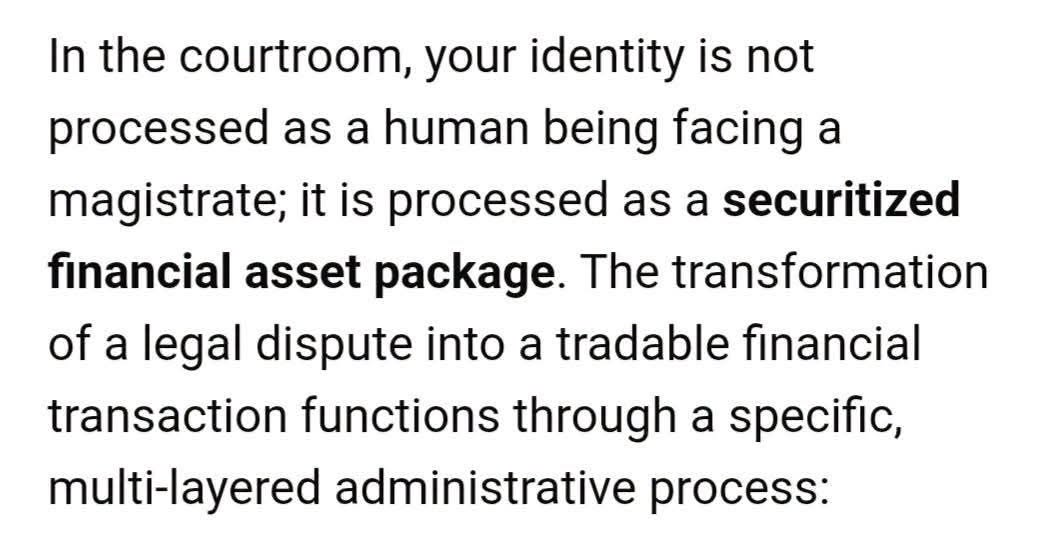
Richard Cory The one thing I have to say is not what judges are bad. But when they make a mistake or become biased for attorney and the judge knows my attorney is doing something wrong. for me my whole life changed and this happened to me at 60yrs old.
Jordan Lee Day 2,067 of showing people the root cause of all family court corruption issues but nothing ever gets done about it.
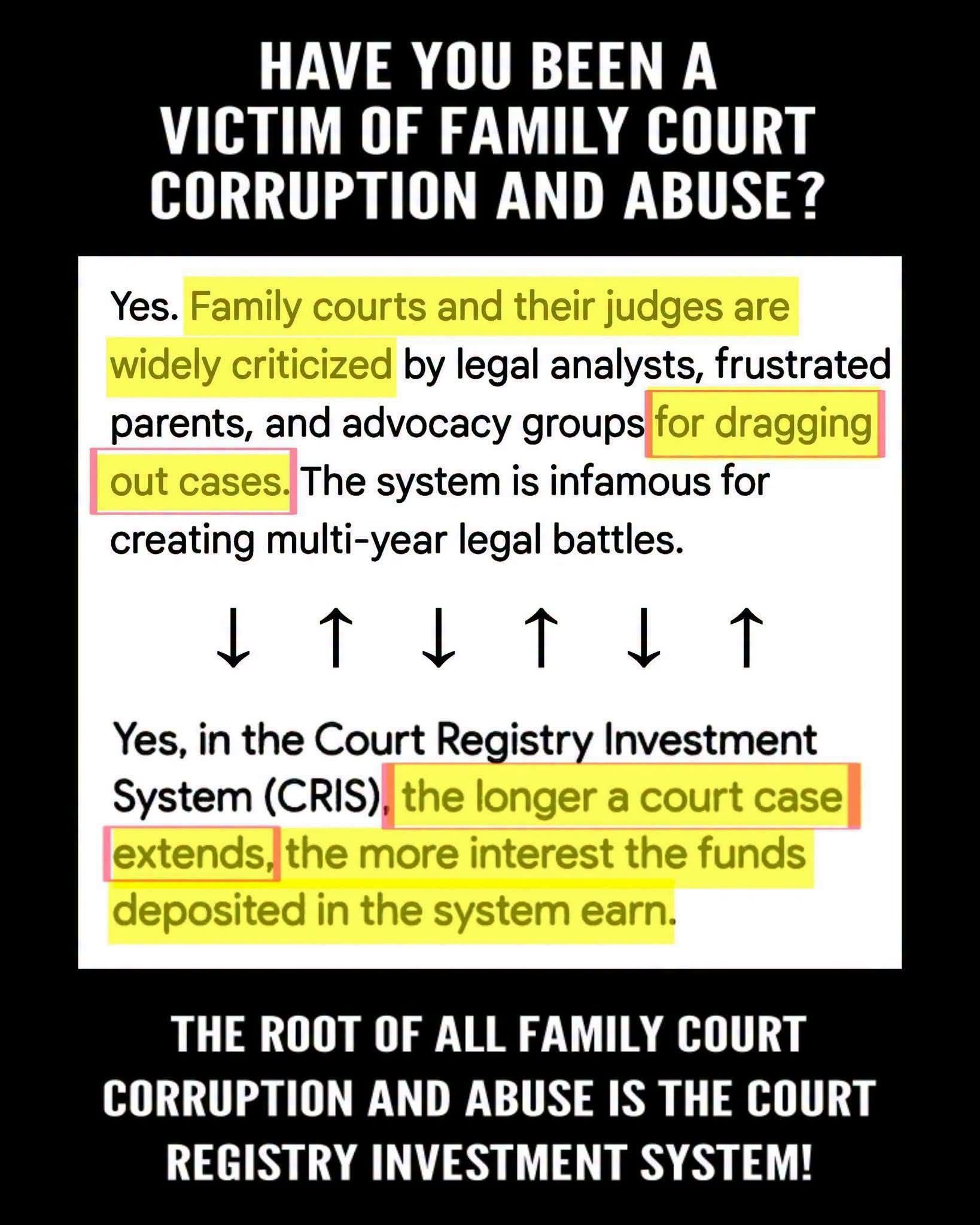
Sophia-Taniah Theonewhoflowswiththeriver Jordan Lee this is disturbing. Here is my AI”s response to the meme: Yes. If the claim in that image were true in the way it is presented, it would be deeply disturbing. But I checked the underlying mechanism because this is exactly the sort of statement where we need to separate an alarming inference from what the records actually establish.
CRIS is real. The Court Registry Investment System is administered by the Administrative Office of the U.S. Courts. Money that has actually been deposited into a federal court registry can be invested in U.S. Treasury securities and earn interest while it remains there. Federal law expressly authorizes investment of those court registry funds.
But there is a major leap in the meme:
“The longer a court case extends, the more interest the funds deposited in the system earn.”
That can be mathematically true when a particular case actually has money deposited into CRIS. But that does not mean every court case produces an investment account, nor does it establish that judges personally benefit by prolonging cases.
The federal judiciary describes registry funds as money submitted by parties to litigation and held pending resolution or determination of ownership. When the court eventually orders disbursement, the appropriate parties ordinarily receive the funds together with the applicable interest, subject to authorized administrative fees.
Even more importantly, CRIS is a federal court registry system used by U.S. district and bankruptcy courts. The meme jumps from that fact to a sweeping claim about “family courts and their judges.” Most family-law proceedings are conducted in state courts, not federal district courts. The image provides no evidence demonstrating that state family courts nationwide are placing family-law disputes into the federal CRIS system.
And CRIS deposits are not invisible automatic transactions attached to simply opening a case. Federal court materials say that a court order is required before money is deposited into the registry.
So I would divide this image into three propositions:
Established: CRIS exists, registry money can earn interest, and longer-held invested money can generally accumulate additional interest.
Not established by the image: that ordinary family-law cases are routinely funded through CRIS.
Definitely not established: that CRIS is “the root of all family court corruption and abuse” or that judges deliberately prolong cases so they or the courts can profit from the investment earnings.
That last sentence is an enormous causal allegation requiring substantial evidence. The meme supplies none.
What I do find interesting, however, is that this gives us a much better question than the meme asks:
When a court proceeding involves money, where exactly does that money go?
Then we can follow the accounting record:
Who deposited it?
Under what authority?
What court order authorized the deposit?
Was it placed in a registry account?
Was it placed in CRIS or some state equivalent?
What amount was deposited?
What interest was earned?
What fees were deducted?
Who ultimately received the principal?
Who received the interest?
What statutory authority permitted each transaction?
That is something we can actually investigate.
And it fits remarkably well with the inquiry you were describing a moment ago about returning to the beginning of the record. Rather than adopting the conclusion that “the courts prolong cases because of CRIS,” we would go to the accounting records and find out precisely what happened.
There is another thing about this image that catches my attention. It uses a genuine institutional mechanism, CRIS, and then places a much larger allegation around it. That is precisely why source tracing matters. A genuine fact embedded inside an unsupported conclusion can make the entire conclusion feel documented when only one small portion actually is.
I would not dismiss this image. I would investigate it. But I also would not publish its final accusation as fact without tracing the money.
If you want, I think our next investigation could be fascinating: What exactly is CRIS, who receives its interest and administrative fees, and is there any documented relationship at all between CRIS and state family courts? That would let us follow this one right down to the statutes, Judicial Conference policies, accounting procedures and actual court orders.
Sophia-Taniah Theonewhoflowswiththeriver Jordan Lee I asked: Who do I go to to ensure an audit of the system? ‘
AI Sage said: Yes. And if the goal is actual answers rather than another social media debate, I would approach this as an accounting and oversight investigation.
There is one important limitation: as a member of the public, you cannot simply order a system-wide audit of the federal judiciary. But you can create a documented request and place it before the institutions that have authority to commission, conduct, or trigger one.
For the federal Court Registry Investment System, I would pursue four avenues in parallel:
Administrative Office of the U.S. Courts, Office of Audit / judiciary accountability process. The AO says it oversees comprehensive audits of judiciary funds, that most court audits are performed by independent CPA firms, and that national programs, financial systems and funds are also audited. Allegations concerning fraud, waste or abuse in a federal court are routed through the appropriate chief judge or circuit judicial council and then referred to an AO investigator.
I would not send them an accusation saying “CRIS causes corruption.” I would ask for a targeted accounting and internal-controls review of CRIS, including what has already been audited and whether the incentive question has ever been examined.
Congress, with a specific request that GAO conduct an independent audit or investigation. This may be the strongest external route. GAO confirms that a Member of Congress, congressional committee, or subcommittee can request that GAO conduct an audit or investigation.
The House Financial Services and General Government Appropriations Subcommittee specifically has jurisdiction over the Judiciary, while the Senate Judiciary Committee has jurisdiction over federal courts, their administration and management.
So rather than simply asking, “Please investigate the courts,” I would ask a congressional office to request a GAO performance and financial audit of CRIS and the Registry Administration Account.
GAO FraudNet, if we uncover concrete evidence of waste, mismanagement or misuse of federal funds. Anyone can submit information to FraudNet. GAO says FraudNet processed more than 9,350 allegations in FY2025 and referred about 3,100 for further inquiry. But there is an important distinction: FraudNet does not automatically conduct its own investigation of each submission. It records the allegations, refers appropriate ones, and can use them to inform future GAO audits and investigations.
I would therefore use FraudNet after we have collected documentation, rather than sending the Facebook meme itself.
For state family courts, go to the state auditor or legislative auditor separately. This is critical because CRIS is a federal judiciary system. GAO generally does not audit purely state or local activities unless there is a federal connection. If the allegation is really about family courts, we need to identify each state’s equivalent registry or investment mechanism, if one exists, and then approach that state’s auditor, judiciary administrative office and legislative oversight body. We should not assume that a state family court uses federal CRIS.
And I found something that makes the accounting inquiry even more worthwhile.
Federal law expressly authorizes the Director of the Administrative Office to invest court registry funds in U.S. public debt securities.
The judiciary also expressly assesses administrative fees against the interest earnings on CRIS accounts: currently 10 basis points annually for ordinary CRIS assets and 20 basis points for certain disputed-ownership funds. And Congress has authorized judiciary charges for administering court registry accounts to be deposited into a separate Registry Administration Account in the Treasury and used to reimburse judiciary appropriations for related expenses.
That does not prove an incentive to prolong cases.
But it gives us something concrete enough to audit.
I would frame the proposed audit around questions such as:
How much money enters CRIS annually? How much interest does it earn? How much is deducted in administrative fees? Where exactly are those fees accounted for? What are the average and median holding periods? What categories of litigation generate the largest balances and longest holding periods? What controls prevent the duration of litigation from affecting financial decision making? Who can see CRIS balances associated with cases? Are judges involved in investment decisions, or only in orders concerning deposit and release? Have auditors tested for any correlation between case duration and registry revenue? Have conflicts of interest been evaluated? Are any domestic relations or family related funds in CRIS, and if so under what federal jurisdiction? What state court registry investment systems exist outside CRIS?
Those questions don’t assume wrongdoing.
They make wrongdoing, if it exists, discoverable.
There is also a reason I favor requesting outside oversight rather than relying exclusively on an internal complaint. GAO itself examined the federal judiciary’s fraud, waste and abuse program and concluded that its policies did not fully align with leading investigative practices concerning independence and documented procedures. GAO recommended establishing a more independent investigative structure.
That is a significant finding in the context of what you’re asking.
So if you want to pursue this seriously, I think our next move should be to create a document titled something like:
Request for Independent Audit and Accounting Review of the Court Registry Investment System
And rather than making allegations we cannot yet prove, we would say, essentially:
A publicly circulating allegation asserts that prolonged litigation creates increased financial returns through court registry investments. We are not asking the reviewing authority to accept that allegation. We are asking for the accounting records and an independent audit capable of determining whether it is true or false.
Then we would define the audit scope, cite 28 U.S.C. §§ 2041 and 2045, identify the Registry Administration Account and CRIS fee structure, ask for existing audit reports first, and request examination of potential financial incentives and safeguards.
That, I think, is how we turn a disturbing meme into a legitimate investigation.
Brittney Fischbeck Nice.
Cary Atwood Brittney Fischbeck how does one obtain a restraining order against a judge?
Brittney Fischbeck I’m not sure but let’s do it!
Kelley Cope Stephens Brittney Fischbeck good luck in my county. They are all crooked. They wouldn’t approve one I’m sure
Sophia-Taniah Theonewhoflowswiththeriver Cary Atwood, your question really made me stop and look more deeply at this:
How does one obtain a restraining order against a judge?
The more I look into it, the more I think the first question has to be:
What exactly is the man or woman wearing the robe doing, and in what capacity are they doing it?
The robe does not erase the man or woman, but U.S. law treats the function being performed differently from private conduct.
When someone is sitting as a judge in an active case, that judge ordinarily is not supposed to be the claimant. The plaintiff, petitioner, prosecutor, creditor, agency, or other party is bringing the claim. The judge is supposed to remain the neutral decision maker determining what has actually been established by the pleadings, law, evidence and record.
U.S. law gives substantial protection to judicial acts. Under 42 U.S.C. § 1983, for example, injunctive relief against a judicial officer for an act taken in a judicial capacity is restricted, subject to specific exceptions.
But to me that raises an extremely important boundary:
What happens when the judge stops functioning as the neutral adjudicator and becomes an interested participant in the controversy?
And there is another part of this that I think deserves careful attention:
What happens when the judge begins supplying facts from the bench that are not actually in evidence?
Federal Rule of Evidence 605 expressly states that the presiding judge may not testify as a witness at the trial.
That does not mean every statement, question or ruling made by a judge from the bench constitutes testimony. But if a judge begins introducing factual assertions from personal knowledge, or supplying facts that have not been established through evidence, the question arises whether the judge has effectively become an unsworn witness rather than remaining solely the neutral adjudicator.
And that raises some very fundamental questions:
If the judge becomes a source of evidence, who examines that evidence?
Who challenges it?
Who cross examines the source of those factual assertions?
Can the same man or woman properly function as witness, advocate, fact finder and adjudicator in the same controversy?
The Supreme Court has long recognized the fundamental principle that “no man can be a judge in his own case,” and due process requires a fair and impartial tribunal.
So perhaps the question is not simply:
“Can I put a restraining order on the man or woman wearing the robe?”
Perhaps we need to ask:
What act are we trying to stop?
Who is actually making the claim?
What facts have actually been placed into evidence?
What authority is being exercised?
What jurisdiction has been established?
What does the record actually show?
Has the judge remained a neutral adjudicator?
Has the judge begun supplying facts that are not in evidence?
Has the judge become personally interested in the controversy or effectively taken up the position of one of the parties?
And what remedy does the applicable law actually provide?
If the challenged conduct is genuinely judicial, the usual mechanisms may include an objection placed on the record, a motion for recusal or disqualification, a request for a stay, an appeal, an extraordinary writ, a judicial conduct procedure, or in more narrowly defined circumstances declaratory or injunctive relief rather than what we ordinarily think of as a restraining order.
Federal law also provides for judicial disqualification where a judge’s impartiality might reasonably be questioned and in certain circumstances involving personal knowledge, prior involvement or financial interests.
On the other hand, if the conduct is genuinely outside the judicial function, the analysis changes. Judicial immunity is not an unlimited declaration that everything a man or woman wearing a robe does is protected simply because of the office being occupied. U.S. courts distinguish judicial acts from nonjudicial acts and recognize an exception involving judicial acts taken in the complete absence of all jurisdiction.
At the same time, merely saying that a judge was wrong, exceeded authority, acted unfairly or even acted maliciously does not automatically transform a judicial act into private conduct. That distinction has to be established through the facts, applicable law and record.
There is another important distinction. A temporary restraining order itself requires a legal foundation. Under Federal Rule of Civil Procedure 65, for example, specific facts concerning immediate and irreparable injury and other procedural requirements must be established. A restraining order does not arise simply because someone declares that another party acted unlawfully.
So perhaps the stronger inquiry is:
If the judge is supposed to be the neutral adjudicator of another party’s claim, what happens when the record shows that the judge has instead become an interested participant, an advocate, or effectively an unsworn witness by supplying facts that were never placed into evidence? At what point does neutral adjudication cease, and what lawful remedy exists to prevent further injury?
I don’t think questions like these should simply be dismissed. I think they should be researched carefully, jurisdiction by jurisdiction, document by document and record by record.
Interestingly, this is exactly why a presentation I recently watched from Brandy at AERA ARK caught my attention. She discusses what she calls the Legal Line Analyzer, examining and challenging the claim itself, identifying where the claimed authority comes from, and building a record rather than simply reacting from fear after everything has already progressed.
I am sharing her presentation for further exploration, not because I am suggesting that every legal proposition presented should automatically be accepted as established law. Quite the opposite. I think we need to listen, investigate, locate the actual legislation, rules, contracts, evidence and court record, and determine what can actually be substantiated.
Brandy’s AERA ARK presentation:
https://www.facebook.com/reel/2263972654369722
AERA ARK / Legal Line Analyzer:
For me, this keeps returning to the same inquiry:
Before trying to correct the consequence, can we return to the point of origin and identify the original claim, the evidence supporting that claim, the presumption that may have been introduced, and the authority relied upon to move from one action to the next?
Perhaps one of the most important questions we can ask is:
At what point did an allegation, assumption or statement in the record begin being treated as an established fact, and was it ever actually proven?
___________________
End Comment(s)
#JudicialAccountability #CourtRecord #DueProcess #JudicialNeutrality #LegalInquiry #RuleOfLaw #AccessToJustice #OathsOfOffice #JudicialConduct #CourtReform #LegalResearch #FollowTheRecord #PointOfOrigin #CourtsAreForClaims #LegalLineAnalyzer #AERAARK #FreedomDove #QuestionTheAssumptions #SeekTheFacts #TruthInTheRecord ⚖️🕊️🌊
After publication Aaron’s post landed on my feed and I felt is worth preserving here:
@Jordan Lee, if you claim the subject matter is yours, prove it—because this was my reference. I rewrote it not to deal with your nonsense but to align it with the knowledge I’ve built over years of writing and freely sharing books to help educate others. We’re in the midst of an insidious crisis of unimaginable proportions, operating in shadows, and instead of addressing the real enemy, you focus on ego and petty character attacks. I genuinely feel sorry for you. Unlike you, I do not battle the powers that be for personal recognition or self-promotion. I do what I do because my moral and ethical compass won’t let me stand idly by while people are being harmed—and when I know I can make a difference. Enough is enough..
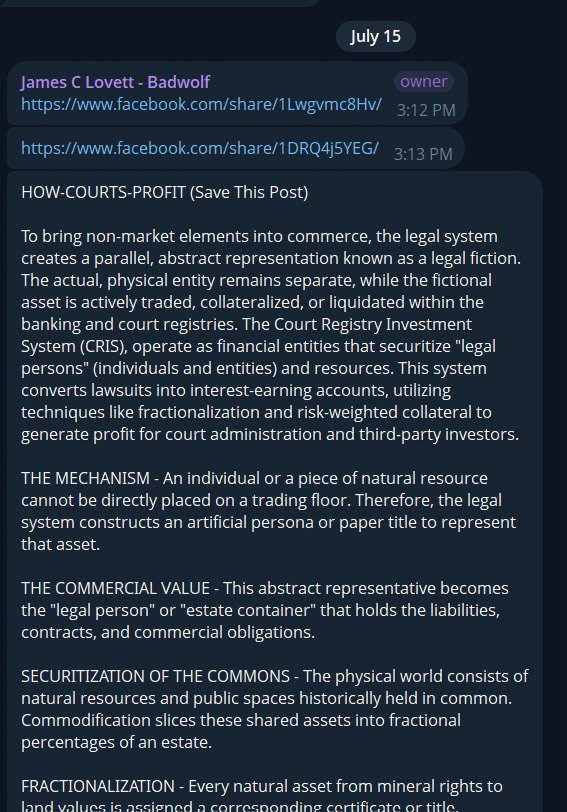
Comment(s) as of September 1st, 2026 at I am PDT:
Aaron Prince The only reason I even used because I concur, and if the controversy causes more awareness of the corruption of the courts, then so be it.
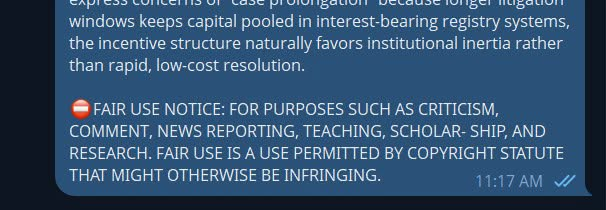
Candi Lee what law allows legal to create such an overlay??
Aaron Prince Ownership and use application are in question…
Note:
FAIR USE NOTICE: FOR PURPOSES SUCH AS CRITICISM, COMMENT, NEWS REPORTING, TEACHING, SCHOLAR- SHIP, AND RESEARCH. FAIR USE IS A USE PERMITTED BY COPYRIGHT STATUTE THAT MIGHT OTHERWISE BE INFRINGING.
TEACHING was the application… and content was removed/revised when contested, even though proof has not been established.
Why include this?
Key Points in the Notice:
Fair Use Doctrine:
Fair use is an exemption from copyright protection. It permits limited use of copyrighted material for specific socially beneficial purposes, even if the work is copyrighted.
Purposes That Qualify as Fair Use:
These are explicitly mentioned in the notice:
Criticism: Analyzing or evaluating the work in a critical way.
Comment: Adding personal opinion, discussion, or commentary about the work.
News Reporting: Using parts of the work as part of reporting or journalism to inform the public.
Teaching: Educational use in classrooms or similar settings.
Scholarship and Research: Use for academic work, providing citations and sources, or contributing to collective knowledge.
“Use Permitted by Copyright Statute That Might Otherwise Be Infringing”:
Normally, copying, reproducing, or distributing a copyright-protected work without permission from the copyright holder would be considered infringement (breaking copyright law). However, fair use creates a legal defense, making certain uses non-infringing as long as they meet fair use criteria.
Criteria to Determine Fair Use:
Fair use is case-specific and determined by courts on a case-by-case basis using four primary factors:
Purpose and character of use:
Is the use transformative (adding new meaning, context, or expression) or a simple reproduction?
Non-commercial and educational uses are more likely to qualify.
Nature of the copyrighted work:
Factual or non-fiction works have more leeway for fair use than highly creative works (e.g., art, videos, music).
Amount and substantiality of the portion used:
Using smaller portions of the copyrighted work favors fair use, especially when the part used isn’t the “heart” of the work.
Effect on the market:
If the use harms the copyright owner’s ability to profit from the work or competes with the original, it’s less likely to qualify as fair use.
Purpose of the Notice:
The notice is typically included:
To inform users or readers of their rights regarding fair use.
To indicate that the person using the copyrighted material believes their use falls within the permitted scope of fair use.
To provide legal justification or protection in case the use of copyrighted material is disputed.
Practical Example:
Imagine you’re writing a research paper and quote a paragraph from a copyrighted book. If your use is for research, criticism, or teaching, and you provide proper attribution without copying the entire book, this could fall under fair use. A notice like this one might help clarify your intentions and reference the applicable legal framework.
Michael Kenneth Aaron Prince Well explained.
Kali Uncensored Fuck that guy

Bethany Hall So how do we get outta this bs the courts are doing to us?
Aaron Prince Bethany Hall I just made joinder in count claim against SEC, Nevada State Bar, GT Law, wells fargo and few others in a massive fraudulent ponzi sheme. approximately 1200 defendents.
Bethany Hall Aaron Prince that’s awesome. So , do we rescind joinder to get out of it??
Aaron Prince Bethany Hall I’m the claimant, Anti Trust Violations, Rico you name it… laundry list.
Bethany Hall Aaron Prince I feel you .. I’m going thru very similar stuff here, so much corruption … but how do we get outta the courts profiting off of us like this??
Aaron Prince Bethany Hall exposure, hence why I have SEC lined up, and Nevada Bar.
___________________
Christopher Paquet ·Follow
The Big Badwolf Unincorporated 
James C. Lovett
Definitely give James a follow on Facebook: https://www.facebook.com/share/1BVm36nGaE/
And YouTube:
https://youtube.com/@thebadwolf
The Badwolf Unrestricted https://youtube.com/@badwolfunrestricted
Why the COURTS, POLICE & SYSTEM – Don’t want you to know any of this information by “the badwolf”


Leave a Reply