
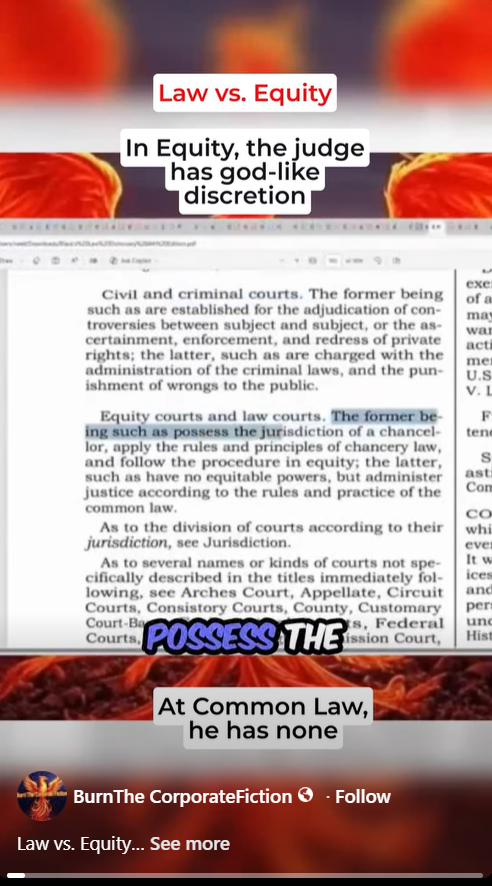
Commentary inspired by a video shared on Facebook by BurnThe CorporateFiction / Kirk Pendergrass. Shared here for study, discussion, and critical examination.
I recently watched a short video shared by Kirk that raised an old but important question: what is the difference between law and equity, and why does that distinction still matter today?
The historical distinction is real. In the Anglo-American tradition, courts of law and courts of equity developed differently. Courts of law were associated with established legal rules and traditional remedies, while equity developed to address situations where a strictly legal remedy was inadequate. Even the U.S. Constitution preserves that distinction by extending the judicial power to cases “in law and equity.”
At the same time, we need to be careful not to overstate what that means in modern practice. In federal court, the 1938 Federal Rules of Civil Procedure merged the forms of civil action and procedure, creating “one form of action”—the civil action. That merger did not abolish equity as a body of thought or remedy. It meant that separate procedural tracks were unified. Equitable remedies, such as injunctions and specific performance, still exist.
This is where many discussions online start to blur categories. It is not accurate to say that every modern court proceeding is secretly “just equity,” or that the absence of a private injured party automatically transforms a matter into equity. Criminal law has long been understood as addressing public wrongs prosecuted by the state, while equity is usually discussed in relation to civil remedies.
The same caution applies to the claim that judges in equity have unlimited or god-like discretion. Equity has always involved discretion, but not lawlessness. Judicial discretion still operates within principles, doctrines, rules, and review. The question is not whether discretion exists, but how it is being exercised and whether it remains tethered to justice.
What I do appreciate about the video is that it pushes people to stop assuming that every courtroom word means what ordinary language suggests. “Law,” “equity,” “record,” “jurisdiction,” and “person” are not casual words in legal systems. They carry history, doctrine, and consequence. For that reason alone, the invitation to slow down, verify, and study is worthwhile.
For me, the deeper value of this conversation is not in adopting blanket formulas, but in becoming more conscious and more discerning. If we are going to question power, then we should do so carefully. If we are going to challenge assumptions, then we should ground ourselves in both truth and precision. Real concerns deserve more than slogans. They deserve clarity.
So yes, the distinction between law and equity is real. Yes, it still matters. But the path forward is not to repeat every viral claim untested. It is to study deeply, speak carefully, and keep asking better questions.
Here is the link to the video for those people with a Facebook account: https://www.facebook.com/reel/1262294805789294
Intro text from post/video:
Law vs. Equity
“In order for a court to be a court of law, it has to proceed according to the course of the Common Law. If it is not a court of Common Law, then they are not enforcing law; they are adjudicating trust disputes in equity.”
Here is the verbatim Turboscribe AI video transcript:
Speaker 1:
Okay, so, equity courts and law courts: the former being such as possess the jurisdiction of a chancellor, apply the rules and principles of chancery law, and follow the procedure in equity; the latter, such as have no equitable powers, but administer justice according to the rules and practice of the common law.
Look at that. It tells you right there: law courts, rules and practice of the common law. Boom. That simple.
If it’s not law, if there’s no victim, you must be in equity. And how do you end up in equity? Contracts.
Exactly. Because all rights are derived from property, right? And if it’s just a whole nation of pauper infants under administration, well, there’s no use in courts of law.
And that’s what they figured. So they just abolished. What they said is that, “We abolished the distinction between law and equity in 1938.”
But you can’t do that because they’re two—like, equity is not even law, first of all. If it was law, they wouldn’t distinguish it from law, right? Article III, Section 2 of the Constitution says that, basically—what does it say?
The judicial branch shall have jurisdiction in all cases in law and equity. And equity—yeah—different things.
And you can’t abolish the distinction because equity exists only to supplement law, meaning it deals with the things law literally cannot deal with, like implied contracts and trust fictions. That’s it. That’s why equity exists.
Because, like he says, the court he went to, they keep a transcript, but that’s not considered enrollment on the record. And they tried to play on that confusion too. Because if you ask, “Does this court keep the record? Is this a court of record?” Right? Which I’m pretty sure Mojo, or somebody—somebody did this—and the court said to them, “We keep a record.”
Well, that’s not what I asked you. I didn’t ask you if you keep a record, right? Your transcript.
I said, “Is this a court of record?” Because it’s not. It’s an inferior court, a special court, a very limited jurisdiction, right?
And they’re adjudicating a breach of trust. Yeah, that’s it. They’re basically like arbitrators.
They’re adjudicating a breach of trust, a claim against the United States for misuse of trust property by one of its agents, which would be you.
Here is the introduction and comments published on BurnThe CorporateFiction and shared on Kirk Pendergrass Facebook page:
Law vs. Equity
In order for a court to be a court of law, it has to proceed according to the course of the Common Law. If it is not a court of Common Law, then they are not enforcing law, they are adjudicating trust disputes in Equity. They have locked your estate into a trust under their administration by removing lawful money thereby making you a pauper and have removed your access to courts of Common Law by mortgaging your property rights in 1933.
See less
Comments
Dre Vaksdal Beneficiary Yep… And that contract is a trust … And you’re holding equity by nature… The courts hold equity in characteristics… Breach of trust
Vincent Warren Equity is the source of law lol. Not subordinate to law. “And law cant deal” they’re scamming you
Martynas Cross Equity is justice?
The law set in trust as right terms and breach cannot be criminal but civil?
The argument is they cannot call it criminal in equity administration considering right from wrong.
Scott TwoBears This goes back to the old laws of the sea, and when a ship, its captain and crew were no less than 12 miles from shore, the captain became a god-king over the bank/vessel/court and its crew/those among the ship considered a ship in dry dock/court house. Have you noticed that all court houses are always by a water way, a river, etc. And by the use of surveyor meridians they can survey any building and dependent upon which meridian they use, that building could actually be surveyed and placed upwards of 3000 miles off shore, or at least 12 miles to give the judge/bank/captain those powers you mentioned being that of a god-king (lowercase g) . Appreciate your videos.
Terry Belden Not true, they are adjudication disputes in commerce. Which is in the constitution.
True equity is about honor and a separate juris from common law and commerce.
In equity you cannot argue facts, jurisdiction, law or venue.
Solar Man Terry Belden so what commerce are they adjudicating when they tell you you can’t travel in your own car.
Terry Belden Solar Man if you have a birth certificate, drivers license, social security account, registered for selective service, these are all contracts with hidden adhesion clauses that cancel your natural rights.
Essentially the american people have contracted their rights away.
Solar Man Terry Belden so you say you cannot argue law, do how is their supposed law enabling violence if there is no law in the court
Terry Belden Solar Man everything is commercial, so you appear as the accounting defendant and discharge it through the federal reserve window.
You will need to study post 33 equity.
Terry Belden Solar Man maxim of law, local custom supercedes the common law.
Local custom is commerce, common law is constitutional law.
But there is no maxim stating anything supercedes equity.
Terry Belden Solar Man forget about the right to travel, you contracted that away long ago.
Monfort Lane Terry Belden The statement on equity is true, you read it as printed in a substituted counterfeit constitution for the genuine 1st constitution assembled in convention to form the laws in behalf AND by the authority of the people.
Judicial department in my genuine 1844 constitution says,
The district courts shall consist of a judge, [no such thing as a magistrate, not until 1968] BE ELECTED by qualified voters, and a term of 4 years
The district court shall be a court of LAW AND EQUITY, and have jurisdiction in all CIVIL AND CRIMINAL matters.
Judges of the district court shall be “conservators of the peace”
The style of “ALL” process shall be “The State of Iowa” AND “ALL” prosecutions shall be in the name and by the AUTHORITY of the same!
Find your genuine constitution for facts, not from substitutes or good enough rules.
Terry Belden Monfort Lane if you want remedy, you need to use post 33 equity.
Pre 33 will not help you
Autodavid Autoknutsen “you” 20cfr§420.402 very interesting read for eyes that see.
Rex Weneer Begg daddy look so good on oklqwears Korean beggers fagits pussys x sluts and kangaroo court daddy never going be there now cry like a little bitch
Jeff Louck They are courts of equity
Steven Huffman 28 USC 454
Crystal Huffman Dear Jesus Christ God Almighty and Mother Mary
Ajayvir Singh Attri Nice information
Scott TwoBears Commercial equity is quite different from true equity, correct?
Toni Beauchesne Oh well, as a Fring flag theorist myself, I must say the difference between equity law and criminal law is the one you go to jail. The other is money or property compensation for violation of your rights equity law means what you were deprived of cannot be replaced, but money is used to compensate criminal law is a jailable reasonable offense at the end of the day they are both law and equity law does not require a contract a civil rights violation is a equity jurisdiction.
Monfort Lane 1844 genuine constitution for the State of Iowa Judicial Department Article VI
sec. 1 The judicial power shall be VESTED in a supreme court, district court, AND such other INFERIOR courts as the legislature may from time to time establish
4 The district court shall consist of a judge, be elected by the qualified voters and hold his office for the term of four years.
The district court shall be a court of LAW and EQUITY and have jurisdiction in ALL civil and criminal matters. The judges of the district courts shall be conservators of the peace in their respective districts.
This constitution is not authentic had been changed in 1968.
Article V Judicial Department
1 The judicial power shall be vested in a supreme court, district courts. AND such OTHER courts, INFERIOR to the supreme court, as the GENERAL Assembly may from time to time establish.
6. The district court shall be a court of law and equity, WHICH SHALL BE “DISTINCT” and “SEPARATE JURISDICTION” and have jurisdiction in civil and criminal.
Aaron Heinlein Monfort Lane what are you saying?
Blake Anthony I really hope there’s loopholes like this when they finish the A.I. Data centers and have A.I. Govern for them. I heard they’re erasing Common Law by doing so. I fear this!
William Cornwell Blake Anthony that’s exactly their plan that will be nobody beat to be held accountable for what’s to come they want AI to be their new government and God
Blake Anthony William Cornwell i figured so lol. Fuck em.
Eddie Fields That’s a lie and it’s fake laws.
Wic Neal The “Court of Record” is whatever “record” has been placed in the hands of the “Clerk of Court” to be put on the “Record”. It is not: a “Superior Court”, “State Court”, “Federal Court”, “District Court”, “Federal District”, “Appellate Court” nor is it the “Supreme Court”. Simply my 2 cents. Aloha!
Wic Neal We simply lack our 12 “Witnesses” also called “Jurors”, and in the BIBLE they are called “Witnesses” in the Old (or First and only) Testament, and “Disciples” in the New Testament (Better referred to as “Fake Testament” or “Roman Testament”). Again, simply my 2 cents. Aloha nò
Pat Smith BRITISH * COLUMBIA LAW & EQUITY ACT * SEC 62

Kate Trueman asset stripping


Pat Smith LAW AND EQUITY * CONTRACT & UNJUST ENRICHMENT * JUSTICE & MERCY
Pat Smith ITS ALL CORPORATE FRAUD
![May be an image of text that says "2:23 scribd.com [SCRIBD] Search These documents are about "CANADA" ... Read more Download S-K/A 18-K/A d324527d18ka.htm htps/ww.w.eakera 18-K/A FORM 18-K/A AMENDMENT 0.2 For Foreign Govermentsan seoisv Thereof SECURITIES AND EXCHANGE COMMISSION ANNUAL KEPOKT CANADA Registrant endofbast bastf calvear. March3 SECURITIES TESREGIST 2011 Time Issue N/A shlebregbstrutioa registration ene Name Name eschangesen which registered Canadian EHONOU uthorized receive DOER ccunisSiOn: America Pennsylvania Anne N.W WAYNE FOSTER Copies Finascial Marters Division Department , DON DONWILSON Comulate បតអញា Canada Americas Amerkas L'Esplanade orStreet တ Laurier Ottawa, Ontario OG5 ROBERT MULLEN nec uP Hadley Chase Machattan Plaza Overview Related documents Download"](https://scontent-sea1-1.xx.fbcdn.net/v/t39.30808-6/631672405_122247113900175328_1460837120711301862_n.jpg?stp=dst-jpg_p100x100_tt6&_nc_cat=106&ccb=1-7&_nc_sid=a0f3c3&_nc_ohc=S3pHTP6op50Q7kNvwEA0NDb&_nc_oc=Adk8INnNWq1_Kt1VHs3IDi05jToLxp_pbSpfzW1ReQ3wMllX5hgXw1hs9UF32eNrxWs&_nc_zt=23&_nc_ht=scontent-sea1-1.xx&_nc_gid=Q9sCJTg_WNFlhQvrV_bisQ&_nc_ss=8&oh=00_AfyZvLHl-aWFR1y_uCY5G8SmKH9OauN3n2gxwXRKC8ZbNg&oe=69BEC6A8)
ALL STATES ARE COMMON LAW EXCEPT LOUISIANA

______________________
LawVsEquity #CommonLaw #Equity #Jurisdiction #CourtSystem #DueProcess #LegalHistory #LanguageMatters #CriticalThinking #FreedomDove
 Freedom Dove
Leave a comment