
Monday, the 28th day of Tishrei, 5786 (10/20/2025)
When I realized the world wasn’t what I thought, I began studying how the system around us actually operates. The learning curve has been steep, sometimes painful, and often eye-opening. I’m sharing this piece to help others avoid the detours I took.
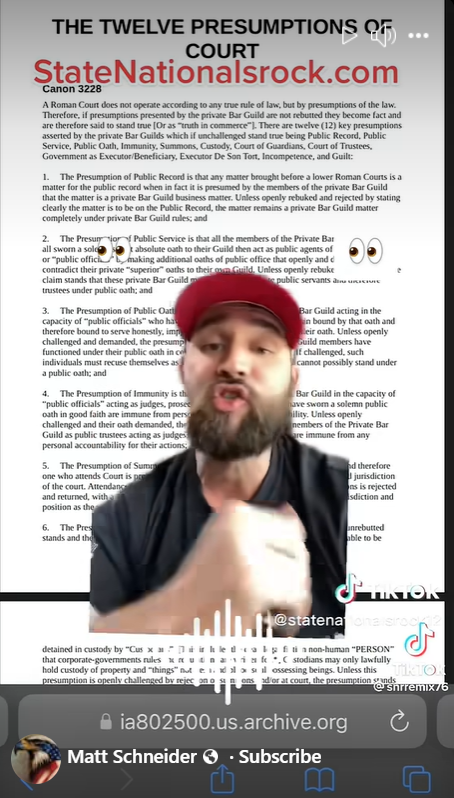
A short TikTok on the “10 presumptions of law” crossed my feed. Parts of it sounded helpful; other parts triggered alarms. So I transcribed the clip and asked my trusted AI assistant, Sage, to test each claim against what courts really do.
Below you’ll find:
• the full transcript;
• a plain-language analysis separating useful doctrine (like “fruit of the poisonous tree”) from common myths (like ALL-CAPS name theories);
• the comment thread snapshot (as of October 20, 2025); and
• two one-page tools you can adapt today—a suppression-motion skeleton and a recusal/mandamus checklist.
This is not legal advice. It’s an invitation to think clearly, act honorably, and use remedies that work.
Link: https://www.facebook.com/reel/2263702760792381
Video transcribed using turboscribe not verified correct please listen to the TikTok video link above
Oct 20, 2025, 4:54 PM
The judge shuts the prosecution down immediately. Your Honor, I know Mr. Steele has an interpretation of the language of the order. I think his interpretation is right.
I’m just going to tell you that. I mean, look at the way it’s capped. It’s styled and everything.
And it makes sense with what you’re asking me to do is kind of just narrowly look at the marijuana and not anything else. He challenged everything that was taken at that particular point in time. And it’s clear in the transcript that he did, in fact, assert the fruit of the poisonous tree.
You hear a judge say it. He asserted a fruit of a poisonous tree. He said styled.
He said capped. Let me show you what all three of those are. And you hear it from a judge’s mouth.
Make up your own mind. Don’t listen to me, anybody else. Make up your own mind.
See for yourself. This is all capped. All capital letters.
That is defined in the government style manual or the English style manual. It’s a government manual of punctuation, capitalization. What does it mean in law? He says it’s styled in all caps.
You see, he’s rebutting a presumption. In court, there’s this thing. It’s called the 12 presumptions in court.
They presume that you have a contract with them and that you’re underneath their subject matter jurisdiction, right? Most of these laws held against you where there’s no victim is called non-positive law. Non-positive law can be defeated by two things. Rebuttal or contradiction by positive law.
I know that sounds a little bit tricky. It kind of is. Once you get it, it’s not that tricky.
Basically, the government’s assuming or presuming you have a contract with them and therefore you’re underneath their authority. But, there’s the but. If you can rebut that presumption and provide admissible evidence in court, this is all from fruit of a poisonous tree.
You provide this admissible evidence in court, which is just a proper process of a document that’s in, it’s not paragraph 2. I said paragraph 2 in the last video, but chapter 2 of this book is what you’ll find in chapter 2. Affidavit of Truth, Assertory Oath, Repudiation and Revocation of Citizenship. So, what this does is once you see all the corruption of the corrupt corporation and what it’s done. I mean, you literally see it for what it is.
All the things pretty much basically done wrong to we the people that’s been given out through the Freedom of Information Act. It is your right to say, hey, I don’t agree with that. Since you put it out there that you did this to us.
Like, for example, the Tuskegee experiments. They released that they did that to the people. And how bad that was and how we don’t agree.
So, it’s in this document. And so is anything else you would like to put. And that is how you write that you don’t consent to what government’s doing.
And it does hold up in court because you just saw it. That’s how you remove consent. Now, you have the right to self-determination.
This also allows you to do self-determination. This is our step 1 that we offer help with. So, while people say it’s not real, clearly that judge says it’s real.
Be the change you want to see.
Comments:
Dennis Powell This\n Is insanity just remove the g****** judge? This is crazy. Enough enough!!!
Brandon Clanin That’s one you will not here much cited by Judge in court!!! Amen!!! El Shaddai!!!
Trey Johnson I thought it was positive law, as in added prohibitions and such? Non positive or whatever you said doesn’t make sense to me, maybe l learned wrong?
What if I’m a felon, with no violence on my record, but got caught with a fire arm In my house,no new charge just a felon without violence?


Sarah E. Sahnd Yeah but she’s a black judge and the white judges are going to eat you for breakfast no offense. 


Jaime Garcia The powers that shouldn’t be will erase those types of rare honest “judges”
Johari Muñiz Capitis diminutio maxima
Dean Hulsey Where’s the closed caption??
Johari Muñiz Do you have the video of Michael Thor
_______________________________
Recommendations from my trusted AI, Sage:
Got your doc and read the transcript. Here’s a crisp, use-what-matters breakdown.
What the clip actually claims (from your transcript)
- The judge referenced things being “capped” and “styled,” and said the defense asserted fruit of the poisonous tree.
- It then treats ALL-CAPS styling and a “government style manual” as legally significant.
- It asserts “12 presumptions in court,” contract/jurisdiction presumptions, and that “non-positive law” can be defeated by “rebuttal or contradiction by positive law.”
- It recommends an “Affidavit of Truth / Assertory Oath / Repudiation and Revocation of Citizenship” as the way to revoke consent and gain “self-determination.”
What’s legally solid vs. not
Solid (use this):
- Fruit of the poisonous tree is real Fourth-Amendment doctrine (exclusionary rule). You use it in a motion to suppress; if the initial search/seizure was unlawful, derivative evidence is excluded—subject to exceptions (independent source, inevitable discovery, attenuation). Scholarly Commons+3Legal Information Institute+3Justia Law+3
Not solid (treat as myth/misapplied):
- ALL-CAPS names / “styled” captions do not change anyone’s legal status. Caps are typography governed by style guides (e.g., GPO Style Manual) and captioning conventions; they carry no jurisdictional meaning. Courts routinely reject “strawman/all-caps” theories. GovInfo+3GovInfo+3GovInfo+3
- “12 presumptions in court.” There’s no official list. U.S. law handles presumptions through the Rules of Evidence (mainly civil), which define how a presumption shifts the burden of producing evidence; there isn’t a catalogue you “rebut” to escape jurisdiction. Legal Information Institute+2Legal Information Institute+2
- “Non-positive law” = not enforceable (or collapses if you just “rebut”). No. “Positive law codification” is about codification method; both positive and non-positive titles contain enforceable law. Non-positive titles are prima facie evidence of the Statutes at Large; conflicts are resolved by looking to the underlying statutes—not by a blanket “rebuttal.” U.S. Code+2Legal Information Institute+2
- “Repudiation and Revocation of Citizenship” to remove court authority. Renouncing U.S. nationality is a narrow statute-driven process (8 U.S.C. § 1481) overseen by State; it doesn’t retroactively nullify criminal jurisdiction over conduct or obligations. Affidavits of “non-consent” don’t opt you out. Legal Information Institute+2Travel Advisories+2
How to turn this into something useful for a live case
1) If there’s a bad stop/search, file a Motion to Suppress (fruit-of-the-tree).
Include: (a) precise timeline; (b) what was illegal (no probable cause, bad warrant, etc.); (c) the evidence to suppress as “fruit”; (d) law (exclusionary rule + exceptions); (e) application to facts; (f) requested order. Legal Information Institute
2) If a judge truly won’t rule or there’s a concrete conflict, use the proper vehicle.
- Recusal/affidavit of prejudice under the state’s rules (then pursue the built-in review route).
- Mandamus/prohibition (extraordinary writs) to make a lower court perform a clear duty (e.g., rule on pending motions) or to halt an ultra vires act—not a “public notice.” (We can tailor this to the forum you’re in.)
3) Rebut the real presumptions that actually show up.
Examples: presumption of service/mailing → rebut with concrete delivery logs; presumption of regularity of official acts → rebut with missing oaths, unsigned charging instruments, or docket gaps; presumption a warrant is valid → rebut with defects in oath, particularity, or staleness. (These live in evidence and procedure—not typography.) Legal Information Institute
4) Keep ADA requests concrete.
Cite Tennessee v. Lane for access-to-courts and ask for the specific accommodation you need (e.g., real-time transcript access, reserved seating, extra time)—not universal recording rights. Justia Law+1
TL;DR for your transcript
- Use the fruit-of-the-tree part → real and powerful when facts support it.
- Ignore the ALL-CAPS / “12 presumptions” / “non-positive law falls to rebuttal” / “revocation of citizenship” bits; they aren’t how courts work and can undercut credibility.
If you want, I’ll turn this into:
- a one-page suppression motion skeleton (with the right headings and case law slots), and
- a one-page recusal/mandamus checklist you can reuse.
______________________________
Here are the template documents use at your own discretion. None of this constitutes legal advise
Absolutely, Sophia. Here are two clean, copy-paste one-pagers you can drop into your doc and tailor fast.
1) Motion to Suppress — one-page skeleton
[HEBREW DATE] / [GREGORIAN DATE]
[COURT NAME]
[COUNTY], [STATE]
[Plaintiff] v. [Defendant: Your full chosen name]
Case No. [########]
MOTION TO SUPPRESS EVIDENCE AND ALL FRUITS; REQUEST FOR EVIDENTIARY HEARING
Relief Requested
The defense respectfully asks the Court to (1) suppress [itemized evidence: e.g., firearm, statements, phone data], and (2) suppress all derivative evidence as “fruit of the poisonous tree,” with an evidentiary hearing.
Key Facts (concise timeline)
• [Date/Time] – [Officer/agency] initiated [stop/entry/search] at [location].
• Basis asserted: [e.g., “equipment violation,” “anonymous tip,” “warrant #____”].
• What happened: [1–3 bullets: detention length, frisk/vehicle search, consent claimed/denied, seizure].
• Evidence obtained: [list].
• Any warrant? [Yes/No]. If yes: obtained at [time], by [affiant]; key defects: [lack of oath/particularity/staleness].
• Statements: [Miranda given? Y/N; circumstances].
Argument
A. Initial seizure/search was unlawful.
– No reasonable suspicion/probable cause supported the stop/search; the detention exceeded the mission/time limits; consent (if claimed) was not voluntary or was tainted.
– Authorities slot: [Terry v. Ohio, ___ U.S. ___ (1968); Rodriguez v. United States, ___ U.S. ___ (2015); state analogs].
B. Any warrant was invalid or executed unlawfully.
– Defects in oath/particularity/staleness; or material falsehoods/omissions require a Franks hearing.
– Authorities slot: [Franks v. Delaware, 438 U.S. 154 (1978); Groh v. Ramirez, 540 U.S. 551 (2004); state cases].
C. Fruits must be suppressed.
– Evidence and statements derived from the illegality are inadmissible absent a recognized exception.
– Authorities slot: [Wong Sun v. United States, 371 U.S. 471 (1963); Brown v. Illinois, 422 U.S. 590 (1975) (attenuation factors); Utah v. Strieff, 579 U.S. 232 (2016); Segura v. United States, 468 U.S. 796 (1984); Nix v. Williams, 467 U.S. 431 (1984)].
– Exceptions do not apply here: no independent source; no inevitable discovery; no sufficient attenuation.
D. Statements are tainted.
– Any post-stop statements were the product of the unlawful seizure and must be excluded.
– Authorities slot: [Dunaway v. New York, 442 U.S. 200 (1979); Taylor v. Alabama, 457 U.S. 687 (1982)].
Requested Remedy
1) Suppress the listed evidence and all fruits; 2) Order the State to refrain from referencing or introducing the same; 3) Set an evidentiary hearing (and a Franks hearing if warranted).
Respectfully presented,
________________________________
[Your Name], self-represented
[Mailing address or ACP address]
[Phone] • [Email]
Certificate of Service
I certify that on [date], I served this Motion on [Prosecutor/Agency] at [service email/address] by [method].
2) Recusal → Mandamus/Prohibition — one-page checklist
Purpose
Get a neutral judge or a ruling on pending motions by using the proper vehicle(s) and preserving a clean record.
A) Move to Disqualify / Recuse (trial court)
1) Grounds (pick what applies; keep it factual):
• Actual bias or appearance of bias (personal interest, relationship, prior involvement).
• Extrajudicial knowledge; ex parte contacts; comments indicating prejudgment.
• Financial or institutional conflicts.
2) Timing: File promptly after learning the facts (check local rule deadline).
3) Papers to file:
• “Motion to Disqualify [Judge Name]” + “Verified Affidavit” stating concrete facts (dates, quotes, exhibits).
• Proposed Order; Notice of Hearing (if local rules require); Certificate of Service.
• Attach exhibits (transcripts, docket entries, emails/letters, financial disclosures if relevant).
4) Ask for a written ruling with reasons. If denied, request findings or ensure the order is on the docket.
B) If the court won’t rule on pending motions (or recusal is denied)
— Consider an extraordinary writ —
5) Choose the right writ (check your state rules):
• Mandamus: to compel a clear, ministerial duty (e.g., rule on pending motions, docket a hearing).
• Prohibition: to prevent a lower court from acting beyond its jurisdiction (e.g., proceeding while a clear disqualification exists).
6) Petition contents (appellate/supreme court):
• Caption; short title (“Petition for Writ of Mandamus [or Prohibition]”).
• Relief requested (one paragraph).
• Issues presented (1–3 bullet questions).
• Standards for the writ (clear legal right; no adequate remedy by appeal; duty is non-discretionary).
• Statement of facts (tight, record-citations).
• Argument (A–C headings; cite rule/canon/statute + key cases).
• Request for temporary stay (if proceedings are imminent).
• Signature + Certificate of Service.
7) Appendix (tabbed, paginated):
• The recusal motion & affidavit; exhibits; the denial order; key docket entries; relevant transcripts; any written requests to rule.
8) Service/format:
• Follow page/word limits, font/margin, binding/ECF rules; serve all parties; include proof of service.
9) Parallel but separate:
• Judicial conduct complaint (if warranted) to the state commission — disciplinary track only; it does not alter your case.
10) ADA access (if needed):
• File a written ADA accommodation request with the court’s ADA coordinator (specific, reasonable asks: e.g., real-time transcript, extra time). Keep proof in the record.
Quick phrasing you can re-use
• “The duty to rule on submitted motions is ministerial; continued inaction prejudices the defense and warrants mandamus.”
• “An objective observer would reasonably question impartiality; recusal is required to protect the app
 Freedom Dove
Leave a comment