
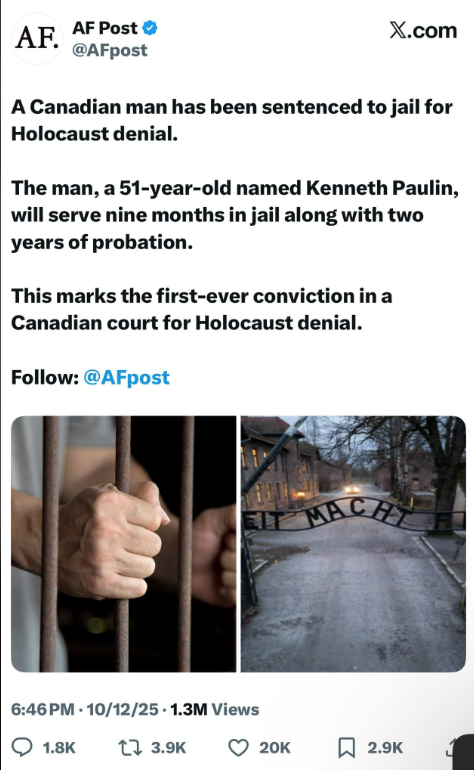
A friend sent me a meme on Facebook Messenger that alerted me to this case. I asked my trusted AI assistant, Sage, to dig deeper. I’m sharing what we found to support further research—and to alert others to what is happening in Canadian courtrooms.
How did the court get jurisdiction over a man’s opinions expressed online, and what laws were used to convict? The man’s name is Kenneth Paulin (age 51, North Bay, Ontario). On September 18, 2025, he was sentenced to 9 months in custody plus 2 years’ probation after convictions for (i) wilful promotion of hatred and (ii) wilful promotion of antisemitism by condoning, denying or downplaying the Holocaust. Crown prosecutors characterized it as Canada’s first jail term specifically tied to Holocaust denial.
How the court had jurisdiction
Subject-matter. These are Criminal Code offences (Section 319), which apply throughout Canada and are tried in the provincial courts of the province where the alleged offences occurred—in this case, Ontario.
Territorial/personal. The communications (posts/videos) were made by a North Bay, Ontario resident and addressed to the public. North Bay Police confirm the investigation, arrest, the specific charges, and that the Attorney General’s consent was obtained (a statutory prerequisite for s.319 prosecutions).
Charter limits (speech vs. hate propaganda). While expression is protected by s.2(b) of the Charter, Canada’s Supreme Court has upheld the constitutionality of these hate-propaganda limits under s.1—notably R. v. Keegstra (upholding s.319(2)) and Whatcott (upholding hate-speech restrictions under a human-rights code).
What laws were used to convict
Criminal Code s.319(2) — Wilful promotion of hatred.
Makes it an offence to wilfully promote hatred against an “identifiable group” by public communications (not private conversation). The section includes specific statutory defences (truth; good-faith religious discussion; public-interest/reasonable-belief; pointing out matters for removal). Attorney-General consent is required to commence proceedings.
Criminal Code s.319(2.1) — Wilful promotion of antisemitism by condoning, denying or downplaying the Holocaust.
Added to the Code in 2022 and now in force: criminalizes wilful, public Holocaust denial/condonation; maximum penalty up to two years (indictable) or summary conviction. Proceedings under (2) or (2.1) require Attorney-General consent.
Consent gate: s.319(6) expressly states “No proceeding for an offence under subsection (2) or (2.1) shall be instituted without the consent of the Attorney General.”
This case (North Bay, Ontario)
- Sentence & date: 9 months’ jail + 2 years’ probation on Sept. 18, 2025.
- Counts: s.319(2) (wilful promotion of hatred) and s.319(2.1) (wilful promotion of antisemitism by Holocaust denial).
- Procedural note: AG of Ontario approved the charges after a seven-month investigation.
- Context: Reported as the first Canadian jail term specifically tied to Holocaust denial.
Personal note
I would like to interview Mr. Paulin directly and review the evidence relied upon (posts, videos, exhibits, and reasons for sentence). If you have contact information for him, his counsel, or access to the court record, please reach out.
Sources for readers who want to go deeper:
- Criminal Code, s.319 (hate propaganda; defences; AG-consent rule): Justice Laws website. Justice Laws
- Police release confirming charges & AG consent: North Bay Police Service. North Bay Police Service
- Case reporting: OrilliaMatters; Friends of Simon Wiesenthal Center; TheJ.ca. Orillia Matters+2fswc.ca+2
- Charter jurisprudence: R. v. Keegstra (SCC); Saskatchewan (Human Rights Commission) v. Whatcott (SCC)
 Freedom Dove
Leave a comment